Soil Compaction with Roller vs Skid Steer: When to Use Each
Preparing construction ground is fundamentally similar to building a house: if the foundation is unstable, the whole structure will eventually collapse. Compaction of soil forms the backbone of any stable construction work, whether it’s a driveway, a building pad, or a new highway. However, after having spotted a few powerful equipment, one often questions whether they should go for a specifically designed Soil Compaction with Roller or a multifunctional Skid Steer?
It can’t be said right away. Both machines can press the soil, but the ways in which they do it are essentially different. Knowing how Soil Compaction with Roller vs Skid Steer works, how efficient these machines are and what their limitations are mainly helps project managers and refurbishers. Here we lay out the pros and cons of each method, how to get the most of the machines and the reasons why your choice that works will save you time and money.
Soil Compaction with Roller vs Skid Steer Basics
Compaction is a process through which air voids are removed from the soil so that its density and load-supporting capability increase. The purpose of a roller is only one, and that is compacting the soil. A skid steer, however, is a sort of “dog of all trades” that can also be used to perform compaction.
- Static pressure vs vibration: A special compaction roller mainly relies on the enormous weight (static pressure) and sometimes on the high-frequency vibration to achieve a good compaction of soil.
- Pick up the pace with skid steer: The primary method of a skid steer to compact is its tire pressure; however, by the use of specific implements such as vibratory rollers or compaction wheels, the versatility of a skid steer can be extended to compaction or even up to the compaction roller level.
- The purpose of the application: High-specification engineering tasks require roller use, while small-size site preparation with multifunctional use may be done with a skid steer only.
Soil Compaction with Roller
Typically, a dedicated roller is the only option on the table when the density percentage must meet the specifications set by the project(say 95% Proctor density). These assemblies have been engineered to offer fast, uniform and very deep compaction on huge surface areas.
- Huge earthwork projects: Due to the sheer width and weight of a drum roller which is much larger than even a mighty big man, the fewer passes required and the more uniform the result, the more the drum roller’s use is justified for highways, parking lots and large building pads.
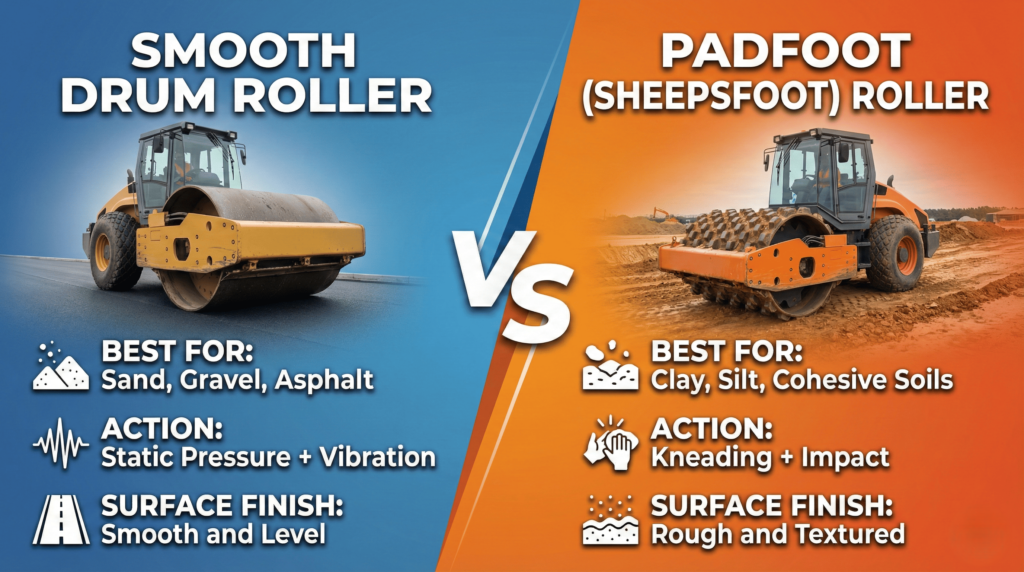
- Particular soil types: A smooth drum roller is a “genius” for sandy or gravelly soils, whereas the padfoot (sheepsfoot) roller is indispensable when dealing with cohesive soils such as clay.
- Compaction depth: If a vibratory duplex drum roller weighs more than 15 tons, its deep compaction ability far surpasses that a skid steer can achieve by means of tire surface-level pressure.
Table: Smooth Drum Roller Vs Padfoot Roller
| Feature | Smooth Drum Roller | Padfoot (Sheepsfoot) Roller |
| Best For | Sand, Gravel, Asphalt | Clay, Silt, Cohesive Soils |
| Action | Static Pressure + Vibration | Kneading + Impact |
| Surface Finish | Smooth and Level | Rough and Textured |
Why Soil Compaction with Skid Steer is more versatile
A skid steer in a construction site is like a “Swiss Army Knife”. Moving material might be its main role, but its ability to perform Soil Compaction with Skid Steer with the result no less than that obtained with a typical roller makes it extremely useful for working in very confined spaces and handling diverse tasks.
- Attachment power: Equipping the spindle with a vibratory roller attachment changes the skid steer into a compact roller equivalent, thereby making it perfect for backfilling utility trenches and landscaping sidewalks.
- Mobility: A monstrous riding roller will never fit in a residential yard or through a narrow gap between two buildings. That is a perfect scenario for a skid steer to unleash its strength.
- Cost-efficiency for tiny jobs: If on the same site for grading purposes you already have a skid steer at your disposal and want to use it for compaction, then you will save money by avoiding the rental and transport fees of a compaction machine.
Core Differences: Efficiency and Ground Pressure
The deciding factor often hinges on the amount of pressure (PSI) the ground is subjected to. Typically, the tires of a skid steer have only four contact points with the ground, so each point applies a relatively high pressure. Without proper operation, rutting may occur instead of achieving uniform compaction.
- Evenness: The roller spreads compaction continuously along a fairly wide path. Hence, the subgrade is free of weak spots.
- Surface Damage: Especially wheeled skid steers tend to make a mess of the ground during tight turns after lifting one set of wheels (skidding). In contrast, rollers march along gentle arcs.
- Speed of Completion: A single vibratory roller pass requires much less time to reach the desired density level than a pass with the skid steer, although the latter is quick.
Soil Types: Machine-to-Soil Compatibility
The dirt under your feet is not all the same. The performance of Soil Compaction with Roller vs Skid Steer relies greatly on whether you deal with “cohesive” or “granular” nature materials.
- Granular Soils (Sand/Gravel): They call for vibration to shake the particles in order to get them to fit more tightly. Naturally, a vibratory smooth drum roller is the best option here.
- Coherent Soils (Clay/Silt): A kneading action is needed to compress moisture and air out. Therefore, a padfoot roller or a skid steer attachment with sheepsfoot is the best choice.
- Mixed Soils: When the soil mixture is diverse, a pneumatic (rubber-tired) roller or even a heavy skid steer might represent a good compromise.
Some Common-sense Ways in Achieving Better Soil Compaction
Whatever machinery you decide to take up, it is your adherence to best practices that will guarantee a stable base.
- Thickness of Layers: Never make a compacting attempt in excess of 6-8 inches of soil each time (also called a “lift”). Even the most powerful roller has difficulties dealing with deep, loose soil.
- Water Balance: Soil too dry will not be adhesive while soil too wet will turn into slime. Strive for that “optimum moisture content” at which the soil keeps its shape after being squeezed.
- Overlap Your Paths: The passes of the compaction machine must overlap the previous one by at least 10-15% to eliminate the possibility of uncompacted “seams.”
Maintenance and Operational Costs
Financially, operating or renting these machines may engage a person differently. On one hand, dedicated rollers represent special equipment and their transport can be a costly affair, whereas changing skid steer attachments is neither expensive nor complicated.
- Downtime: If a roller breaks down, compaction stops. However, if a skid steer attachment is the one that’s broken, then usually you can switch to another task until the time for repair comes.
- Transport: Skid steers are perfect for hauling with normal trailers, but in contrast, large rollers inevitably require trucks with specialized equipment and even heavy-haul permits.
- Fuel Consumption: The latest generation of skid steers can be highly fuel-saving; however, running a vibratory attachment at high RPMs can noticeably increase fuel consumption.
Skid Steer Soil Compaction with Roller – FAQs
Can I compact the soil simply by running the skid steer over the ground?
Indeed, for minor landscaping or shed pads, a skid steer tire pressure might be sufficient for basic compaction. Nevertheless, for structural foundations or driveways, in order to reach the necessary depth and density, a vibratory attachment or a dedicated roller is indispensable.
Which is better for clay: a smooth roller or a skid steer?
Neither of them works perfectly as a single solution. Clay being a cohesive soil requires “kneading.” Hence, you should use a padfoot (sheepsfoot) roller. If the situation demands the use of a skid steer, then make sure it has the padfoot drum attachment on it for breaking up clay bonds.
How many passes would it take to get 95% compaction?
Basically, 4 to 8 passes with a vibratory roller would suffice for most kinds of soils, assuming that the height of the layer is the correct one. Without a vibratory attachment, a skid steer might need a lot more passes, and even then, it will hardly reach the required density.
Does vibration really make a difference in soil compaction?
Indeed. Vibrations serve to reduce the inter-particle friction which, in granular materials (especially sand and gravel), allows particles to settle down into a much denser state than that achieved by static pressure only.
Would a track loader be a better choice than a wheeled skid steer for compaction purposes?
Actually, no. Track loaders (CTLs) are meant for low ground pressure so that they can “float” over soft mud. For compaction, what you need is high ground pressure which is the very reason why wheeled skid steers generally do better at pressing down soil.
What are the consequences of too much compaction?
The soil architecture can be so compressed that water drainage is greatly compromised and thus causing the soil to “heave” or crack. Moreover, your rollers and skid steer attachments will experience premature wear.
At what point will I have to rent a dedicated roller instead of my skid steer?
Get hold of a dedicated roller if a Proctor testlike certified density testis required for your project, if your work covers more than half an acre, or else, if you are handling thick granulated soil layers that call for deep vibration.
Soil Compaction with Roller vs Skid Steer – Your Choice Matters!
Whether you opt for Soil Compaction with Roller vs Skid Steer largely depends on the scale and accuracy of your project. For the very large projects such as transport infrastructure, where the density of the material has a direct bearing on safety and durability, a dedicated roller is undoubtedly the right machine.
On the other hand, the modern contractor working on residential sites, installing utility trenches, or landscaping can get a Skid Steer with the right combination of attachments and enjoy a level of versatility that a single-purpose roller mere cannot match.
By figuring out the type of the soil, the density needed, and the restriction of the site, you may pick the machine that will allow your project to weigh on a solid foundation for years and years.