How to Choose the Right Skid Steer Horsepower
Picking out the right skid steer for your collection or a personal come-up usually comes down to one big question: How to Choose the Right Skid Steer Horsepower? It’s always tempting to just choose the biggest number on the spec sheet, but the truth about heavy machinery is much deeper.
The horsepower (HP) of a machine is basically its life force. It decides the amount of work the machine can do, the speed at which it can complete it, and the types of attachments it can be able to power effectively. However, a high horsepower disconnected from a Rated Operating Capacity (ROC) or the right hydraulic flow is like having a racing car engine in a golf cart—powerful, but underutilized.
At skidsteerloader.org, we know that a skid steer is a commitment to increased production. Whether you are a weekend warrior doing residential landscaping or a site manager handling a large demolition project, the horsepower you select will lead your efficiency as well as your financial results. This book clarifies everything about skid steer horsepower, frame sizes, and hydraulic requirements that you need to understand to be sure to make the best choice possible.
Understand Skid Steer Horsepower Classes
Generally, the industry classifies skid steers into three separate classes based on their engine power and physical frame size. Knowing what your requirements are in relation to these categories will help you narrow down your search.
- Small Frame (Under 50 HP): These are the ninjas of the construction world. Built for tight spots and light tasks, they are ideal for residential landscaping and upside-down demolition.
- Medium Frame (50-70 HP): This is typically the “sweet spot” for general contractors. They equally balance power and maneuverability and can easily handle most construction and farming tasks.
- Large Frame (Over 70 HP): These giants are made for heavy lifting, roadworks, and the operation of high-demand attachments like cold planers or large mulchers.
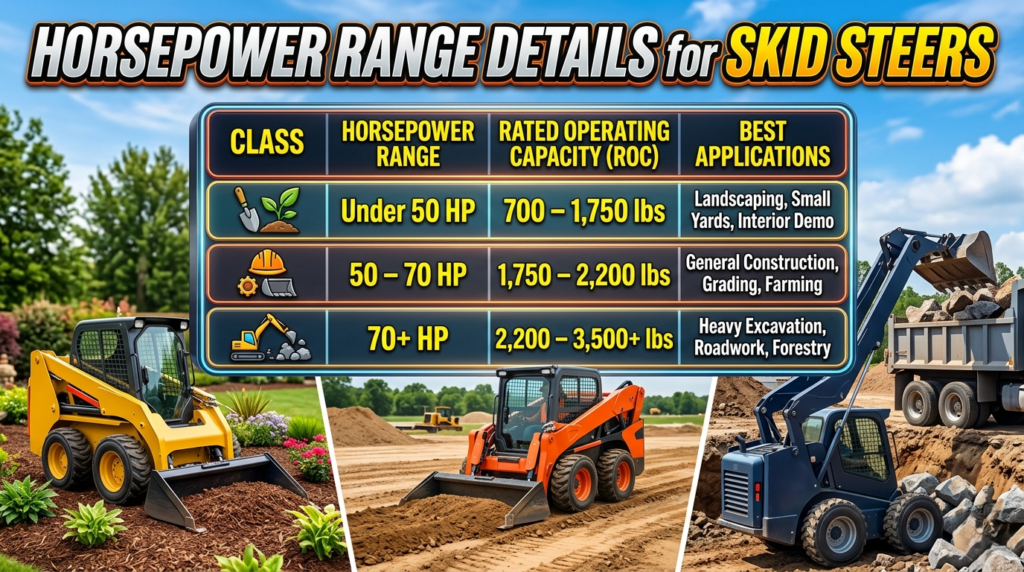
Table: Horsepower Range Details
| Class | Horsepower Range | Rated Operating Capacity (ROC) | Best Applications |
| Small | Under 50 HP | 700 – 1,750 lbs | Landscaping, Small Yards, Interior Demo |
| Medium | 50 – 70 HP | 1,750 – 2,200 lbs | General Construction, Grading, Farming |
| Large | 70+ HP | 2,200 – 3,500+ lbs | Heavy Excavation, Roadwork, Forestry |
The Connection Between Horsepower and Rated Operating Capacity (ROC)
Your engine’s horsepower is akin to how much power your car has. Likewise, the Rated Operating Capacity (ROC) indicates how much weight your machine can lift without swaying or losing balance. These 2 items are strongly related but they are used for different things in your job.
- Lifting vs. Pushing: A machine with a great horsepower but a small ROC is going to be able to push around a large amount of earth in a field but would be unsafe when trying to load a high-sided dump truck with heavy wet gravel, for example.
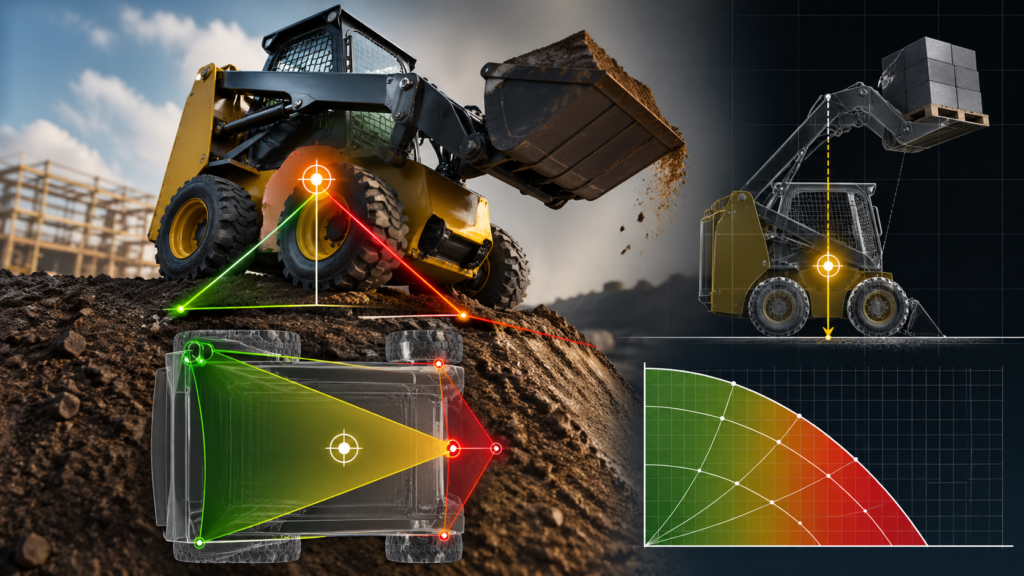
- Stability: To do work properly, you need stability. That’s why a higher horsepower usually comes with a bigger engine and a heavier frame, which also increases the ROC. The additional weight is providing the ballast required to deal with heavy pallet loads.
- Efficiency Gains: When you opt for a machine where the HP and ROC are closely matched, it means the engine will not be overworking to reach the maximum lifting capacity, which will also help to keep your hydraulic pumps and seals in good condition for longer.
Hydraulic Flow: The Unsung Hero of Horsepower
While horsepower is the energy that the engine produces, hydraulic flow is the mechanism by which this energy is transmitted to the attachments. Thus, when it comes to choosing the right skid steer horsepower, do not forget to check the hydraulic flow.
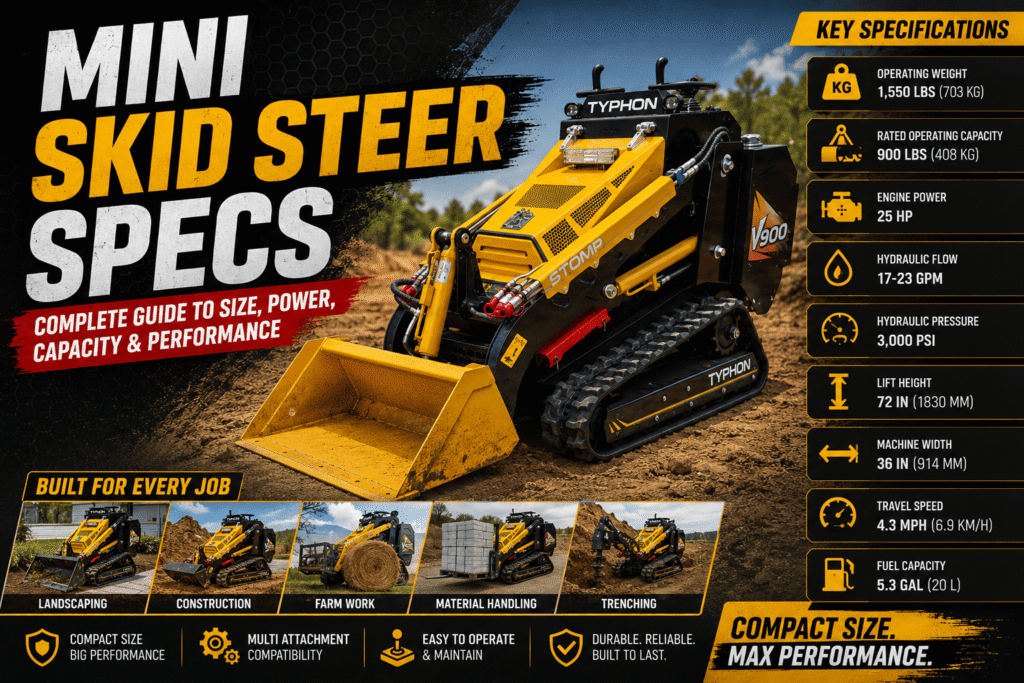
- Standard Flow (17-25 GPM): It is enough for running basic tools like buckets, pallet forks, and regular augers. Usually, most machines below 60 HP are equipped with this configuration.
- High Flow (30-45 GPM): Planning to operate “power-hungry” attachments such as stump grinders, rock saws, or snow blowers makes high flow a must. Maintaining these flow rates calls for high horsepower.
- Pressure (PSI): It is not only the volume of fluid that matters (GPM), but also the pressure (PSI). Typically, the machines with high HP are the ones that provide high PSI which means more torque to be able to dig into hard-packed clay or frozen ground.
Pairing Skid Steer Horsepower to Your Specific Attachments
How versatile your skid steer is, depends on the instruments that you plant on its nose. Initially, prior to choosing the horsepower, examine the attachments that you have or those that you will be renting/ buying in the future.
- Digging and trenching: Augers and small trenchers generally require 40-60 HP to operate efficiently without stalling in rocky soils.
- Material handling: Weight of heavy pallets of sod or bricks should be moved with a medium-to-large frame (60+ HP). It will ensure the hydraulics can handle the repeated lifting and tilting.
- Vegetation management: Brush cutters and mulchers are known for needing high horsepower. For a clean cut without the engine “bogging down”, you should aim for a minimum of 75 HP.
Worksite Environment’s Effect on Power Selection
Both, the work you do and the place where you do that work, are of equal importance to the choice of a machine with a high-horsepower. For example, an overpowered machine is useless if it cannot fit the gate of a backyard project.
- Maneuverability vs. Muscle: Small-frame loaders (30-45 HP) are able to pass through 36-inch gates and even operate inside buildings. Larger machines are necessarily for open sites and heavy-duty trailers for transport.
- Ground Conditions: A high-HP wheeled skid steer on soft turf might sink or tear up the grass. In such scenarios, a Compact Track Loader (CTL) with equivalent HP might be more suitable for weight distribution.
- Altitude and Climate: Note that naturally aspirated engines lose power at high altitudes. If you work in mountainous regions, opting for a higher-horsepower turbocharged model is often necessary to compensate for the thin air.
Cost vs. Performance: Discovering the ROI
Overbuying horsepower is a widespread mistake that results in extra fuel consumption and maintenance expenses. On the other hand, understaffing your machine causes work delays.
- Fuel Consumption: Big engines (80+ HP) use a lot more diesel than small ones per hour. If 90% of your job consists of light grading, a 50 HP machine will save you tons of fuel over its life.
- Maintenance Complexity: Today’s high-horsepower engines (above 74 HP) come with Selective Catalytic Reduction (SCR) and Diesel Exhaust Fluid (DEF) as part of their Tier 4 emissions standards. Lower HP machines are usually without these complex systems.
- Resale Value: Medium-frame machines (60-70 HP) are typically the ones that keep their value best since they are the most versatile and most desired size in the second hand market.
FAQ’s – Skid Steer Horsepower
Do you always get better performance if you buy a skid steer with more horsepower?
Not always. More HP does allow you to perform cycles faster and chew up heavier attachments. However, it also raises fuel consumption, purchase price, and maintenance headaches. The best is to match the HP to the operations that you carry out most often, rather than to your most extreme ones.
How are engine horsepower and hydraulic horsepower different?
Engine HP represents the overall power produced by the motor, but hydraulic HP is the power available for running attachments (formula being PSI x GPM / 1714). Needless to say, you need a high-HP engine to produce high hydraulic output.
Is it possible to use high-flow attachments with a low-horsepower skid steer?
Mostly not. High-flow attachments need a certain volume of oil that small engines just don’t supply. Trying to do so will either overheat the hydraulic system or cause the engine to stall.
Can horsepower influence how much you can lift?
In a kind of roundabout way, yes. Big engines have more weight and this helps tip the scales when handling heavier loads. Usually, higher-horsepower engines are coupled with bigger frames and stronger lifts arms to increase the Rated Operating Capacity (ROC).
What do I need horsepower-wise for a skid steer brush cutter?
Working with light grass and weeds, 40-50 HP is fine. To get the job done with thick brush and saplings, you will be best with a medium-to-large frame machine with 60-90 HP and high-flow hydraulics.
Are higher-horsepower skid steers required to have DEF?
Usually, diesel engines larger than 74 HP require Diesel Exhaust Fluid (DEF) for compliance with EPA Tier 4 Final emission standards. Lots of operators buy machines in the 70-74 HP band to stay away from the additional cost and upkeep of DEF systems.
What kind of horsepower is needed for a snow blower attachment?
Snow blowing is really high-demand. While you can run a tiny blower on 50 HP, a 70+ HP machine with high flow will throw snow a lot further and allow for faster ground speeds, which is super important for commercial snow removal.
Summary – Choosing the Right Skid Steer Horsepower
Picking the right Skid Steer Horsepower is a matter of balancing up your worksite’s physical size, the weight of the materials you handle, and the needs of your attachments. By stressing the “How to Choose the Right Skid Steer Horsepower” standards here—especially the matching of HP to ROC and hydraulic flow—you make sure that your equipment continues to be a productive extension of your capability rather than a costly overhead.
Whether you go for a nimble 40 HP unit for residential work or a 90 HP monster for heavy excavation, always bear in mind that the best machine is the one that gets used the most. Stop by skidsteerloader.org for more technical guides and reviews that will help you power your projects with confidence.