The Ultimate Guide to Emergency Skid Steer Repairs: Solutions That Have Been Tested in the Field
When you’re in the middle of a big earthmoving job and have a short deadline, the last thing you want to hear is the sudden hiss of a blown hydraulic hose or the sputtering of an engine that is about to die. When you use heavy machinery, equipment breakdowns are unavoidable. This can be easily dealt with emergency skid steer repairs.
However, how you deal with them will determine whether you lose an hour of work or a whole week of progress. We at skidsteerloader.org know that knowing how to fix your skid steer in an emergency can save your day, your money, and your reputation.
This complete guide is all about giving you tried-and-true solutions that experienced operators use to safely and quickly get their machines back up and running.
How to Fix Emergency Skid Steer Repairs?
Knowing how to fix a broken skid steer in an emergency doesn’t mean you have to replace your mechanic. It means knowing how to do quick fixes and troubleshoot problems so you can safely move the machine, stop more damage from happening, and finish the job at hand. Let’s take a close look at the most common field failures and the exact steps you need to take to fix them when you’re far from the nearest service shop.
Finding and fixing hydraulic leaks on the fly
Your skid steer’s hydraulic systems give it the huge power it needs to lift, push, and dig. Sadly, this high-pressure setting makes hydraulic hoses and fittings very likely to wear out, get scratched, or break suddenly.
If you don’t fix a line that blows right away, you lose fluid quickly, which can cause serious damage to the pump and pollution of the environment. To fix hydraulics on an emergency skid steer, you need to think quickly and act quickly to stop the bleeding and protect the equipment.
When a hydraulic system suddenly fails, operators must first lower the boom and attachment to the ground in a safe way to relieve pressure from the system. Never use your bare hands to look for a hydraulic leak because high-pressure fluid can easily get through your skin and cause very bad injuries.
Instead, use a piece of cardboard or wood to find out where the leak is coming from. You need to replace a permanently blown hose, but you can sometimes fix minor pinhole leaks or loose fittings in the field.
- Secure the machine right away: Before doing any inspections or emergency repairs on the skid steer, lower all of the loader arms to the ground and turn off the engine to let the hydraulic system lose pressure.
- Find the leak safely: Always use a piece of cardboard, thick paper, or a wooden stick to run along the hoses to find the fluid that is leaking. Keep your hands completely away from the high-pressure stream.
- Use quick fixes: Use heavy-duty hydraulic wrap tape or special emergency hose clamps to temporarily seal small cuts so you can move the machine onto a trailer or out of a dangerous work area.
How to Handle an Engine That Suddenly Overheats
One of the most common reasons why operators have to do emergency skid steer repairs is because the engine gets too hot. This happens a lot in the summer when it’s hot or when they are working in very dusty places like demolition sites or dry agricultural fields.
Because a skid steer is so small, its cooling system has to work extra hard, and the radiator can quickly get clogged with dirt, leaves, and other debris. If you don’t pay attention to the temperature gauge, your engine could seize or your cylinder head could warp. This could turn a small problem into a huge financial loss leading to emergency skid steer repairs.
You have to stop working under load as soon as the temperature alarm goes off or the needle moves into the red zone. But sometimes, shutting off the engine right away when it gets too hot can cause parts to warp because they cool down too quickly.
Instead, let the machine sit for a minute or two with the attachments off and the fan running to try to cool the engine block down before turning the key off. Most of the time, fixing an overheating emergency skid steer in the field just means clearing blockages and getting the radiator to flow air again.
- Take the load off the engine: Stop digging or lifting right away, park the machine in a safe place, and let it idle with no load so the cooling system can try to lower the temperature.
- Clear the airflow pathways: Open the back door and carefully use compressed air or a soft brush to get rid of the thick layer of dust, straw, or mud that has built up on the radiator fins and hydraulic cooler.
- Carefully check the fluid levels: After the engine has cooled down enough (never open a hot radiator cap), look at your coolant reservoir and add water or antifreeze if there was a small boil-over.
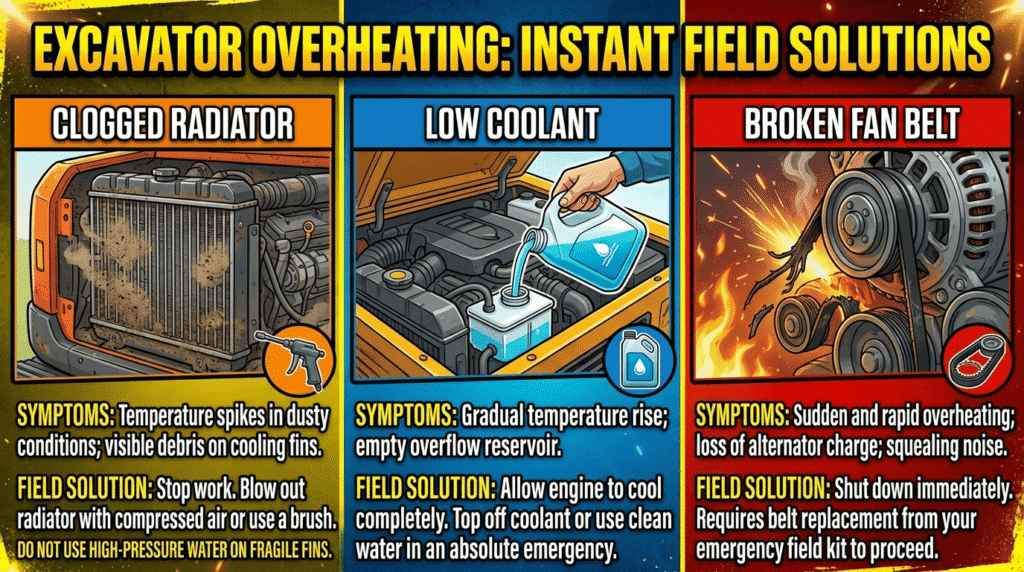
Table: Emergency Skid Steer Repairs Symptoms and Solutions
| Overheating Cause | Symptoms | Immediate Field Solution |
| Clogged Radiator | Temperature spikes in dusty conditions; visible debris on cooling fins. | Stop work. Blow out radiator with compressed air or use a brush. Do not use high-pressure water on fragile fins. |
| Low Coolant | Gradual temperature rise; empty overflow reservoir. | Allow engine to cool completely. Top off coolant or use clean water in an absolute emergency. |
| Broken Fan Belt | Sudden and rapid overheating; loss of alternator charge; squealing noise. | Shut down immediately. Requires belt replacement from your emergency field kit to proceed. |
Quick Fixes for Electrical Problems That Happen at Random
Electrical problems can stop a tough, powerful skid steer in its tracks in seconds. When you turn the key, you might only hear a frustrating click, or your safety interlock system might suddenly freeze your joysticks, making it impossible for the machine to move.
Wires can easily wear down, short out, or come loose because skid steers are exposed to a lot of vibrations, jolts, and the weather. It’s important to know how to do basic electrical emergency repairs on a skid steer so you can fix small sensor problems or reconnect the battery.
The first step in field troubleshooting is to check the power source. A loose or heavily corroded battery terminal is the cause of a surprising number of “dead machine” situations.
The next step in fixing your emergency skid steer should be the fuse box if the battery is secure. If the fuse for the safety interlock circuit or the fuel shutoff solenoid blows, the equipment will stop working completely.
- Check the battery connections: Look for heavy corrosion on the battery posts, make sure the clamps are tight, and wiggle the ground wire to make sure it is securely connected to the machine’s chassis.
- Look at the master fuses and relays: Bring a diagram and check the fuses for the ignition, safety interlocks, and fuel delivery. If a relay fails, replace it with a non-essential one, like a horn or light relay.
- Check the safety switch harnesses: Check the wiring that goes to the seatbelt switch and the lap bar switch. Debris can often pull these wires loose, making the computer think the operator is not safely seated.
Taking care of track and tire problems in the muck
The whole point of a skid steer is to move things around, so if you throw a track or puncture a pneumatic tire, you can’t do any work. Tracked machines, like compact track loaders, are known for getting off track when they go up steep hills or turn hard on rough terrain full of debris.
On the other hand, pneumatic wheeled skid steers often get hurt by nails, rebar, and sharp rocks. To fix mobility parts on a skid steer in an emergency, you need brute force, mechanical leverage, and the right methods.
If you have a wheeled machine, having a heavy-duty tire plug kit and a portable 12V air compressor in your truck can save the day. Putting a heavy rubber track back on the undercarriage of a tracked machine in the middle of a muddy field is a hard job, but it can be done.
It means using the machine’s own hydraulics to lift the side that is affected, relieving the tensioner, and using pry bars (or a heavy chain attached to the bucket) to move the track back over the idlers.
- Learn how to release the tension: For machines that have lost their tracks, find the grease valve on the track tensioner right away, loosen it carefully to let the grease out, which makes the idler collapse and gives you the slack you need to put the track back on.
- Use the bucket to lift: Use the loader bucket to safely raise the side of the machine with the flat tire or derailed track. Before putting any body parts near the undercarriage, make sure to put a block under the chassis.
- Use heavy-duty plug kits: For pneumatic tires, find the hole, ream it out, and forcefully insert several heavy-duty tire plugs to stop the leak. Then, fill the tire back up with air to get the machine back to the staging area.
Putting together a necessary emergency skid steer repairs kit
What you have in your service truck or toolbox before an emergency happens has a big impact on how well your emergency skid steer repairs go. You can’t use solutions that have been tested in the field if you don’t have the right tools and materials on hand.
The best thing an operator can do to be ready for an emergency is to make a full emergency kit. At skidsteerloader.org, we always tell operators to make a kit that can fix the most common problems, like losing fluids, having electrical problems, and having hardware come loose.
Your kit shouldn’t just be a bunch of wrenches thrown together; it should be well-organized. Pay attention to the exact wrench sizes you need for your brand’s hydraulic fittings, as well as general sealing and splicing materials. If you have these tools on hand, you can turn a possible multi-day delay into a quick 30-minute stop.
- Pack a lot of extra fluids: Always have at least two gallons of the hydraulic fluid that the manufacturer recommends, a gallon of pre-mixed engine coolant, and a quart of engine oil on hand to refill systems after sealing a leak.
- Include important electrical bypass tools: Fill your kit with different kinds of fuses, electrical tape, wire strippers, crimp connectors, and a digital multimeter to find voltage drops and get around broken accessory wires.
- Bring along heavy-duty tools: Make sure you have a grease gun, extra grease fittings (zerks), a heavy-duty pry bar for realigning the track, hydraulic wrap tape, and an extra-large wrench set that fits your machine’s main hydraulic hoses.
Questions About Emergency Skid Steer Repairs
What do you do if your skid steer won’t start?
Check the voltage of the battery and look for corrosion on the terminals first. If the battery is good, you should hear a click from the starter relay. Check all of the safety interlocks, like the lap bar and seatbelt switch. If the machine’s computer thinks the operator isn’t safe, it will turn off the starter. Finally, check the fuel shutoff solenoid and the fuel filters.
What makes a skid steer lose its hydraulic power?
The most common reason is that the hydraulic fluid is low because a hose broke or a fitting leaked. Other reasons could be a hydraulic filter that is too full and stopping fluid flow, a hydraulic pump that is failing, or a pressure relief valve that is stuck and sending fluid back to the tank instead of to the cylinders.
How often should you take care of a skid steer?
Different manufacturers have different schedules for regular maintenance, but in general, engine oil and filters should be changed every 250 hours. Every 500 to 1,000 hours, you should change the hydraulic fluid and main filters. Every 8 to 10 hours of use, you need to do daily checks like greasing the pivot points, checking the fluid levels, and cleaning the radiator.
Can you fix a broken hydraulic hose in the field?
If a high-pressure hydraulic hose has completely broken, you can’t fix it for good. For small pinhole leaks, though, you can use special high-pressure silicone wrap tape to slow the leak down enough to safely drive the machine onto a transport trailer. You should always have extra hoses on hand for the most fragile attachments.
Why does my skid steer keep getting too hot?
Most of the time, overheating is caused by a problem with airflow. Dust, mud, or debris from the job site can get stuck in the fins of the radiator or oil cooler. A broken or loose engine fan belt, low coolant levels, or a failing water pump can also cause it. First, always look for blockages on the outside of the radiator.
How do you put a track back on a skid steer?
First, use the bucket to lift up one side of the machine and block the chassis safely. Next, find the track tensioner valve and loosen it to let the grease out. This will pull the front idler back. First, use heavy pry bars to move the rubber track over the rear sprocket, and then over the front idler. Lastly, put grease back into the tensioner to make the track fit the required spec.
What are the most common emergency skid steer repairs?
The most common repairs are replacing blown hydraulic hoses, worn-out tires or torn rubber tracks, broken electrical safety switches (like the lap bar sensor), and starter motors or alternators that have been through a lot of vibration and dust.