How to Change a Skid Steer Bucket
You cannot operate a skid steer effectively if you only know how to drive it, because the operation of the attachment is equally important if not more. Transitioning from a standard skid steer bucket to a grapple or a pallet fork, and even other specialist tools, you firstly, need to understand your machine’s mechanics to ensure safety and efficiency in your work.
Breaking a skid steer bucket change into a few simple steps can make the whole process easy and convenient for you, look at this helpful blog and see how it is done in step-wise format.
Understanding the Hydraulic Quick-Attach System Mechanics of the Skid Steer Bucket
Quick-attach system is practically the hallmark of a modern skid steer, a system that provides a uniform plate for both the loader arms and the rear side of the bucket, allowing quick switching between tools.
It is necessary to grasp the method of locking, releasing, or securing the attachment before the swap, whether that is by manual or hydraulic mechanism, because it impacts step-by-step actions, the level of your physical effort and the tools you need for the job.
- Compatibility Check: Make sure the bucket mounting plate is conforming to the SAE J2513 standard which is the one most major manufacturers use.
- Locking Pins Check: Make sure that the pins are running smoothly and are not bent or obstructed by dried mud or rust.
- Clean the Interface: Scrape off the accumulated lye with a wire brush in the wedge-shaped receiving pockets on the bucket for perfect fitting.
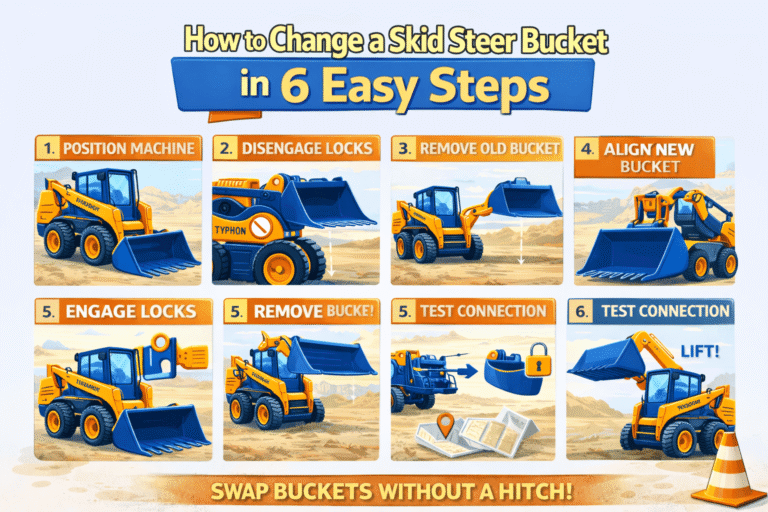
Top 6 Steps to Change Skid Steer Bucket:
Step 1: Position the Machine and Prepare for Disconnect
You cannot be safer by any other means than positioning your machine correctly first. You want to have a surface that is even and stable so your bucket will be lying flat on the floor without any chance of rolling during the unlocking.
If you release the pins while the machine is on a slope, the skid steer bucket can move unexpectedly and cause you to get injured or the machine to get damaged. Lower the loader arms so the bucket is only a couple of inches off the ground. To take the pressure off the locking pins, you should tilt the plate forward a little.
- Ground Level: Always changing attachments on hard surfaces like concrete or compacted soil as this will prevent the skid steer bucket from being sunk, or tilted.
- Hydraulic Pressure Relief: When using a hydraulic quick-attach, turn off the engine and cycle the controls to release pressure.
- Engage the Parking Brake: Absolutely sure that the machine is at a complete standstill before leaving the cab to manually engage or disengage pins.
Step 2: Disengage the Locking Mechanisms
This stage follows the placement of the machine, which is about the physical separation of the attachment and the loader. The manual system needs you to turn two robust mechanical levers on the top of the quick-attach plate. They, basically, remove the two steel wedges that fit in the bucket’s bottom holes.
But how a breakthrough in engineering for skid steer owners is the “Power Quick-Attach” hydraulic system. This method allows the operator to perform both locking and unlocking of the attachment from inside the cab by using a switch or a joystick.
- Manual Control Check: Make certain that the control levers are maximally pushed up; a halfway engagement can lead to “ghost” sticking during detachment.
- Careful Look: Look under the mounting plate to witness the pins being fully retracted into the housing.
- Frozen Pins: In case the pins do not move, use a penetrating oil and a deadblow hammer and avoid forcing the levers which might bend the linkages.
Step 3: Backing Away and Aligning the New Attachment
With the wedges pulled out, the mounting plate is tilted forward, while the skid steer is slowly backing away from the old bucket. After it is freed, head the machine in the direction of the new bucket. This is the trickiest part of the job.
The new attachment must be met straight-on so as to touch the top lip of the bucket’s mounting bracket with a hook from the plate. For the operator, keeping the arms low throughout approach helps to maintain a good field of view from the seat.
- Keep It Low: The loader arms should be lowered to the maximum during the approach to provide a better operator sight line from the seat.
- Inspect the Top Flange: The curved top edge of the loader plate must be fitted tightly to the “pocket” at the top of the bucket.
- Straight On: The machine needs to be absolutely at a right angle with the bucket to avoid the plate from getting crooked on one side.
Step 4: Engagement and Tilting Upward
The top flange of the loader plate has been snagged to the skid steer bucket’s flange so the next step is to extend the loader arms while green turning the loader arms together with tipping the plate towards the operator’s seat. This is the very action in which a bucket gets “seated” on a mounting plate at the same time; the machine should feel the weight of the bucket going onto it.
- Slow Lifting Motion: Carry out the lifting gradually by Take the help of minute steps to ensure the top flange does not slip off before the bottom is in
- Monitor the Seat: Through the front window or screen, keep an eye on the operation, the skid steer bucket should be completely close to the plate without any gaps which are clearly visible.
- Space Shortening: Increase the bucket height just enough to be sure the bottom edge of the bucket is not in the way, and pins can be used without any problems.
Step 5: Locking the Pins and Secondary Verification
You have now situated your bucket and are ready to secure it. By all means, if purchasing a manual kit, you will need to get out of the cab and push down the levers hard while for hydraulic secure locking, it is a matter of activating the switch.
- The major point here is safety: a bucket that will not be properly locked in place is a huge risk, so an accident can occur when the bucket falls. Following locking, you should give it a “push test” by tilting the bucket downwards and applying slight force to the ground to check if it stays locked.
- Manual Lever Resistance: At the time of pressing down, the manual levers should meet resistance as each pin extends fully to the farthest position, this is the feel of the “over-center” snap.
- Do a Pull Test: Slightly press the bucket down into the soil and reverse your machine momentarily to check if the pins still hold.
- Pin Check: The steel pin ends should be seen sliding out from the bottom holes of the bucket bracket to confirm the locking.
Step 6: Final Safety Inspection and Testing
The real confirmation of a safely and correctly attached bucket is a functional bucket test in which the bucket is allowed to go through the full arc of its movement. For instance, you should tilt the bucket fully up and down.
Guarantee your skid steer is up for the new job after this final check that is done in a routine professional manner.
- Inspect the Auxiliary Lines: Make sure that the auxiliary hoses are kept out of “pinch points” where loader arms can squeeze them.
- Tidy the Couplers: Cleaning the hydraulic flat-face couplers with a lint-free cloth helps in not bringing the dirt into the machine’s hydraulic system.
- Sound of Vibrations: A well-attached bucket should not produce independent movement.
Comparison: Manual vs. Hydraulic Quick-Attach Systems
| Feature | Manual Quick-Attach | Hydraulic Power Attach |
| Operator Effort | High (Must exit cab) | Low (Controlled from seat) |
| Speed of Change | 2–5 Minutes | Under 60 Seconds |
| Maintenance | Grease pins regularly | Check hoses and cylinders |
| Reliability | Extremely High (Few parts) | High (Requires hydraulic integrity) |
| Cost | Standard / Lower Cost | Premium / Add-on Cost |
Sum Up – How to Change a Skid Steer Bucket in 6 Easy Steps
To sum up, learning how to change a skid steer bucket in six straight forward steps not only helps you save time but also increases your efficiency at work. Knowing the right methods and always putting safety first, you will become sure of yourself when performing this necessary action.
Periodic servicing and inspections of your machinery may result in more effective working and an extended durability of both the skid steer and its tools. Feel free to tell your story or any advice you have gotten to the rest of the community. Get going and make the most out of your skid steer!
Frequently Asked Questions – How to Change a Skid Steer Bucket in 6 Easy Steps
Why won’t my skid steer bucket pins engage?
Generally, dirt in the pin holes of the bucket or lack of lubrication on the locking wedges is the cause of your problem. In addition, it is necessary to be on a level ground for the holes to match exactly.
Can I use a Bobcat bucket on a Caterpillar skid steer?
Yes, this is possible because most of the modern skid steers utilize the “Universal Quick-Attach” system (SAE J2513), which makes it possible to change attachments among different brands, like John Deere, Case, and Kubota
How often should I grease the quick-attach levers?
Greasing your pivot points and sliding wedges points should be done every 10 to 20 hours of operation or whenever you find the levers to become stiff or harder to move.
What are the signs of a worn-out mounting plate?
Signs include top flange “mushrooming,” faceplate metal thinning, and pin holes elongating. If the mounting plate is distorted, the bucket will shake during its operation.
Is it safe to change a bucket on a slope?
Changing attachments on a slope is risky as the released bucket may slide or roll away, causing a potential hazard. Also, the difficulty in alignment is significantly increased.
Do I need to turn off the engine to change a bucket?
For manual operation, the safest way is to engage the brake and lower the bucket. It is necessary to have the engine running to move the pins for a hydraulic system.
How do I release hydraulic pressure for auxiliary attachments?
Apart from the fact that the engine has been turned off, most auxiliary machines will allow you to “jiggle” the auxiliary thumb switch or use a pressure-release button on the instrument panel.