Retrofitting Attachments: Fitment, Hydraulics, and Safety Checks
Adding retrofitting attachments is a smart way to give your current skid steer fleet a new lease on life. You can improve the way your machine works by adding modern specialized tools to it, which is much less expensive than buying a brand-new loader.
But it’s not as easy as “plug and play” to retrofit attachments like fitment, hydraulics, and safety checks. To make sure your machine runs at its best and lasts a long time, you need to know a lot about its mechanical limits and hydrauliRetrofitting Attachments: Fitment, Hydraulics, and Safety Checks made easy! Explore our guidec capacity.
Retrofitting Attachments Importance:
We at skidsteerloader.org want to stress that a compatibility audit is the first step in a successful retrofit. If you’re adding a forestry mulcher to an older model or a high-precision grading blade, the connection between the machine and the tool must be perfect.
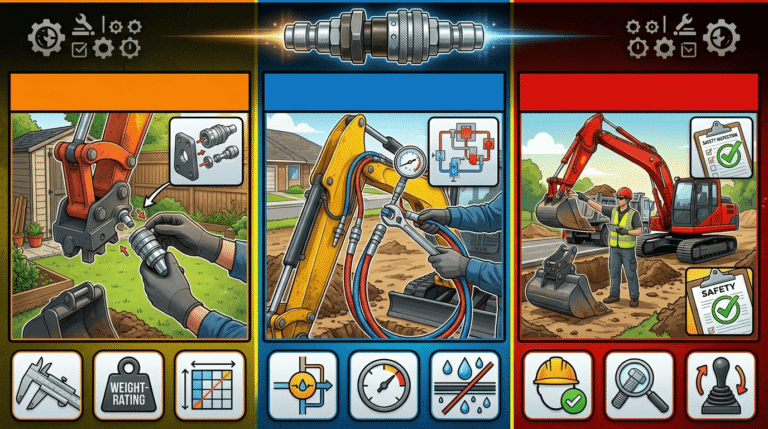
This guide talks about the three most important parts of retrofitting: making sure everything fits perfectly, matching the hydraulic flow, and keeping strict safety standards.
Getting the Fitment Right: The Universal Quick Attach Standard
The physical connection between the loader and the attachment is the most important part of Retrofitting Attachments: Fitment, Hydraulics, and Safety Checks. The Universal Quick Attach (UQA) system, also known as the SAE J2513 standard, is used by most modern skid steers.
This design makes it easy for operators to switch between buckets, forks, and augers made by different companies. However, when you try to fit older machines or mini skid steers with new parts, you often run into problems because of wear and tear or proprietary mounting plates.
- Check the Mounting Plate’s Integrity: Before putting on a new attachment, check the locking pin holes and the top flange of the quick-attach plate for cracks or thinning.
- Check for Pin Engagement: Make sure that the locking levers fully engage the attachment pins. If they only partially engage, the attachment could “pop off” when it is under a lot of weight.
- Take into account the geometry of the machine: Some retrofitted attachments may have different “roll back” or “dump” angles, which can make it harder to load trucks with high sides.
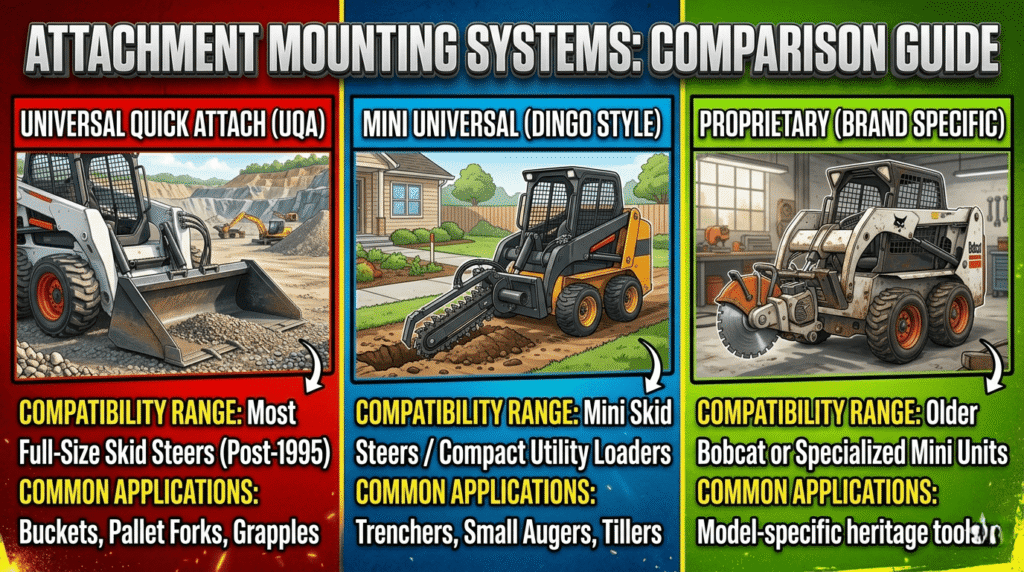
Retrofitting Attachments: Comparison of Mounting Systems for Compatibility
| Mounting Type | Compatibility Range | Common Applications |
| Universal Quick Attach (UQA) | Most Full-Size Skid Steers (Post-1995) | Buckets, Pallet Forks, Grapples |
| Mini Universal (Dingo Style) | Mini Skid Steers / Compact Utility Loaders | Trenchers, Small Augers, Tillers |
| Proprietary (Brand Specific) | Older Bobcat or Specialized Mini Units | Model-specific heritage tools |
Aligning Hydraulics: Flow, Pressure, and Case Drains
The hydraulic system is the most important part of any successful retrofit. You can’t just connect a high-flow mulcher to a standard-flow machine and expect it to work.
“Flow is Speed, and Pressure is Power” is a saying in the world of Retrofitting Attachments: Fitment, Hydraulics, and Safety Checks. If these factors don’t match up, you could overheat the hydraulic oil, blow seals, or cause the pump to fail completely.
- Make sure the GPM and PSI ratings match: Compare the auxiliary flow (gallons per minute) of your machine to the needs of the attachment. If you run an attachment at a lower-than-rated flow, it will stall and be less productive.
- Set Up Case Drain Lines: A third “case drain” line is needed for many high-performance attachments, such as stump grinders or cold planers, to relieve back pressure on the motor seals.
- Use Pressure-Compensated Valves: If your machine’s output is higher than the attachment’s maximum rating, you might want to add flow-control valves to keep the inside from getting damaged.
Important Safety Checks: Keeping the Operator and Machine Safe
The last step of Retrofitting Attachments that can’t be changed is safety checks. A retrofitted tool changes the weight distribution and center of gravity of your skid steer.
If you don’t check safety properly, you could get hurt by a machine tipping over or by hydraulic injection. After every retrofit, there should be a “dry run” in a safe place.
- Check the Rated Operating Capacity (ROC): Your loader should never go over its ROC. Keep in mind that the weight of the attachment and the weight of the material must stay between 35% and 50% of the tipping load limit.
- Inspect Hydraulic Hoses and Couplers: Check the hydraulic hoses and couplers for “weeping” at the fittings or scratches on the hose jackets. Use flat-face couplers to keep dirt and pressure from getting in when you connect.
- Test Control Logic: Make sure that the joystick buttons or foot pedals work the attachment’s functions right away and without any unexpected movements.
FAQs: Retrofitting Attachments: Fitment, Hydraulics, and Safety Checks
Is it possible to use a high-flow attachment with a standard-flow skid steer?
No, that’s not a good idea. High-flow attachments need a lot more hydraulic volume (GPM) than standard-flow machines can give them. If you use them on a standard-flow loader, they will not work well, overheat, and could even damage the hydraulic motor on the attachment.
What is a “Case Drain,” and does my attachment that I added need one?
A case drain is a third hydraulic line that takes extra oil away from the motor of the attachment. Attachments with high-speed motors, like brush cutters and mulchers, need to keep the internal pressure from blowing out the motor seals.
How can I tell if an attachment that’s 20 years old will fit my new loader?
The loader and the attachment should connect physically if they both use the Universal Quick Attach (UQA) plate. You still need to make sure that the hydraulic couplers match and that the loader’s Rated Operating Capacity can handle the weight of the older attachment, which is often heavier.
What are the signs that the hydraulic system is not working right after a retrofit?
Some common signs are too much noise (cavitation), the attachment moving slowly, high hydraulic oil temperatures, and the machine “stalling” when the attachment is under load.
Is it possible to add a high-flow hydraulic kit to my standard-flow machine?
Some companies do sell retrofit kits, but they are usually hard and expensive to install because they require new pumps, valves, and cooling systems. If your work needs it, it’s usually cheaper to trade for a high-flow machine.
How often should I check the pins on my quick-attach plate?
You should check it visually every day. Check the locking pins every 50 hours of use to see if they are bent or worn. When pins wear out, they can let the attachment move, which can cause dangerous failures while lifting.
Final Thoughts on Adding New Parts:
To get the most out of your skid steer, you need to do the right things when retrofitting attachments, like checking the fit, the hydraulics, and the safety. You can turn a simple loader into a powerful tool for many jobs by making sure it fits well, works well with hydraulics, and is safe for the operator.
Always read your operator’s manual and choose high-quality parts to make sure your machine stays useful for a long time.