Top 12 Skid Steer Hacks Every Operator Should Know:
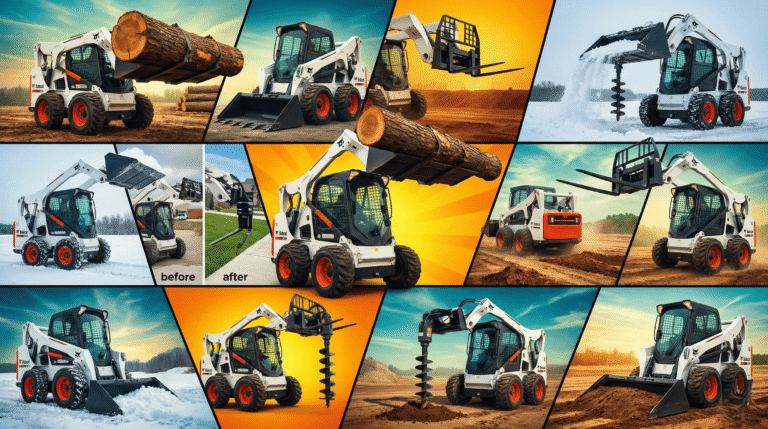
Skid steer loaders are like “Swiss Army Knives,” versatile tools of construction and landscaping. Their versatility is unmatched whether you are working in a crowded residential backyard or on an extensive industrial site. But knowing how to operate a skid steer machine won’t make you the top of the class without knowing the common skid steer hacks.
To do that, you will have to learn the best “Skid Steer Hacks” – the tricks and shortcuts that can give you great results faster and that professionals keep to themselves.
At skidsteerloader.org, we want you to be fully equipped to make the most out of your machines. Here are 12 powerful skid steer hacks packed with pluses of productivity, machine longevity, and safety on your work site.

Top 12 Skid Steer Hacks Every Operator Should Know:
1. The “Cardboard Test” to Spot Hydraulic Leak
Hydraulic system is the heart of a skid steer. To catch an invisible leak with your bare hands can be dangerous as the fluid at high pressure can pierce the skin. Always use your hands as a last resort, a high-pressure fluid may penetrate the skin and cause an injury.
- The hack: Pick a bit of cardboard and drag it along the hoses. The leak will leave a visible “spray” or wet spot on the cardboard.
- Keep your equipment maintained: Check your machine this way once a week, and you’ll fix small problems before they turn into big, expensive ones.
2. Don’t Forget the Rule of Safety “Three-Points Contact”
Though it seems simple, many accidents happen while the operator is entering or leaving the cab. An unexpected fall may be a result of a slippery step or a muddy handrail.
- When getting down or up, you should always be facing the skid steer.
- You should keep stability while you are on the skid steer by holding on to the machine at all times with two hands and one foot, or two feet and one hand.
- If there is mud, ice, or debris, the foot controls and the steps can get very slippery and you should clean them regularly to ensure a firm grip.
3. Work the Center of Gravity to Your Preference
One of the biggest mistakes a skid steer operator makes is driving with the bucket lifted high. In this way, the center of gravity rises and the machine becomes less stable, thus increasing the risk of tipping.
- Bucket low: The travel bucket should always be kept as low to the ground as possible for greatest stability.
- Going uphill: When carrying a load the heavy end should always be facing uphill.
- Joystick: Movements should be smooth as jerky movements of the joysticks will cause abrupt weight shifts.
4. The Quick-Change Attachment Shortcut
Quick-attach systems are standard on modern skid steers, but they can get clogged with dirt and grit.
- Interface: Before changing the attachment, thoroughly wipe off the attachment plate to ensure the pins will fully engage.
- Locking: After the pins are locked, give the attachment a “test push” from the ground to be sure it’s secure.
- Hydraulic Hoses: If you can’t connect the hoses, turn off the engine and “cycle” the controls to relieve back pressure.
5. Effective Grading with Lift Arm “Float”
The best skid steer hacks is when having a hard time creating a smooth and flat surface? The “float” feature of your lift arms becomes almost indispensable when grading.
- Allow the bucket to float: This causes the bucket to ride over the contours of the ground without putting any pressure on it.
- Back-dragging: For a nicer surface, tilt the bucket forward a little bit and then drive in reverse while in float mode.
- Material control: Bucket angle will determine the flow of material. Make the adjustments in small increments.
6. Cold Weather Battery Hack
Winter is a challenge for even the most powerful diesel engines in skid steers.
- Glow Plugs: Let the glow plugs fully heat (wait for the light to go off) before starting the engine.
- Block heaters: Spend 2 hours pre-heating the engine with a block heater if you are working in a very cold area.
- Fuel Tank: Keep the tank full at night to prevent the formation of condensation in the fuel lines.
7. Getting Maximum Life Out of Tires and Tracks
The tires and tracks of a skid loader are the items most prone to wear and tear and also among the most expensive ones.
- Counter-rotating is the root of the problem. A skid turn on abrasive surfaces like asphalt will quickly wear out your tires. When you can, make use of wide turning radii.
- Follow the manufacturer’s instructions with regard to track tension. Over-tightening wears out the bearings, while under-tightening causes the track to come off.
- Always check the air pressure of your tires. Tires that are not filled evenly have poor traction and cause uneven bucket levels.
8. Precision Material Placement
When spreading materials you should never just dump, always try to place. Precision saves time and reduces the need for manual shoveling later.
- Slow Tilt: The vibrator technique is basically the use of the joystick for small and fast movements to shake material out evenly.
- Height Calibration: Raise the bucket only as high as the truck or pile to minimize cycle time.
- Edge Awareness: You should have a perfect understanding of where your bucket edge is to avoid hitting curbs or other structures.
9. Fuel Economy Secrets
Operating the engine at full throttle 100% of the time is not always the best strategy.
- Follow the RPM: Use only the necessary power. High RPM is for digging; low RPM is fine for simple transport.
- Idling reduction: shut the engine if your away from the cabin is more than 2 min.
- Cleaning filters: If the air filter is dirty the engine will need more power and it will also consume more fuel.
10. The “Mirror and Camera” Scan
Since the view is limited in a skid steer cab.
- Windows and cameras should be cleaned regularly to ensure you have a 360 degree view.
- Horn Hack: Even if no one is there behind you, it is recommended to always tap the horn twice before backing up.
- If you are working in tight quarters, establish clear hand signals with a ground spotter before starting the work.
11. Hydraulic Flow Customization
Different attachments need different amounts of hydraulic flow.
- Change Flow: In the cab, you can adjust the hydraulic flow rate to suit your attachment (e.g., lower for a grapple, higher for a brush cutter).
- Keep an eye on heat: High-flow attachments can cause the hydraulic oil to overheat; monitor the temperature gauge.
A high flow attachment should not be used on a standard flow machine.
12. Pre-Operation Ritual
Top operators are excellent with both machine operation and inspection.
- Daily check: Take a look at your oil and coolant in the morning before you start working.
- Greasing regularly: Daily pumping of fresh grease into the pivot pins might save you thousands in repair costs in the long run.
Before you start your machine, make sure the seatbelt and the safety bar sensor are working properly.
Skid Steer Maintenance & Capability Overview
| Feature | Recommended Practice | Benefit |
| Daily Greasing | All pivot points & cylinders | Prevents pin wear & friction |
| Tire Pressure | Check daily (Wheeled models) | Improves stability & leveling |
| Track Tension | Check weekly (Track models) | Extends undercarriage life |
| Hydraulic Oil | Check daily for clarity/level | Prevents pump failure |

Frequently Asked Questions (FAQs) – Skid Steer Hacks
Do I need a special license to operate a skid steer?
Usually, you don’t have to get a special “skid steer license” if you only plan to use it for personal use. But according to OSHA, businesses must make sure that all employees who run the machine on a commercial work site are fully trained and qualified.
Why is it called a “skid steer”?
Skid steer is the name of a machine that has no conventional steering device. Instead, it “skids” to turn. That means the wheels/tracks of one half of the machine go faster than the other side or even in the opposite direction to the other, thus the machine pivots on the spot.
What is the typical lifting capacity of a skid steer?
The load a skid steer can safely carry depends on its frame size. Generally, small units can carry between 1,200 and 1,800 lbs, whereas large-frame units can handle up to 3,500 lbs or even more. It is essential to refer to your owner’s manual to be sure of the Rated Operating Capacity (ROC).
Can different brands of attachments be used with my skid loader?
Yes, almost all the new machines use a universal “Quick Attach” system. You just need to be sure that the hydraulic flow requirements and weight of the attachment are compatible with your specific model.
How long can a skid steer be expected to last?
With proper care, a skid steer can operate efficiently for somewhere between 5,000 and 7,000 hours. The two most important things to pay attention to if you want to reach this level are regular oil changes and greasing.
Between a tracked skid steer and a wheeled one, which is better?
Track-type loaders (CTLs) provide better traction than wheeled loaders on soft or uneven ground, and they also exert less pressure on the ground. However, wheeled loaders are quicker on hard surfaces such as concrete, and maintenance is usually cheaper for them.
What is the most hazardous aspect of being a skid steer operator?
The majority of accidents involve rollovers and employees being run over. Wearing a seatbelt, keeping the bucket low, and being aware of your surroundings in all directions can prevent the majority of these incidents.