Top 7 Skid Steer Winter Maintenance Tips: Snow Removal Tips
Proper skid steer winter maintenance is very essential since cold temperatures and snow can affect the working of the machine in a major way. It is true that a skid steer loader is mainly used for snow removal in winter and landscaping or construction activities are minimally done.
Cold weather, ice, and salt on the roads can not only make the vehicle dirty but also rust it, so it really does make sense to be very careful when you operate and look after it during this time when skid steer winter maintenance tips comes handy. Lack of timely seasonal adjustments might result in engine breakdowns, less responsive hydraulics, and costly downtime when you are in a hurry to use the machine.
Here a detailed guide on our skid steer winter maintenance tips will walk you through the essential steps of winter maintenance along with tactical tips for snow removal efficiency.
Top 7 Skid Steer Winter Maintenance Tips:
1. Essential Engine and Fluid Preparations
The cold winter air is thin and causes both engine starts and fluid movement to be more difficult. Lubrication and the right chemical balance are basically the first line of the internal component’s loaders to consider for the skid steer winter maintenance tips which helps in defense against an “Arctic freeze” which can seize up the loader’s components.
- Change to Winter-Grade Fluids: It is highly recommended that you replace the normal engine oil with a chemically lower-viscosity, winter-grade oil (eg. 5W-30 or 0W-40) to guarantee that the engine is properly lubricated immediately after the start-up.
- Antifreeze Concentration: Make sure that the engine coolant is mixed at the right ratio in order to prevent the radiator from freezing or cracking (usually 50/50).
- Fuel Additives: If you use “winterized” diesel or add an anti-gel additive, your fuels filters won’t get clogged by paraffin wax which naturally forms in fuel during cold weather.
2. Battery Health and Electrical System Integrity
The second prominent and never to miss among skid steer winter maintenance tips are to check Lead-acid batteries which are less efficient when the weather is cold. A battery which is fully charged in the summer, may have its cranking capacity reduced by up to 50% when the temperature goes down to 32°F (0°C).
- Load Testing: Conduct a load test to find out whether your battery can deliver a high current, which is necessary during cold starts, before the arrival of the first snow thus providing assurance of your battery’s capability to endure such weather conditions.
- Clean Terminals: Ensure you have thoroughly cleaned battery terminals of any corrosion or oxidation and then cover them with a protective dielectric grease in order to keep a strong electrical connection.
- Use Block Heaters: In case your skid steer is being kept in an unheated place, then you should use an engine block heater or a battery blanket to maintain the core temperature overnight.
3. Hydraulic System Warm-Up and Care
The hydraulic system of the skid steer is basically the machine’s heart and supplies power to the lift arms and snow blower attachments, etc. If cold and thick hydraulic oil is used, it will result in seal failure and pump cavitation, especially if the malfunctioning hydraulic system has been working for a while before it got to the operating temperature.
- Pre-Operation Idling: Machinery should always be left to idle for 5 up to 10 minutes. During this time, the operator should slowly cycle through the lift and tilt functionalities in order to appear to the oil circulation through the hoses.
- Seal Inspection: You should be checking all the hydraulic fittings and hoses for brittleness or cracks, because rubber becomes less flexible and more prone to breaking in freezing weather.
- Cold-Weather Fluid Options: If the weather is consistently below zero degrees and you are doing outdoor work, then you may want to switch to a high-viscosity index (HVI) hydraulic fluid which is specially designed for cold weather.
4. Tire and Track Maintenance for Maximum Traction
Having good traction is vital not only for efficient work but also for the safety of the operator. No matter if your skid steer’s contact with the ground is by wheels or tracks, during snow removal operations, you should continuously check those points.
- Pressure Monitoring: As the temperature lowers, so does your tire pressure; that is why a regular checking of the tire pressure at least once a week is highly necessary in order to make sure that the full tread area is in contact with the surface.
- Tread Depth Check: Make sure that your tires still have enough lug depth; if you are facing icy conditions, then you may be thinking of using tire chains or getting specialized “snow tires” that have siping equipment.
- Undercarriage Cleaning: If you own a tracked loader, then you must clean it daily, or else the mud and snow will freeze solid in the rollers which can result in a thrown track or damages to the drive motor.
5. Selecting the Right Snow Removal Attachments
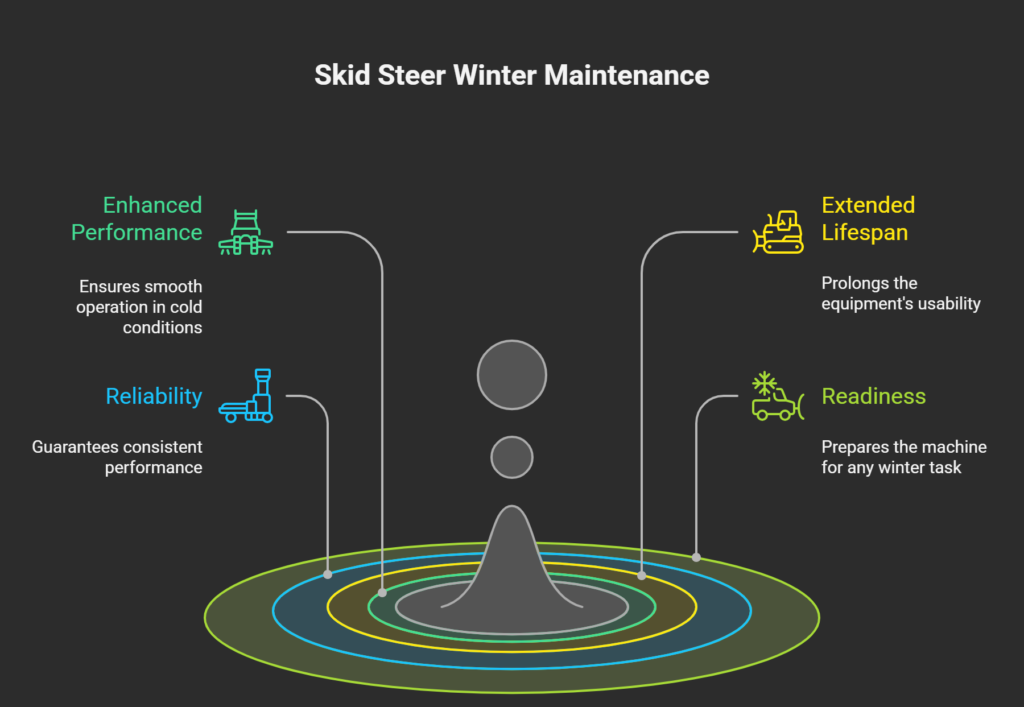
One of the finest qualities of a skid steer is its versatility that is clearly evident in the variety of attachments it can use. By using the appropriate attachment for the specific type of snow (“powder” or “heart-attack snow”), the operator will not only save time and effort but also extend the lifespan of the machine with this amazing skid steer winter maintenance tips.
- Snow Pusher: Best used on the large parking lots and open spaces and as its main advantage can moveingly massive volumes of snow without windrowing be listed;
- Snow Blower: Ideal for deep drifts and restricted spaces and its key advantage is that the site is prevented from a pile by throwing snow far away;
- Angle Broom: Suitable for light snow and sensitive surfaces and the key benefit here is that it can clear down to the pavement, thus making it an excellent choice for sidewalks and pavers;
- Snow Blade: Perfect for long driveways and road clearing with the main advantage here being the possibility to allow for “windrowing” snow to the side at high speeds.
- Inspect Cutting Edges: Frequently check the wear of the cutting edges of your plow or pusher; if the cutting edges are hard to wear out, replace them when the base metal of the attachment is just a few millimeters beneath.
- Grease Pivot Points: Apply a low-temperature grease to all attachment pins and quick-attach mechanisms to guarantee that they will not seize.
- Hydraulic Coupler Cleaning: It is important to clean the hydraulic couplers before switching near or setting the attachments to avoid the formation of ice or salt crystals which may harm the system.
6. Tactical Snow Removal Tips for Operators
Getting the work done quickly does not mean that it is only the machine that is responsible for the efficiency of the snow removal operation. The right approach and technique can help you avoid damaging your property as well as protecting yourself from accidents during long working hours.
- Site Mapping: Check the site before the snow arrives so that you can mark the positions of the obstacles such as curbs, fire hydrants and manhole covers using the bright stakes.
- Pile Placement: Decide in advance where you want the snow piles to be and never push the snow towards the buildings and, besides, leave room for motorists’ view which can be obstructed by the increasing size of the piles.
- Smooth Operation: Snow piles should not be “rammed” at high speeds, rather, steady momentum should be maintained so that pushing or lifting the snow will not result in jarring the loader’s framework.”
7. Post-Operation and Corrosion Control
Street salt and chemical de-icers are rude guests for the metal as well as the electrical parts of your skid steer. Therefore, after each working day, it is highly important to take care of your investment in this special skid steer winter maintenance tips should be your priority if you want it to last for the long term.
- Daily Rinse: Rinse the machine with fresh water if possible after work and wash off the salt. Make sure you pay special attention to the undercarriage and pivot points.
- Corrosion Inhibitors: You can choose to use a protective lubricant or “EquipCoat” to be sprayed onto the bare metal surfaces and around the electrical connectors.
- Indoor Storage: It is always a good idea to keep your machine in a dry and sheltered place if possible as it will be protected from ice formation on door seals or cab controls.
FAQs Skid Steer Winter Maintenance Tips
How long should I let my skid steer warm up in the winter?
It is strongly recommended that you let your engine idle from 5 to 10 minutes until it gets warm. After that slowly, cycle the hydraulic functions, for example, the lift and tilt functions for a couple of minutes to make sure the hydraulic oil is warm and will flow freely without causing seal damage.
Can I use regular diesel fuel in the winter?
When the temperature drops below 32°F (-17°C), it is very likely standard #2 diesel fuel will “gel” or wax. Hence, a #1 diesel fuel blend should be used or an anti-gel additive should be added to the fuel tank to keep the engine from stalling.
Do I need different tires for snow removal?
Standard tires will do if that is the only thing you own but getting specialized snow tires with deeper lugs and siping will improve your traction on the ice thus making your work safer and more effective. For extreme scenarios, tire chains are the surest way of stopping you from slipping and sliding on packed snow.
How often should I check my skid steer’s battery during winter?
It is advisable to perform a check-up on battery health and terminal connections once a month at least. Cold weather makes the voltage of batteries to drop faster and therefore, it is vital to control the battery’s charge so that you won’t be caught off-guard on a freezing morning.
Why is my skid steer’s hydraulic system acting sluggish in the cold?
Usually, this problem arises because of the increased viscosity of the fluid or, in other words, the fluid has thickened (oil). In case the oil has not been heated up to the operating temperature, then it will be very slow to move through the valves. Switching to a winter-grade hydraulic fluid might solve the problem to some extent.
Is it better to use a bucket or a snow pusher for clearing parking lots?
If you want to maintain a large, flat surface, then a snow pusher is the best choice. Though buckets are more useful for creating or moving large piles of snow, pushers enable you to clear a much larger area of snow in a single pass (even 3-4x more) with little spillage over the sides.
How do I prevent my skid steer tracks from freezing?
Cleaning the mud and slush from the undercarriage is a must after every working day. If you neglect it, then the mixture will freeze overnight thus the rollers won’t be able to turn and consequently, the tracks will either snap or derail due to heavy forces being applied on them.