Electrification: The Rise of Electric Skid Steers and What It Means for Fleets
Electric Skid Steers are at the center of a major change in the world of heavy machinery. For many years, diesel-powered machines have been the most important part of construction, landscaping, and farming fleets because they provide the raw power needed to get tough jobs done.
But the industry is moving toward electrification as environmental rules get stricter, battery technology gets better, and the need for equipment that is quiet, versatile, and doesn’t produce emissions grows.
Electric Skid Steers are no longer just a futuristic idea shown off at trade shows; they are now being used on job sites all over the world, and they are a great alternative to traditional internal combustion engines.
This change is a big deal for fleet managers and equipment owners who need to think about the pros and cons of zero-emission technology in light of the realities of charging infrastructure and upfront costs.
Anyone who wants to future-proof their business, lower long-term costs, and stay ahead of the competition in a market that is becoming more environmentally friendly needs to understand where Electric Skid Steers are headed.
Learning about the technology that makes electric skid steers work
Electric Skid Steers’ mechanical design is very different from that of older machines that used a lot of diesel fuel. Modern Electric Skid Steers use advanced lithium-ion battery packs and sophisticated electric motors to power their hydraulic pumps instead of a traditional internal combustion engine.
In some of the newest models, like the all-electric compact loaders that just came out, even the old hydraulic systems have been completely replaced by electrical drive systems and ball screw actuators. Because Electric Skid Steers transfer power directly through electricity, they can provide instant torque, which means that operators can respond right away, which diesel engines can’t do.
The software built into these machines is like a smart power management system that adjusts how much energy they use based on the load and the task at hand. Manufacturers have made Electric Skid Steers simpler but better by getting rid of the complicated network of hydraulic hoses, fluids, and filters. This means that there are fewer points of mechanical failure and a much smoother operational experience.
- Advanced Battery Chemistry: High-capacity lithium-ion and lithium iron phosphate (LiFePO4) batteries keep the voltage up for long periods of time, which is needed for tough daily tasks.
- Instantaneous Torque Delivery: Electric motors give you peak torque right away, so you can lift and push without any engine lag.
- Smart Power Management: Onboard telematics and software automatically assign power to the drive and lift functions, which helps the battery last longer and work better.
Benefits for Fleets in Terms of the Environment and Operations
Adding electric skid steers to a fleet of heavy machinery opens up a lot of operational and environmental benefits that directly affect a company’s bottom line and the range of projects it can work on.
The biggest and most well-known benefit of Electric Skid Steers is that they don’t produce any exhaust emissions at all. These machines are the best choice for indoor demolition, warehousing, agricultural facilities, and underground construction where ventilation is poor and diesel fumes are very bad for your health. They don’t produce any localized greenhouse gases.
Electric Skid Steers also make a lot less noise than diesel Skid Steers. This big drop in noise not only protects the hearing of the operator and ground crew, but it also lets contractors work in residential areas in the early morning or late evening without breaking any noise laws.
Fleet managers can confidently bid on government or green-certified projects that require low-emission equipment when they use Electric Skid Steers. This opens up new ways for the company to make money while also lowering its overall carbon footprint.
- Zero Localized Emissions: Gets rid of carbon monoxide and particulate matter completely, making work safer in small or poorly ventilated areas.
- Big Noise Reduction: Works quietly, so it can be used in the early morning, late at night, and in cities without bothering people nearby.
- Access to Green Contracts: Helps businesses meet the strict environmental rules that must be followed for LEED-certified and government-funded projects.
Cost Effects: Initial Costs vs. Savings Over Time
Fleet managers have to figure out the complicated math of upfront capital costs versus total cost of ownership (TCO) when deciding whether or not to buy Electric Skid Steers. The fact that Electric Skid Steers cost a lot more than diesel models is a fact that can’t be denied.
This is mostly because of the high cost of lithium-ion battery technology. But this initial cost is quickly made up for by big drops in daily running costs and routine maintenance. You don’t need to buy diesel fuel, DEF fluid, engine oil, or regular engine filters for Electric Skid Steers because they don’t have a regular engine.
Also, models that don’t use hydraulic fluids at all get rid of the risk of expensive hydraulic leaks, hose replacements, and fines for cleaning up the environment. During a normal five-year ownership cycle, Electric Skid Steers are often a better financial choice because they save a lot of money on fuel and cut down on mechanical downtime.
- Higher Initial Purchase Price: It costs more to buy battery-powered machinery right now because the battery and motor parts are more advanced.
- Much less maintenance: You don’t have to change the oil in the engine, the fuel filters, the spark plugs, and in some cases, all of the hydraulic fluid.
- Lower Daily Energy Costs: Charging a battery through the electrical grid is usually much cheaper per hour of use than constantly filling it up with diesel, which can be dangerous.
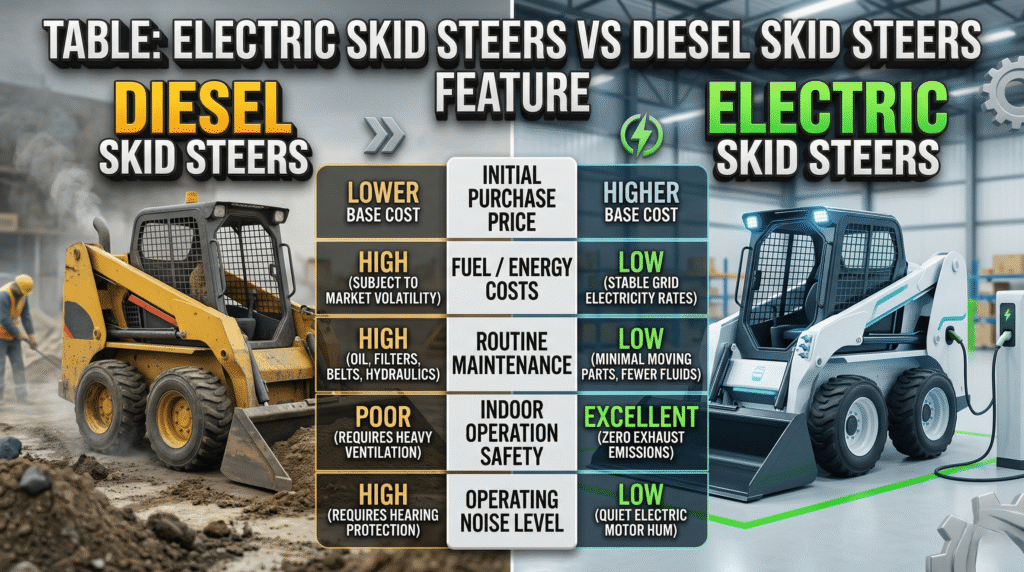
Table: Electric Skid Steers VS Diesel Skid Steers Feature
| Feature / Expense Category | Diesel Skid Steers | Electric Skid Steers |
| Initial Purchase Price | Lower Base Cost | Higher Base Cost |
| Fuel / Energy Costs | High (subject to market volatility) | Low (stable grid electricity rates) |
| Routine Maintenance | High (oil, filters, belts, hydraulics) | Low (minimal moving parts, fewer fluids) |
| Indoor Operation Safety | Poor (requires heavy ventilation) | Excellent (zero exhaust emissions) |
| Operating Noise Level | High (requires hearing protection) | Low (quiet electric motor hum) |
Infrastructure for charging and managing a fleet
A well-planned charging infrastructure and smart fleet management are very important for the successful use of Electric Skid Steers. You can refuel diesel machines in a few minutes with a mobile transfer tank, but Electric Skid Steers need their own charging stations and enough power on the electrical grid.
Most heavy-duty Electric Skid Steers need a 220V/240V power source to charge normally. However, fast-charging setups can charge a battery from 20% to 80% in less than two hours. Fleet managers need to change how they do things every day to fit in these charging times.
They often plug machines in overnight or use fast chargers during lunch breaks to make sure the equipment can handle an 8- to 10-hour shift. Additionally, modern Electric Skid Steers come with advanced Battery Management Systems (BMS) and telematics that let fleet managers keep an eye on charge levels, machine health, and energy use from a distance.
This data-driven method makes sure that Electric Skid Steers are used in the best way possible and that battery wear and tear is kept to a minimum over the life of the equipment.
- Infrastructure Needs: Needs access to strong 220V/240V electrical outlets or special high-voltage fast-charging stations on the job site.
- Adapting the workflow: This requires careful planning for charging downtime and using breaks and off-hours to keep the battery levels as high as possible.
- Advanced Telematics: Uses remote monitoring software to keep an eye on the health of the battery, the efficiency of the operator, and exact data on energy use.
Performance and Power: Setting the Record Straight
One common myth about electrifying heavy machinery is that using batteries means losing raw performance. This couldn’t be further from the truth for modern electric skid steers. Electric Skid Steers have been put through a lot of testing and used in real life, and they have been shown to have the same or better Rated Operating Capacity (ROC), breakout force, and pushing power as their diesel counterparts.
Because electric motors give torque right away, operators don’t have to wait when they are driving, lifting, and tilting the bucket at the same time. This is a common problem with diesel engines that can slow down when they have to handle heavy loads that do more than one thing.
Electric Skid Steers also keep their power output steady no matter how high or low the temperature is, while internal combustion engines usually lose power when the air is thin and high.
Electric Skid Steers are fully compatible with existing non-hydraulic attachments, so they can immediately start grading, moving pallets, and hauling heavy aggregates without any problems. The selection of specialized electric attachments is still growing.
- Uncompromised Breakout Force: This machine can lift as much or more than traditional diesel loaders and has a Rated Operating Capacity (ROC) that is equal to or greater than theirs.
- Multiple Functions at Once: Electric motors keep the machine from getting stuck when it is driving, lifting, and tilting at the same time.
- Altitude and Temperature Resilience: Keeps up with peak performance levels without losing power due to lack of oxygen, which happens with diesel engines.
The Future of Battery-Powered Tools
When we look ahead to the future of the construction and landscaping industries, the future looks very bright for Electric Skid Steers. Big companies are putting a lot of money into research and development to grow their electric portfolios.
This means that the market will soon have a lot more frame sizes, track configurations, and battery capacities to choose from. The next important step in the development of Electric Skid Steers will be the widespread use of fully electric, high-efficiency attachments that get their power directly from the machine’s battery pack instead of using standard auxiliary hydraulics.
As battery technology improves, we can also expect energy densities to rise. This will lead to Electric Skid Steers that can run for longer and charge faster. Electric Skid Steers are quickly becoming the standard for modern, forward-thinking equipment fleets as governments around the world tighten emissions rules and offer generous grants for buying green technology.
- More equipment options: Manufacturers are working hard to make different sizes and configurations that can be used in more situations.
- Next-Generation Attachments: The industry is moving toward fully electric tools that are made to get the most out of batteries and power.
- Financial and Legislative Incentives: More government subsidies and tax credits will make battery-powered fleets more financially viable and encourage their use.
Questions About Electric Skid Steers
What is a skid steer that runs on electricity?
An electric skid steer is a small piece of construction equipment that uses a big lithium-ion battery pack and electric motors to move and lift things. It doesn’t need a diesel engine anymore.
Can electric skid steers lift as much as diesel ones?
Yes, Electric Skid Steers are built to have the same Rated Operating Capacity (ROC) and breakout force as diesel ones. In fact, they often have faster torque response because they use electric motors.
How long does the battery on an electric skid steer last?
Depending on the model and how hard the work is, a fully charged electric skid steer usually runs for 4 to 8 hours straight. This is usually enough time to finish a normal 8- to 10-hour work shift with breaks.
How do you charge a skid steer loader that runs on electricity?
Most of the time, you can charge an electric skid steer with a regular 220V/240V power outlet or a special fast charger. A standard charger can charge the battery in 8 to 10 hours (which is great for overnight charging), while a fast charger can do it in 1.5 to 2 hours.
What does “zero emissions” mean for building things inside?
Zero emissions means that the machine doesn’t give off any harmful gases or particles, so Electric Skid Steers are completely safe to use in warehouses, agricultural barns, and poorly ventilated indoor demolition sites.
Do traditional attachments work with Electric Skid Steers?
Yes, most standard non-hydraulic attachments, like regular buckets and pallet forks, work perfectly with standard quick-attach plates. High-flow hydraulic attachments may need to be set up in a certain way or switched to electric-specific attachments that will be available in the future.
Is it less expensive to keep an electric skid steer up?
Yes, for sure. Electric skid steers don’t have diesel engines, so they don’t need oil changes, fuel filters, DEF, or spark plugs. This cuts down on maintenance costs and mechanical downtime over the life of the machine.