Skid Steer Attachments: Explore the top 10 must-have features
Choosing the right Skid Steer Attachments can be as crucial as the machine (a loader) itself in major industries like construction, landscaping, and agriculture. A loader is like a mobile hydraulic power station, and its real value is revealed only when combined with the right tools.
At skidsteerloader.org, we point out that although it is important to have a powerful engine and good tires, it is the Skid Steer Attachments that serve as the interface between the machine and its work which largely determine your daily output and ROI.
If you are looking to buy a new or used unit, you should not be attracted by only the shiny paint of the machine. Besides looking at the features of the machine which will be able to support a wide range of Skid Steer Attachments, you should also consider the ones that are simple and involved with buckets but also complex high-flow mulchers.
This guide will list and explain the top 10 features that will ensure your loader is compatible, stable, and powerful enough to handle even the most demanding industry Skid Steer Attachments.
Top 10 Skid Steer Attachment Features
1. Hydraulic flow capacity for working with specialized tools
Your most powerful Skid Steer Attachments engine is the hydraulic system. Even the most costly attachment will be worthless if no sufficient flow is provided. You have to differentiate between standard flow and high-flow systems according to the needs of your projects.
- Standard Flow: Suitable for basic types of Skid Steer Attachments like buckets, pallet forks, and standard augers.
- High-Flow Hydraulics: Needed for extremely resource-intensive Skid Steer Attachments such as cold planers, rock saws, and very powerful brush cutters.
- GPM and PSI: Always verify the Gallons Per Minute (GPM) to make sure that it satisfies the needs of your specific Skid Steer Attachments.
2. The Universal Quick-Attach System
The defining factor of your worksite efficiency is how quickly you can change your Skid Steer Attachments. A piece of equipment that needs manual pinning every time will definitely slow down your operation and worker utilization will go up.
- Hydraulic Quick-Couplers: Makes it possible for operators to connect or disconnect Skid Steer Attachments without having to leave the safety and comfort of the cab.
- Universal Compatibility: As a rule, modern loaders come with a standard hitch that can be used for attaching Skid Steer Attachments from different manufacturers.
- Manual Backups: Make sure that locking pins are strong and simple to grease to avoid Skid Steer Attachments getting stuck to the machine.
3. Rated Operating Capacity (ROC) and Machine’s Balance
The center of gravity of the machine is greatly affected by the weight of the Skid Steer Attachments. At skidsteerloader.org, we recommend that the weight distribution 70/30 rule skid steer be strictly followed in order to ensure safe operation during heavy lifts.
- Load Matching: Make sure ROC covers at least 50% more than the weight of your heaviest Skid Steer Attachments plus the material that is being handled.
- Counterweight Kits: Machines that come with weights on the rear can be used to counterbalance heavy front-mounted Skid Steer Attachments.
- Tipping Limits: When dealing with extended-reach Skid Steer Attachments such as tree booms, you should be aware of the tipping limits of your machine.
4. Lift Path: Vertical vs. Radial
Relative to the Skid Steer Attachments that are most compatible, it is also how the loader arms move that matters. The whole design of the machine including the interaction with the ground and truck bed depends on the lifting mechanism.
- Vertical Lift: Great for Skid Steer Attachments associated with loading, that include pallet forks or high-dump buckets.
- Radial Lift: Most suitable for Skid Steer Attachments that work at the ground level like trenchers, grapples, and stump grinders.
- Visibility: Make sure that the arm design does not obstruct the view of the coupling points of the Skid Steer Attachments.
5. Auxiliary Electrical Connectors (7-Pin and 14-Pin)
Today, many Skid Steer Attachments are dependent on more than just hydraulic power, they need to communicate electronically with the onboard computer of the machine for proper function.
- Multi-Function Control: This is necessary for Skid Steer Attachments which have parts with motion, such as highly adjustable snow blowers or graders.
- Joystick Integration: Go for controls that permit you to switch attachment functions right from the handles.
- Plug-and-Play: Make sure the electrical harness is wrapped and guarded against debris to secure a constant connection with your Skid Steer Attachments.
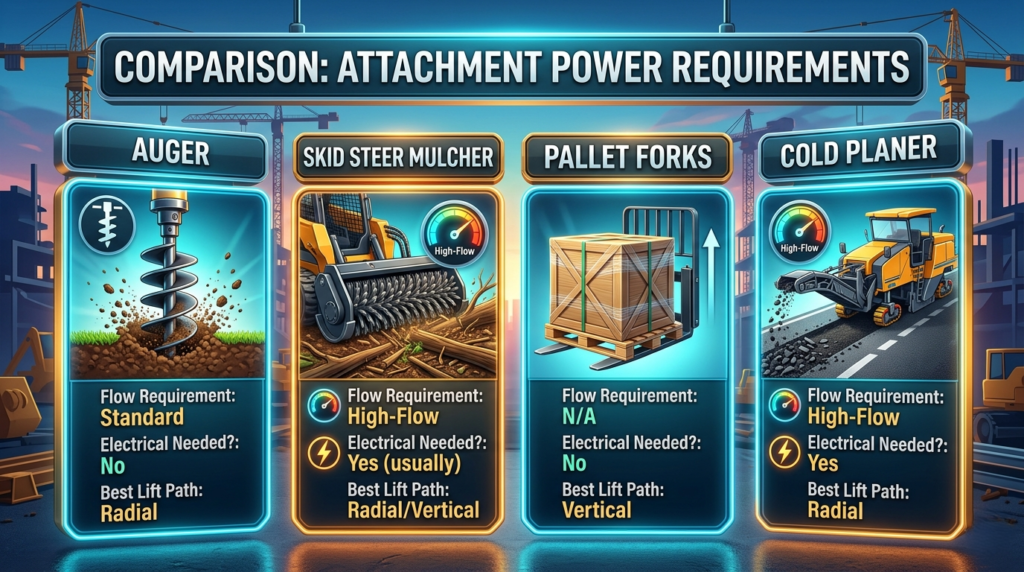
Comparison: Attachment Power Requirements
| Attachment Type | Flow Requirement | Electrical Needed? | Best Lift Path |
| Auger | Standard | No | Radial |
| Skid Steer Mulcher | High-Flow | Yes (usually) | Radial/Vertical |
| Pallet Forks | N/A | No | Vertical |
| Cold Planer | High-Flow | Yes | Radial |
6. Cooling system and thermal management
Using powerful Skid Steer Attachments will heat the hydraulic oil inside of the machine substantially. Your equipment will regularly enter “limp mode” if you do not have a good-quality cooling system.
- Side-by-Side Coolers: In addition, they come with the ability to be cleaned more easily and are more efficient at rejecting heat when the Skid Steer Attachments are heavily used.
- Reversing Fans: Have the ability to blow out dust and wood chips – an essential feature when running a skid steer mulcher.
- Temperature Monitoring: Having real-time hydraulic temperature gauge alerts you of possible damage thus helping you in avoiding downtime while running demanding Skid Steer Attachments.
7. Operator Cab Ergonomics and Visibility
Effective operation of your Skid Steer Attachments is not possible if you cannot see them clearly. The cab must be constructed in such a way that the line of sight is uninterrupted to the tip of the forks or cutting edges.
- Glass Roof Panels: Make it possible for the operator to see the Skid Steer Attachments when the arms are raised to full height.
- Reduced Noise: Helps the operator in listening to the “load” on the Skid Steer Attachments thereby avoiding stalls.
- Control Customization: By changing joystick sensitivity, the operator can benefit from precise movements especially when working with grading Skid Steer Attachments.
8. Stability and Ground Pressure
Both types of undercarriage – tires and tracks require the machine’s footprint to be taken into consideration as to how it will carry the different Skid Steer Attachments weights. Among other factors, stability is actually the base of safety.
- Wide Tracks: Allows for the weight of the heavy Skid Steer Attachments to be spread so that they do not sink into the soft earth.
- Wheelbase Length: Apart from better skid steer stability, a longer wheelbase is also an advantage while carrying heavy buckets across rough terrain.
- Ride Control: Controls the “bouncing” that happens when you travel with Skid Steer Attachments thus protecting both the machine and the operator.
9. Telematics and Attachment Tracking
You can now expect to be able to monitor not only your fleet of machines but also your Skid Steer Attachments utilization through the use of advanced fleet management software.
- Maintenance Logs: Allows you to keep in check the times when specific Skid Steer Attachments have their blades sharpened or seals replaced.
- Location Tracking: GPS for the protection of your expensive Skid Steer Attachments that are left on job sites.
- Performance Data: Keeps track of the fuel used while operating certain high-flow Skid Steer Attachments.
10. Durability and Reinforcement of Loader Arms
The loader arms take the brunt of the vibration or the impact of the heavy Skid Steer Attachments (like breakers or shears). If the arms are weak, they will develop cracks and eventually fail.
- Heavy-Duty Pins: All pivot points where Skid Steer Attachments connect should come with large and greasable pins.
- Reinforced Plates: Additional steel has been added in highly stressed areas to ensure that the machine can handle large and heavy Skid Steer Attachments without it breaking.
- Cylinder Protection: Hydraulic cylinders protection prevents them from damage after falling debris has hit lines connected to your Skid Steer Attachments.
FAQs: Skid Steer Attachments Features
What are the most common skid steer attachments?
Skid Steer Attachments most widely available are general-purpose buckets, pallet forks, augers, and grapples. These four types will cover roughly 80% of your construction and landscaping work.
Can I use high-flow attachments on a standard-flow machine?
Not at all. Performance level will be very low using high-flow Skid Steer Attachments on standard-flow machines and besides that, they might overheat and fail due to the hydraulic pump of your machine or the attachments.
How do I choose the right skid steer attachments for landscaping?
In everything related to landscaping, you must invest in Skid Steer Attachments that are radial lift friendly such as soil conditioners, trenchers, and sod rollers in order to minimize ground disturbance.
Are all skid steer attachments universal?
Mostly, they are the ones that use the “Universal Skid Steer Quick Attach” (USSQA) plate. However, the size of the hydraulic coupling is different in different manufacturers and electrical connectors (7-pin vs. 14-pin) may also be different.
How much do skid steer attachments cost?
Cost is from $500 for a used simple bucket up to more than $30,000 for highly specialized Skid Steer Attachments such as forestry mulchers or 3D grading systems.
Do I need a special license to operate different skid steer attachments?
Normally, no, although OSHA is requiring that operators are trained on the machine they are using and any Skid Steer Attachments that extensively changes machine handling or safety profile.
How do I maintain my skid steer attachments?
First of all, inspect daily the hydraulic hoses for leaks. Then, grease all pivot points, and finally, check the “cutting edges” of your Skid Steer Attachments that are worn out.