Cold-Weather Skid Steer Attachments for: Choosing What Works Best
Running a skid steer in freezing weather takes more than a standard bucket and a warm cab. Sub-zero temperatures thicken hydraulic oil, make steel more brittle under shock loads, and turn routine clearing jobs into a grind if your gear isn’t built for it. Matching the right skid steer attachments to the surface, snow depth, and your machine’s hydraulics keeps work moving without beating up your loader.
Why Purpose-Built Winter Skid Steer Attachments Matter
Standard earth-moving attachments aren’t designed around frozen ground, road salt, or repeated impacts hidden beneath snow cover. Purpose-built winter tools help in three practical ways:
- Tougher builds: Heavier steel frames, reinforced mounts, and replaceable wear edges hold up better when temps drop and ice builds up.
- Faster passes: Dedicated snow and ice tools clear wider paths or move more volume per trip, cutting fuel burn and operator hours on commercial sites.
- Less strain on the machine: Features like trip edges, float/skid shoes, and proper hydraulic flow matching reduce shock loads and overheating.
Top Cold-Weather Skid Steer Attachments
1. Snow Pushers and Snow Buckets
A snow pusher (box plow) uses side containment walls to trap snow and move big loads straight ahead in fewer passes—ideal for parking lots, retail sites, and long drives. Many commercial models run passively with no hydraulics, cutting down on cold-weather hose or cylinder headaches.
- Sizing: Common widths span roughly 6 to 16 feet depending on machine power and lot size. As a rough rule of thumb, 50–70 HP machines handle around a 10-foot pusher well, while 90+ HP units can step up to 12–16 feet.
- Obstacle protection: Trip-edge blades flex when catching on speed bumps, manhole covers, or curbs instead of jarring the loader arms.
- Surface care: Rubber or polyurethane cutting edges protect asphalt, pavers, and decorative concrete better than bare steel.
- Pusher vs. snow bucket: Pushers excel at bulk pushing across open pavement, while snow buckets shine when you need to scoop, carry, haul, or load snow into trucks.
2. Angle Brooms
An angle broom sweeps light snow, slush, sand, and grit off sidewalks, plazas, and lots without scraping delicate finishes.
- Cab angle control: Hydraulic angling (often around 25–30 degrees left or right) lets you windrow material to the side without hopping out or stopping.
- Bristle options: Poly/nylon bristles handle light snow and slush gently, while wire or mixed bristles tackle packed grit and stubborn debris.
- Four-season return: Once spring arrives, it doubles as a cleanup sweeper for construction sites, yards, and events.
3. Salt and Sand Spreaders
Front-mounted spreaders run off auxiliary hydraulics to lay down rock salt, sand, grit, or treated blends for traction and de-icing.
- Metered application: Adjustable flow and spread width let you match output to icy spots, walkways, or wide lanes without wasting material.
- Corrosion resistance: Stainless steel or poly hoppers stand up far better to salt and brine than plain painted steel.
- Streamlined operation: Cab-integrated controls let one operator manage ground speed and spread rate smoothly.
4. Snow Blowers
When snow is deep, wet, or drifted—or when you simply have nowhere left to push piles—a snow blower chews through it with an auger and impeller and throws it clear of the work zone (often 30–50 feet depending on model and flow).
- Heavy snow & tight spots: Great for rural lanes, narrow paths, municipal work, and sites hemmed in by buildings or parked vehicles.
- In-cab chute control: Adjust throw direction and deflection angle on the fly to keep snow off buildings, fences, and traffic.
- Skid shoes: Adjustable shoes help keep the cutting edge from digging into gravel or gouging pavement.
5. Cold Planers and Frost Rippers
When winter shifts from snow removal to hard ice or frozen ground, milling and ripping tools take over:
- Cold planers: A rotating drum with carbide teeth shaves down thick ice layers or damaged asphalt/concrete with controlled depth.
- Frost rippers: Heavy-duty shanks fracture frozen topsoil so trenching, footings, and utility work don’t stall out in deep frost.
- Built for vibration: Both see heavy shock and vibration, so frame strength and hydraulic flow matching are critical.
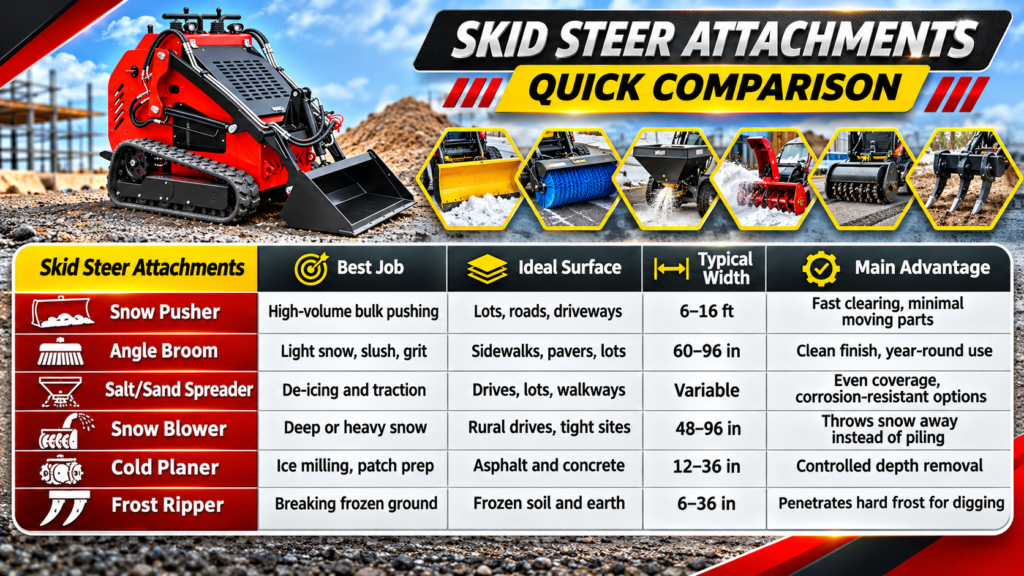
Table: Skid Steer Attachments Quick Comparison
| Skid Steer Attachments | Best Job | Ideal Surface | Typical Width | Main Advantage |
| Snow Pusher | High-volume bulk pushing | Lots, roads, driveways | 6–16 ft | Fast clearing, minimal moving parts |
| Angle Broom | Light snow, slush, grit | Sidewalks, pavers, lots | 60–96 in | Clean finish, year-round use |
| Salt/Sand Spreader | De-icing and traction | Drives, lots, walkways | Variable | Even coverage, corrosion-resistant options |
| Snow Blower | Deep or heavy snow | Rural drives, tight sites | 48–96 in | Throws snow away instead of piling |
| Cold Planer | Ice milling, patch prep | Asphalt and concrete | 12–36 in | Controlled depth removal |
| Frost Ripper | Breaking frozen ground | Frozen soil and earth | 6–36 in | Penetrates hard frost for digging |
How to Pick and Care for Your Setup
- Check hydraulic flow first: Match standard-flow vs. high-flow requirements (GPM and PSI) to your loader so motors and blowers don’t run sluggish or overheat.
- Confirm the mount: Most skid steers use a universal quick-attach plate, though heavy or specialized skid steer attachments should always be double-checked for fit and pin lockup.
- Think beyond a single storm: Weigh dedicated winter tools against multi-season skid steer attachments like angle brooms and spreaders based on how often winter hits your area.
- Keep up with winter maintenance: Knock off packed snow and ice after shifts, check cutting edges and shoes for wear, use cold-rated grease on pivots, rinse or coat salt-exposed metal, and store gear dry when parked.
FAQs – Cold-Weather Skid Steer Attachments
Can I get by without special winter attachments?
You can push light snow with a standard bucket in a pinch, but it’s slower, spills more, and puts extra wear on the machine compared to purpose-built tools.
Do these fit most skid steer brands?
Most connect via standard skid steer quick-attach mounts across major brands (such as Bobcat, Case, Cat, John Deere, New Holland, and Kubota), provided hydraulic flow and weight limits match.
Can I use my skid steer loader in cold weather without any extra attachments?
Yes you can run a skid steer in cold weather without special attachments, but it really hurts your productivity and may damage the machine and conventional attachments. In terms of cold-weather-rated attachments, they are designed to withstand the rigors of ice, frost and heavy snow, making them a must for safe and effective winter operations.
How do I choose the correct snow pusher size for my skid steer?
Select snow pusher width according to your skid steer’s rated operating capacity and hydraulic horsepower. A 50- to 70-horsepower machine can often push a 10-foot pusher without any problems, while bigger machines of 90+ HP can easily handle 12- to 16-footers.
Are skid steer snow blower accessories worth the cost?
Yes, if you have businesses that deal with heavy snow on a regular basis or deep drift situations, a skid steer snow blower attachment is definitely worth the investment. It greatly decreases the clearance time in heavy accumulation locations and removes the need to windrow snow, which may be an issue in confined places.
Are cold weather accessories universal to all skid steer brands?
Most cold weather skid steer attachments are designed to fit universal skid steer quick-attach systems and will operate on major manufacturers like Bobcat, Case, Caterpillar, John Deere, New Holland, and Kubota. Always check with the attachment provider for the individual mounting plate standard and hydraulic flow requirements before ordering.
How do I maintain skid steer attachments in the winter?
Clean all attachment parts after each usage to remove compacted snow and ice. Check cutting edges and blades for wear. Lubricate pivot points with low temperature lubricant. Keep accessories in dry storage while not in use. Salt and moisture may damage metal surfaces throughout the winter, but a coating of corrosion inhibitor can help protect them.