Prevent Poor Fuel Economy in Skid Steer Loaders: Simple Fixes
Let’s face facts. Running heavy equipment right now is expensive, and diesel prices certainly aren’t doing any of us any favors. Skid steer loaders are the absolute backbone of most construction, landscaping, and farm gigs simply because they can do almost anything you throw at them. But man, when they start guzzling fuel, you feel it straight in your wallet. It eats up your profit margins incredibly fast. How to handle the fuel economy in skid steer loaders and gain profits.
Why Your Skid Steer is Guzzling Diesel
If you’re looking to actually prevent poor fuel economy in skid steer loaders, you have to look way past just checking the fuel gauge every morning. It takes a solid, realistic mix of keeping up with basic maintenance, managing how the guys in the cab are driving, and maybe even adopting a little bit of modern tech. Fuel waste doesn’t just happen out of nowhere.
It creeps in slowly through neglected dirty filters, guys leaving the engine idling while they eat lunch, and machines that are struggling to push through thick mud with low tire pressure. Once you spot these hidden money pits, you can finally put a stop to them and keep your equipment running strong without burning through your cash flow on unnecessary fuel runs.
- Tracking down the real, underlying reasons your machine is drinking too much diesel is the only way to save money long-term.
- Sticking to a rock-solid, no-excuses maintenance habit keeps the engine running smooth and keeps fuel usage way down.
- Getting your operators to drop the “heavy foot” driving style and stop idling can instantly slash your daily diesel burn.
The Hidden Culprits Behind High Fuel Consumption
So, what is actually causing your machine to burn through a tank so fast? To really prevent poor fuel economy in skid steer loaders, you have to understand the mechanics of how these compact beasts get overworked. A lot of the time, the engine is just fighting against itself because of neglected parts.
Take your fuel injectors, for example. If they get clogged up with junk from cheap diesel, they stop spraying a nice fine mist and start dumping raw fuel, meaning your engine has to chug more just to get the same amount of pushing power. The same thing happens when your engine oil gets sludgy or your air filters look like they’ve been buried in a sandbox.
The engine can’t breathe or move easily, so it works overtime. And let’s not forget how we actually use the machines on the job. If you slap an oversized bucket on a mid-sized loader and try to move wet clay all day, the hydraulic system is going to scream for mercy. All of that extra strain translates directly into a dropping fuel gauge.
- Gunked-up fuel injectors and nasty engine oil force the motor to burn extra diesel just to maintain basic horsepower.
- Hooking up attachments that are way too heavy for your specific model puts brutal strain on the hydraulic pumps.
- Choked-up air filters starve the engine of oxygen, completely ruining the combustion mix and wasting expensive fuel.
Nailing Down Routine Preventative Maintenance
Talk to any seasoned mechanic, and they’ll tell you that skipping skid steer maintenance is the easiest way to throw money in the trash. Getting serious about your preventative maintenance schedule is hands down the best way to prevent poor fuel economy in skid steer loaders.
A machine that is taken care of just runs better, turning every drop of fuel into actual dirt-moving power instead of wasted heat. You’ve got to check those air filters constantly, especially if you’re working in dry, dusty dirt lots or demolition sites. When an engine has to suck air through a clogged filter, it compensates by dumping more fuel into the cylinder. It’s a huge waste. Then there’s fluid management.
You shouldn’t just guess when it’s time to change the oil, hydraulic fluid, or coolant—stick to the book. Fresh hydraulic fluid keeps the loader arms moving fast and smooth without dragging. If you make it a hard rule to do your daily, weekly, and monthly walk-arounds, you’ll catch the small stuff before it turns into a massive fuel-draining headache.
- Doing a quick daily check on oil, coolant, and hydraulic levels stops the engine from grinding away due to bad lubrication.
- Swapping out air filters on a strict schedule guarantees your engine breathes right and burns fuel efficiently.
- Hitting the grease zerks on your pivot points and bucket pins cuts down metal-on-metal drag, saving engine power.
Why Tires and Tracks Matter More Than You Think
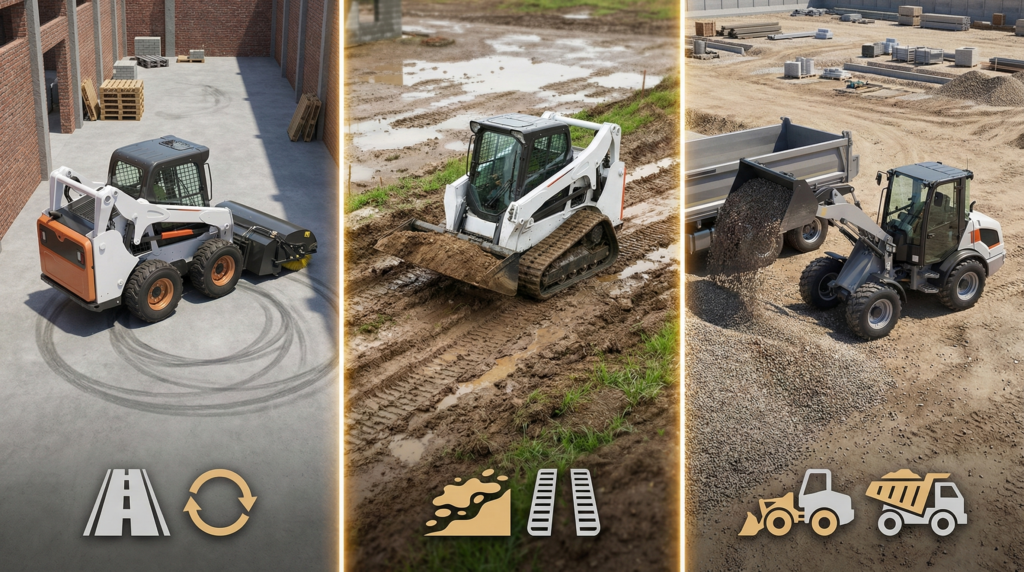
Here is something a lot of fleet owners completely overlook when they try to prevent poor fuel economy in skid steer loaders: the part of the machine that actually touches the dirt. If you run a wheeled skid steer, your tire pressure is a massive deal.
Think about trying to ride a mountain bike with flat tires. Your legs burn, right? It takes way more energy. Your skid steer feels the exact same way. Low tire pressure creates a ton of rolling resistance, meaning the engine has to throttle up just to drive across the yard. For the guys running compact track loaders (CTLs), track tension is your equivalent.
If you crank those rubber tracks too tight, they grind against the undercarriage idlers and sprockets, acting like a brake. Too loose, and you’re just spinning tracks and wasting power. Clean the packed mud out of your undercarriage at the end of the day, check your pressures, and you will absolutely notice the fuel savings by the end of the week.
- Driving a wheeled machine on soft, underinflated tires creates a massive drag that forces the motor to guzzle diesel.
- Running tracks that are cranked way too tight creates nasty friction, while loose tracks just slip and waste power.
- Digging the dried mud and rocks out of your wheel wells or track frames drops dead weight and stops mechanical drag.
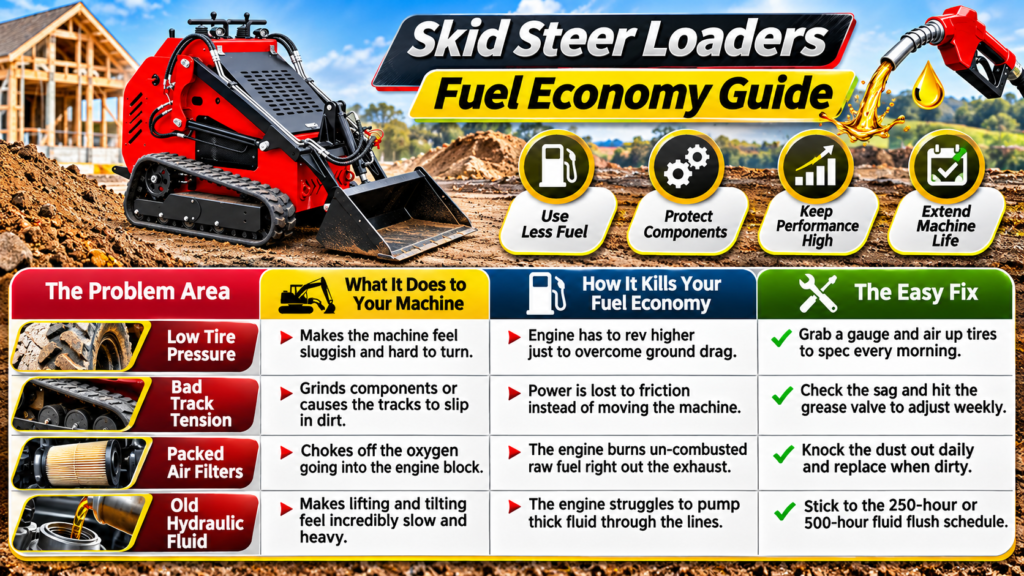
Table: Fuel Economy in Skid Steer Loaders
| The Problem Area | What It Does to Your Machine | How It Kills Your Fuel Economy | The Easy Fix |
| Low Tire Pressure | Makes the machine feel sluggish and hard to turn | Engine has to rev higher just to overcome ground drag | Grab a gauge and air up tires to spec every morning |
| Bad Track Tension | Grinds components or causes the tracks to slip in dirt | Power is lost to friction instead of moving the machine | Check the sag and hit the grease valve to adjust weekly |
| Packed Air Filters | Chokes off the oxygen going into the engine block | The engine burns un-combusted raw fuel right out the exhaust | Knock the dust out daily and replace when dirty |
| Old Hydraulic Fluid | Makes lifting and tilting feel incredibly slow and heavy | The engine struggles to pump thick fluid through the lines | Stick to the 250-hour or 500-hour fluid flush schedule |
Fixing Operator Habits on the Job Site
You can have the most perfectly tuned, freshly serviced machine in the world, but if the guy sitting in the seat drives it like a maniac, your fuel savings are gone. Operator habits will make or break your attempts to prevent poor fuel economy in skid steer loaders.
The undisputed king of wasting fuel is excessive idling. We all know the drill—a guy is waiting for a dump truck to back in, or he’s eating a sandwich, and he just leaves the machine running for 45 minutes. That alone can spike your fuel costs by crazy amounts and ruin your engine oil prematurely. You really need to push an anti-idling rule: if you aren’t moving dirt for more than five minutes, turn the key off.
Also, watch out for the guys who treat the throttle like an on/off switch. Jerky, wide-open acceleration and slamming the machine into piles wastes a ton of fuel compared to smooth, steady movements. Even just organizing the job site better so guys aren’t driving back and forth across a massive lot all day will save you gallons of diesel.
- Putting a hard stop to long idling times keeps your guys from burning up expensive diesel while literally doing nothing.
- Coaching operators to roll into the throttle smoothly instead of instantly redlining it stops crazy spikes in fuel use.
- Setting up the dirt piles and staging areas close to the work zone cuts out pointless driving and saves fuel.
Using Tech to Keep an Eye on the Fleet
If you want to take things to the next level, modern technology is basically a cheat code to prevent poor fuel economy in skid steer loaders. Almost all newer heavy machines roll off the lot with GPS and telematics built right in, and if yours didn’t, you can easily add them. These systems ping data back to your phone or computer, telling you exactly what the machine is doing.
You can see real-time fuel burn rates, track exactly how many hours a machine sat there idling, and figure out if a specific operator has a heavy foot. When you have the actual numbers in front of you, it takes the guesswork out of the job. You can easily pull a guy aside and say, “Hey, you idled for three hours yesterday, cut it out.” Plus, a lot of these apps will shoot you a warning if fuel efficiency suddenly drops off a cliff, which usually means a hydraulic leak or an injector is failing before you even see the smoke. Using the data just makes you a smarter, more profitable owner.
- Telematics dashboards give you the raw truth about how much fuel is burning, so you can spot the money leaks fast.
- GPS monitors flag exactly when and where machines are sitting idle, so you know who needs a quick talking-to.
- Maintenance tracking software pings your phone when it’s time for filters, so you never accidentally skip a service.
FAQs – Fuel Economy of Skid Steer Loaders
What’s the best way to prevent poor fuel economy in skid steer loaders?
Honestly, the absolute best way to prevent poor fuel economy in skid steer loaders is a mix of basic common sense maintenance and smart driving. Start under the hood—make sure your air and fuel filters are fresh, because a suffocating engine will always burn more diesel. Next, look at the ground; keep your tires aired up properly or your tracks tensioned right so the machine rolls easily. Finally, talk to your operators. Tell them to turn the machine off when they aren’t working and to stop driving it like they are in a drag race.
- Keep up with your filter changes so the engine doesn’t have to fight to breathe or pump fuel.
- Make sure your tires aren’t sagging and your tracks aren’t overly tight to kill rolling resistance.
- Get serious about shutting the engine down instead of letting it idle during breaks or wait times.
Does idling really waste that much diesel in a skid steer?
Oh, absolutely. Idling is probably the dumbest way you can burn through your budget. When a skid steer is just sitting there running, it’s drinking fuel while doing exactly zero work for you. Beyond just the cash you are literally burning, idling for long stretches causes incomplete combustion. That means nasty carbon buildup inside the engine, and it breaks down your oil way faster. Shutting it down when you’re just sitting around is the easiest trick in the book to prevent poor fuel economy in skid steer loaders.
- Leaving the machine running while parked is just setting your diesel budget on fire for no reason.
- It clogs up your engine with carbon because the motor isn’t getting hot enough to burn clean.
- Killing the ignition during downtime makes your expensive engine oil last significantly longer.
Will old hydraulic fluid hurt my machine’s fuel efficiency?
Yes, it absolutely will. A lot of guys forget this, but the hydraulic system is what actually does the heavy lifting. When that fluid gets old, dirty, and broken down, it thickens up and creates a ton of internal friction. Your engine has to work incredibly hard just to force that sludgy fluid through the pumps and hoses. Keeping that fluid fresh means the loader arms snap up quickly and smoothly, which takes a lot of the heavy load off the diesel engine.
- Nasty hydraulic oil creates drag inside the lines, forcing the main engine to burn more fuel to push it.
- Running dirty fluid can cause your pumps to get way too hot and bog down the whole machine.
- Flushing the system on time keeps the power transfer snappy and keeps fuel consumption low.
How much does tire pressure matter for heavy equipment fuel use?
It matters a ton. Think about a flat tire on a wheelbarrow—it takes all your strength to push it. A wheeled skid steer works the same way. If the tires are low, they flatten out on the bottom, creating a massive, sticky footprint on the dirt. The engine has to rev up just to overcome that drag and get the machine moving. Grabbing an air chuck and keeping those tires inflated to the factory specs is basically free fuel savings.
- Soft tires drag on the dirt, making the engine fight way harder just to cruise across the yard.
- Running them low ruins the sidewalls, which means you’ll be buying expensive new tires way sooner.
- Keeping the air pressure perfect means the machine turns smoother and uses way less throttle.
Does the type of attachment I use affect how much fuel I burn?
Big time. If you slap an oversized bucket on a machine that isn’t rated for it, the engine is going to be screaming all day trying to lift it. Or, if you’re using a bucket with teeth that are totally worn down and dull, the machine can’t cut into the dirt smoothly. Instead, it has to use pure, brute horsepower to smash into the pile, which drinks diesel fast. Using the right size tool with sharp edges helps prevent poor fuel economy in skid steer loaders.
- Putting a giant, overweight attachment on a smaller machine forces the motor to run at maximum effort.
- Trying to dig with dull, worn-out bucket teeth means you’re ramming the dirt instead of slicing it, wasting gas.
- Matching the right-sized, well-maintained tool to the job keeps the machine working fast and efficiently.
Do I really need to run the machine at full throttle all the time?
No, and it’s a huge rookie mistake to do so. Some guys think they always need the throttle pinned wide open, but that just wastes fuel. Sure, if you are doing heavy digging or running a high-flow forestry mulcher, you need those high RPMs. But if you are just carrying a load of mulch across a parking lot or doing some light back-dragging, back the throttle off. Matching your engine speed to the actual job you are doing is a massive fuel saver.
- Pinning the throttle for light work just blasts diesel out the exhaust pipe for absolutely no reason.
- Backing off the RPMs when you’re just driving from point A to point B saves fuel and saves your ears.
- Learning how to actually manage the throttle depending on the task is what separates the pros from the rookies.
How often should I realistically change my air filters?
There’s no single magic number because it depends entirely on where you are working. If you are doing demo work indoors or grading bone-dry dirt in the summer, you might need to knock the dust out daily and replace the filter every couple of weeks. A clean filter gives the engine the exact air it needs to mix with the diesel. If it’s clogged, the engine runs “rich” (way too much fuel), which is exactly what you are trying to avoid to prevent poor fuel economy in skid steer loaders.
- A totally plugged air filter starves the engine, making it burn raw fuel unevenly and wastefully.
- Working in horrible, dusty conditions means you can’t trust the manual—you have to check it constantly.
- Popping a fresh filter in immediately wakes the engine up, giving you your horsepower and fuel mileage back.