The Ultimate Guide: What to Look for Before Buying from a Skid Steer Loader for Sale Yard
Let’s face it. Dropping a massive chunk of change on heavy machinery isn’t something you do on a whim. Whether you’re beefing up a construction fleet, tackling bigger landscaping jobs, or running an agricultural operation, getting the right rig is everything. But walking onto a skid steer loader for sale yard can be seriously intimidating. You’re staring down rows of different makes, models, and machines that have seen varying levels of abuse.
How do you separate a reliable workhorse from a total money pit? You need to know exactly how to check the specs, spot structural damage, listen to the engine, and dig into the machine’s past. This guide is going to walk you through the gritty details and pro-level inspection tricks you absolutely need before signing any paperwork.
The Ultimate Guide: Are you Buying from a Skid Steer Loader for Sale Yard? Checklist Guide:
1. Figuring Out Your Rated Operating Capacity (ROC) Needs
Before you even think about heading to a skid steer loader for sale yard, you have to nail down your Rated Operating Capacity (ROC). This isn’t just some fancy spec sheet number—it dictates if a machine can actually do your job safely without tipping over.
Basically, ROC is calculated as exactly 50% of the machine’s actual tipping load. It’s your safe lifting limit. A lot of first-time buyers screw this up. They get hypnotized by engine horsepower or how beefy the machine looks, totally forgetting to calculate the actual weight of the stuff they’ll be moving.
Scooping a bucket of dry topsoil is a whole different ballgame compared to lugging around heavy, wet concrete. If you’re constantly redlining the ROC, you’re going to wreck the machine’s hydraulics and put your crew in danger.
To make sure you don’t buy a machine that is dangerously underpowered for your specific job, keep these rules in mind:
- Nail down your heaviest material: Figure out the absolute heaviest thing you’ll move on a regular basis, like packed wet clay or gravel, and match that weight per cubic yard to the loader’s lifting specs.
- Give yourself a 20% cushion: Don’t buy a machine where your everyday load hits the max ROC limits. You want at least a 20% safety margin to account for bouncy terrain and uneven ground.
- Don’t forget the attachment weight: Heavy-duty add-ons like forestry mulchers, brush cutters, or trenchers aren’t light. Their raw weight subtracts directly from what you can actually lift in the bucket.
2. Wheels or Tracks: Picking Your Setup
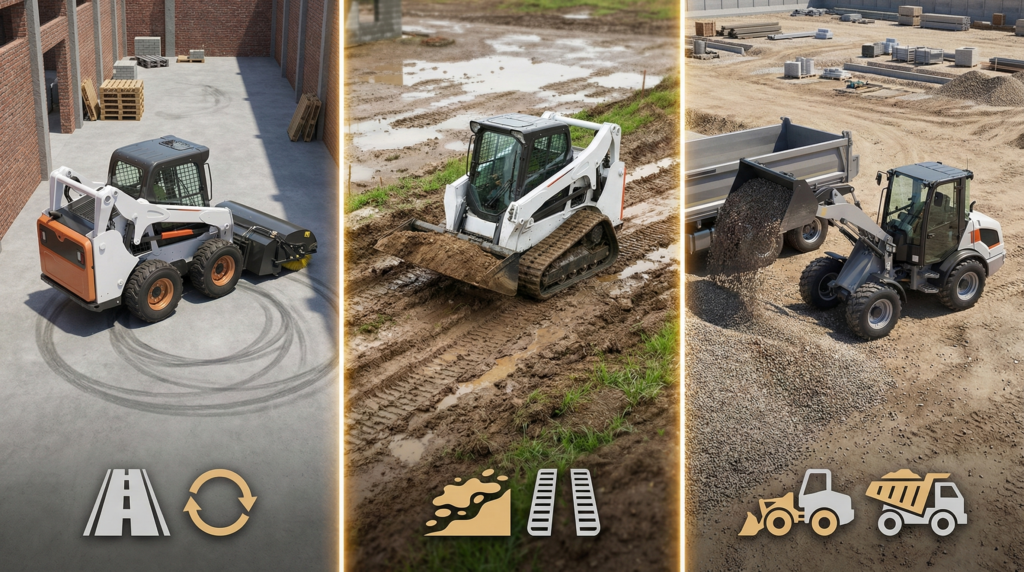
So, you’ve got your lifting numbers sorted out. The next big hurdle at the skid steer loader for sale yard is deciding between a classic wheeled setup or a compact track loader (CTL). Honestly, this choice should be entirely based on the dirt you’ll be driving on every day. Wheeled rigs are quick, nimble, and way cheaper to keep running over the long haul.
If you’re working on asphalt, concrete, or hard-packed dirt, they are absolute beasts. But put them in deep mud or loose sand, and they’ll just spin out and make a massive mess. That’s where track loaders shine.
They spread the machine’s heavy weight out across a wide surface area, giving you crazy good traction and floatation in sloppy conditions. The catch? You’re going to pay more upfront, and replacing worn-out rubber tracks and undercarriage parts will definitely hurt your wallet.
When you are out on the lot looking at different frame types, look closely at these details:
- Look hard at your daily job sites: If you’re strictly doing street repairs, scrap yard loading, or residential concrete work, save yourself a fortune in maintenance costs and stick to wheels.
- Check those tracks closely: If you do go the CTL route, get down in the dirt and inspect the rubber tracks for nasty cuts or missing treads, and check the steel sprockets for heavy wear and tear.
- Tire types matter on wheeled units: See if a wheeled machine has air-filled, foam-filled, or solid rubber tires. Solid tires mean no flats on a messy demo site, but your back is going to feel every single bump.
3. Getting Dirty with Engines and Hydraulics
A fresh coat of paint can hide a lot of sins, which is why poking around the engine and hydraulics is the most crucial part of visiting a skid steer loader for sale yard. The hydraulic system is basically the machine’s central nervous system. It runs the heavy lift arms and the drive motors.
If it’s shot, you’re buying a very expensive yard ornament. When you show up, you need to demand a totally cold start from the dealer. If the seller already warmed it up before you got there, they might be hiding nasty cold-start issues, bad glow plugs, or a rough engine knock.
Once you fire it up, listen closely. You don’t want to hear rhythmic banging or weird sputtering. Pull the hydraulic dipstick, too. The fluid should be mostly clear. If it looks like a strawberry milkshake, water got in. If it smells like burnt toast, the machine has been run into the ground and overheated.
Before you make any kind of offer, get your hands dirty and run these mechanical tests:
- Insist on a cold engine start: Physically put your bare hand near the engine block before turning the key to ensure it hasn’t been run. Watch for thick white or black smoke when it finally cranks over.
- Run a heavy hydraulic stress test: Rev the engine up, raise the boom all the way to the top, curl the bucket, and shut the engine off. If the arms slowly drift down on their own, you’ve got blown cylinder seals or leaky valves.
- Check the lifeblood of the machine: Pull every single dipstick you can find. You’re looking for correct oil levels, zero shiny metal flakes, and fluid that doesn’t smell roasted or look milky.
4. Scrutinizing the Frame, Tires, and Safety Cage
Heavy equipment lives a hard, abusive life. These rigs are constantly slamming into piles of dirt, bouncing over rocks, and vibrating like crazy for hours on end. When you’re wandering around a skid steer loader for sale yard, you’ve got to look past the shiny armor.
Honestly, if I see a freshly spray-painted machine on a used lot, I immediately get suspicious. A quick rattle-can paint job is the easiest way to hide scary stress cracks or ugly backyard welding jobs. Pay close attention to the massive loader arms, especially right around the pivot pins.
You’re hunting for hairline fractures. Also, don’t ever ignore the Roll-Over Protective Structure (ROPS). That metal cage is the only thing keeping the operator alive if things go sideways on a hill. If the cab is bent, poorly welded on, or missing shatterproof glass, the rig took a massive hit at some point. Just run away.
Take a very slow walk around the machine and stare hard at these structural areas:
- Comb over the boom arms and chassis: Hunt for any weird, non-factory welds or thick steel plates welded on as aftermarket patches. That usually means the machine was heavily overloaded and snapped.
- Shake the ROPS cab to check stability: Make sure the safety cage is straight as an arrow. Check that the door hinges aren’t sagging and that internal safety features like the lap bar actually click into place and engage the parking brake.
- Test the front quick-attach plate: Look closely at the mounting plate where your attachments hook up. If the locking pins are rusted solid or heavily mangled, you won’t be able to swap your buckets easily.
5. Digging into the Machine’s Past Life
The digital hour meter on the dash is only a tiny piece of the puzzle. A rig with 3,000 hours that was babied by a single owner-operator will usually run circles around a 1,500-hour machine that got totally trashed by a rental yard. When you’re talking price at a skid steer loader for sale yard, you have to ask to see the service records.
A solid, honest seller will have logs showing regular engine oil changes, hydraulic filter swaps, and proof that the pivot pins actually saw a grease gun once in a while. Try to figure out what the machine used to do for a living, too.
If it spent five years pushing road salt or highly corrosive fertilizer, it’s probably rusting from the inside out. If it just moved mulch at a local plant nursery, you’ve basically struck gold. If the seller plays dumb about the machine’s history or refuses to let you test drive it, pack up and leave.
To figure out what you are really getting into, always ask these historical questions:
- Ask for the actual paper trail: Demand to see the maintenance logs. You want hard proof that OEM service intervals were hit, especially when it comes to the expensive hydraulic flushes.
- Find out its old day job: Ask exactly where it worked before it ended up on the lot. Machines used for heavy concrete demolition take a horrific beating compared to machines used for light farm chores.
- Count the number of previous owners: One single owner usually means the machine was treated right. Rigs that have bounced around between five different owners or wholesale auctions are usually deeply neglected.
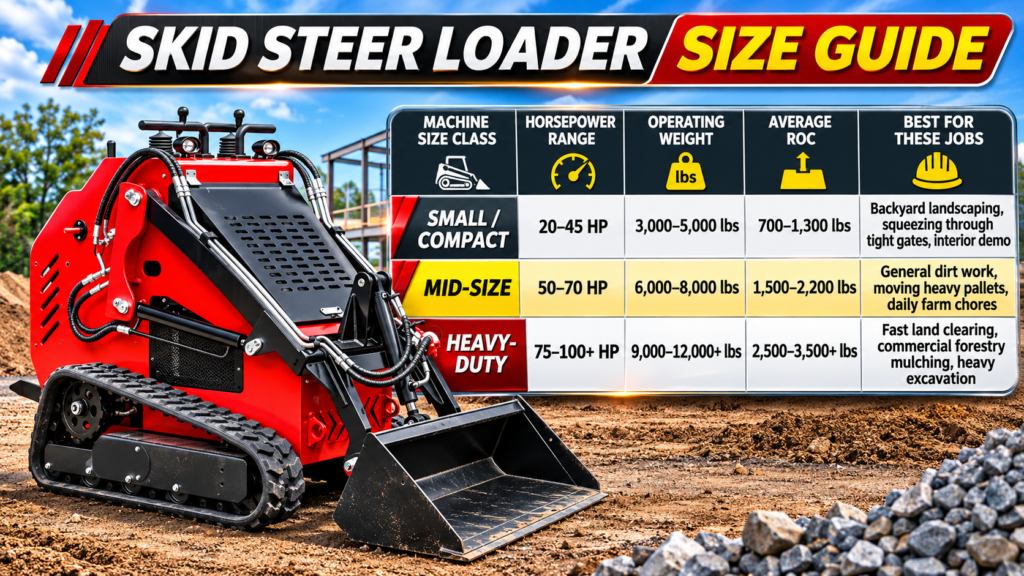
Table: Skid Steer Loader for Sale Yard
| Machine Size Class | Horsepower Range | Operating Weight | Average ROC | Best For These Jobs |
| Small / Compact | 20 – 45 HP | 3,000 – 5,000 lbs | 700 – 1,300 lbs | Backyard landscaping, squeezing through tight gates, interior demo |
| Mid-Size | 50 – 70 HP | 6,000 – 8,000 lbs | 1,500 – 2,200 lbs | General dirt work, moving heavy pallets, daily farm chores |
| Heavy-Duty | 75 – 100+ HP | 9,000 – 12,000+ lbs | 2,500 – 3,500+ lbs | Fast land clearing, commercial forestry mulching, heavy excavation |
To make a smart financial choice that won’t bite you later, remember these tips:
- Map out your local dealer network: Don’t buy a brand unless there is a legitimate service center and a well-stocked parts counter within a reasonable hour’s drive of your main shop.
- Think hard about long-term resale value: Name brands like CAT, Bobcat, Deere, and Kubota hold their value incredibly well. Strange off-brands will drop like a rock the second you sign the check.
- Watch out for dead or orphaned models: Make absolutely sure the manufacturer still makes replacement parts for the exact year and model you’re eyeing. Having to custom fabricate parts is a total nightmare.
FAQs – Before Buying a skid steer loader for sale yard
How many hours is considered high for a used skid steer?
Honestly, anything under 2,500 hours is usually a very safe bet and is considered the sweet spot for used buyers. Once a machine hits that 4,000 to 5,000-hour mark, you’re entering the territory where expensive stuff like drive motors and hydraulic pumps start giving up the ghost. Good brands can definitely push 8,000 hours if they were well-maintained, but the asking price needs to heavily reflect that wear and tear.
What are the absolute must-check items on a used loader?
You need to be completely thorough. Start with a cold engine crank and watch the exhaust smoke closely. Test the hydraulics by lifting the heavy machine with the bucket and watching for pressure drift. Check the ROPS cage for bends, look for nasty backyard welds on the boom, and measure the tire tread or rubber track depth.
Is there a safe way I can test the hydraulics myself?
Absolutely. You just need to safely stress the system. Lift a full, heavy load of dirt (or use the bucket to push the front wheels entirely off the ground) and hold it there. If the machine stutters, stalls out, or the arms slowly drop back down when you take your hands off the joysticks, the hydraulics are leaking internally.
Should I buy a wheeled machine or a track loader?
It entirely comes down to your local dirt. Wheeled machines are fantastic, fast, and cheap to maintain if you work mostly on pavement, hard dirt, or rocks. Tracks are absolutely the way to go if you work in sloppy mud, soft sand, or need to avoid tearing up nice lawns, but get ready for much higher repair bills.
What’s a fair and normal price for a used skid steer?
Prices are all over the place depending on the year, brand, and hours. A tired, older wheeled unit might run you $12,000 to $15,000. A solid mid-sized machine is usually hovering somewhere between $25,000 and $45,000. If you want a late-model track loader with a closed cab, AC, and low hours, be prepared to drop anywhere from $50,000 to $70,000.
What exactly does Rated Operating Capacity (ROC) mean?
ROC is the maximum physical weight the machine can safely lift without tipping over on its nose. It’s calculated at exactly half of the machine’s actual tipping load. If you routinely exceed the ROC, you’re going to break the loader arms or cause a serious, life-threatening accident.
Who makes the absolute best skid steers on the market?
The heavy hitters that mechanics and veteran operators swear by are Bobcat, Caterpillar (CAT), John Deere, Kubota, CASE Construction, and JCB. Sticking to these major players means you won’t be tearing your hair out trying to find replacement parts down the road.