How Contractors Use Short-Term Skid Steer Rentals to Win Bids
Listen, the bidding process today is absolutely brutal. You’re fighting tooth and nail over pennies to secure a contract, all while trying not to completely tank your own margins. Guys who own massive fleets often think they have the upper hand, but they’re carrying huge overhead costs that quietly eat away at their bottom line. That’s exactly where short-term skid steer rentals come into play.
The Competitive Edge in Modern Construction Bidding
Instead of bleeding cash on a machine that sits idle in your yard for weeks during the slow season, you’re only paying for the equipment when it’s actively moving dirt and making you money. This immediate drop in your baseline operational costs means you can slide in a highly competitive bid without starving your own business.
Plus, construction throws curveballs at you every single day. A client changes their mind, or a massive rainstorm washes out a trench. Being stubbornly tied to the one loader you own limits what your crew can actually do. By leaning on short-term skid steer rentals, you get exactly what you need, exactly when you need it. You end up outsmarting the bigger, slower companies simply because your operations are lean, fast, and highly adaptable.
- Keep your cash flow moving and fluid instead of locking it up in heavy iron that depreciates the second it leaves the dealership lot.
- Drop your project bids down to highly competitive levels since you don’t have to calculate long-term machine depreciation into the customer’s quote.
- Show up on the jobsite with the newest, most advanced models, proving to the client that you run a modern, efficient, and exceptionally safe operation.
Why Short-Term Skid Steer Rentals Make Financial Sense
Cash is king in the contracting world, period. If you’ve got a couple hundred grand tied up in machinery loans, you’re instantly handcuffed on how many jobs you can float at once. Moving your business model toward short-term skid steer rentals flips your company from facing a heavy capital expense nightmare into managing a smooth, predictable operational expense.
Think about the hidden costs for a second. When you buy, you’re constantly feeding that machine—insurance premiums, winter storage fees, interest rates on the loan, and transport trailers. When you rent, you just take the daily or weekly rental rate and plug it directly into the customer’s bid as a clean, simple line item.
This strategy makes your job costing dead accurate. And let’s talk about the weather or permit delays. If the city stalls your project for two weeks, an owned machine is just sitting on the dirt costing you daily loan interest. A rented machine goes straight back to the yard, stopping the financial bleed instantly. This kind of financial agility is exactly why smart estimators are pivoting hard to short-term skid steer rentals to scale up without taking on massive debt.
- Say goodbye to massive down payments and sky-high interest rates that routinely choke out small contracting businesses.
- Turn wild, unpredictable machinery costs into simple, fixed numbers that make your job costing perfectly accurate and profitable.
- Keep your business credit lines wide open so you can jump on sudden material deals or cover emergency payroll during a tough week.
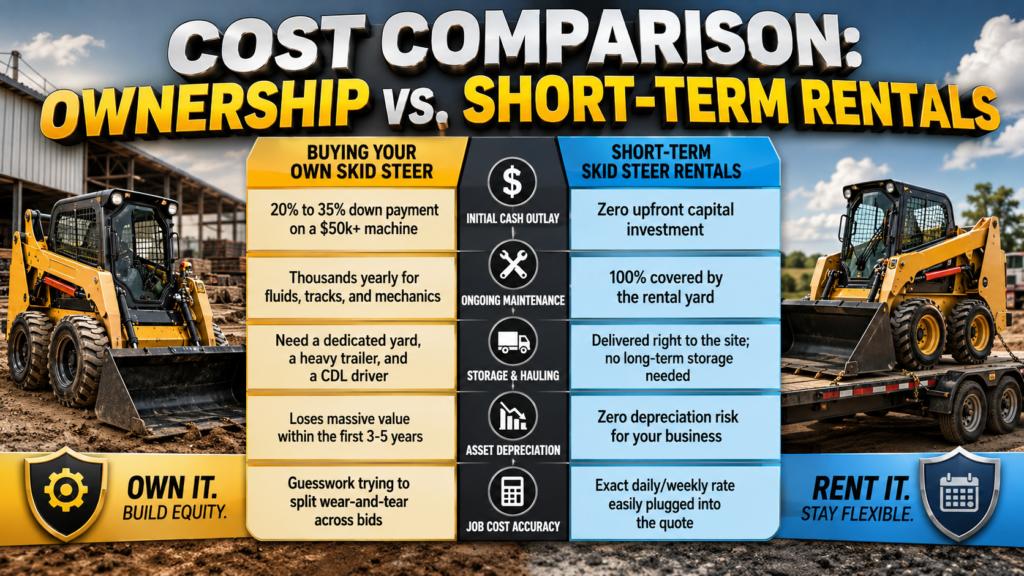
Cost Comparison: Ownership vs. Short-Term Skid Steer Rentals
| Expense Category | Buying Your Own Skid Steer | Short-Term Skid Steer Rentals |
| Initial Cash Outlay | 20% to 35% down payment on a $50k+ machine | Zero upfront capital investment |
| Ongoing Maintenance | Thousands yearly for fluids, tracks, and mechanics | 100% covered by the rental yard |
| Storage & Hauling | Need a dedicated yard, a heavy trailer, and a CDL driver | Delivered right to the site; no long-term storage needed |
| Asset Depreciation | Loses massive value within the first 3-5 years | Zero depreciation risk for your business |
| Job Cost Accuracy | Guesswork trying to split wear-and-tear across bids | Exact daily/weekly rate easily plugged into the quote |
Leveraging Attachment Versatility to Outbid Competitors
Here’s the real beauty of a skid steer: it’s essentially a giant, hydraulic Swiss Army knife. But going out and buying every single attachment you might ever need is a fast track to bankruptcy.
That’s why relying on short-term skid steer rentals is a massive cheat code for winning complex bids. You don’t need to rent a dedicated ride-on trencher, a separate rough-terrain forklift, and a mini excavator.
You just rent one base machine and a handful of specialized attachments. It drops your delivery fees to almost nothing, cuts down on your diesel fuel bill, and makes your bid look incredibly attractive to the client.
You can punch fence post holes in the morning with an auger, sweep the concrete at noon with a broom, and load heavy pallets in the afternoon with forks—all with one operator and one engine. Clients absolutely love seeing a compact, organized jobsite without five different machines tearing up their turf. When you can promise that kind of low-impact versatility, you win the contract over the guy bringing a massive fleet.
- Bundle your machine and attachment rentals from one local dealer to negotiate deep package discounts on your bid.
- Sell the client on the fact that your single-machine approach means fewer hazards, less noise, and less ground damage on their property.
- Pivot instantly when a client changes the plan mid-job; just swap a bucket for a breaker instead of scrambling to mobilize a whole new piece of heavy equipment.
Matching Equipment Size to Job Site Demands
Nothing kills a project’s profitability faster than showing up with the wrong sized gear. Bring a massive, heavy-duty loader to a cramped residential backyard, and you’re going to destroy their fences, crack their sidewalks, and ruin the lawn. Bring a tiny wheeled unit to a massive commercial dig, and your guys will be out there spinning their wheels for weeks.
Short-term skid steer rentals solve this headache completely. Every single time you quote a job, you can handpick the exact width, weight, and lift capacity that the specific site demands. If you’re working in deep mud or soft soil, you grab a tracked unit to lower your ground pressure.
If you’re running on hard asphalt, you grab tires so you can move faster. By detailing this specific, tailored approach in your proposal, you show the property owner that you’ve actually thought about their site. It proves you’re a seasoned professional who cares about efficiency, which is a massive selling point that often wins the job even if you aren’t the cheapest guy on the block.
- Pick the exact track or tire setup needed for the current soil conditions to avoid getting stuck and wasting expensive labor hours.
- Match the machine’s lifting capacity right down to the pound of the materials you’re moving so you aren’t paying extra for overkill.
- Opt for ultra-compact or low-emission units when bidding on tight urban jobs or indoor demolition work to keep the site safe and legal.
Minimizing Maintenance Costs and Downtime
We’ve all been there. You’re pushing hard to meet a strict deadline, and suddenly a hydraulic hose blows or the engine starts knocking. If it’s your own machine, the entire job grinds to a halt.
You’re paying a crew of guys to stand around doing nothing, and you’re making frantic calls to expensive field mechanics who charge $150 an hour just to pull into the driveway. Integrating short-term skid steer rentals pushes that entire nightmare onto someone else’s plate. The rental yard takes care of the oil changes, the grease, the filters, and the track wear.
If the machine dies on your site, one phone call usually gets a replacement dropped off the exact same day. This means the completion date you put on your bid is actually rock solid. You aren’t playing Russian roulette with old equipment.
The profit margin you calculated back in the office is the profit margin you actually take to the bank, purely because you eliminated the risk of surprise, out-of-pocket repair bills.
- Cut out the massive payroll expense of trying to keep a full-time heavy diesel mechanic on your company staff.
- Stop bleeding money on the endless nickel-and-dime costs of daily grease, expensive hydraulic fluid, and replacement rubber tracks.
- Use the rental yard’s guaranteed uptime and fast swap-out policies as a major selling point when assuring clients you’ll definitely finish on time.
Strategic Logistics and Project Agility
Getting heavy iron from point A to point B is a massive hidden cost in construction that burns up a lot of profit. If you own your fleet and win a bid three counties over, you’re suddenly dealing with CDL drivers, massive heavy haul trailers, DOT weigh stations, and brutal fuel costs just to mobilize.
Short-term skid steer rentals wipe that logistical headache clean off the board. You just call a rental yard right down the street from the new remote jobsite and have them drop it off locally. That hyper-local strategy strips heavy transportation costs out of your bid entirely, letting you comfortably underbid the local guys right in their own territory.
Plus, if a job suddenly accelerates and you need to double your dirt-moving speed to beat an incoming storm, you just make a phone call and get a second machine delivered. You can scale your field operations up or down by the day. That kind of agility makes a small, aggressive crew hit like a massive company, letting you snag contracts you normally wouldn’t even be able to touch.
- Team up with rental outfits close to the specific project location to absolutely gut your heavy hauling and mobilization costs.
- Tighten up your delivery and pickup windows so you never pay a single cent for equipment sitting idle on a weekend.
- Turn your non-existent transportation costs into a strategic financial discount on your bid to smoke the local competition.
Frequently Asked Questions – Short-Term Skid Steer Rentals
What size skid steer do I actually need for my job?
It all comes down to where you are working and what you are lifting. If you are doing residential work, a small frame machine that can squeeze through a 36-inch backyard gate is your best bet. If you are loading high-sided dump trucks or moving heavy pallets of block on a commercial site, you’ll need a large-frame machine with a vertical lift path.
Is it cheaper to rent or buy a skid steer loader?
For short-term projects, renting is hands-down the cheaper option. Buying a machine only makes sense if you plan to run it continuously for the vast majority of the year. Renting eliminates down payments, insurance, storage, and maintenance costs, making it perfect for contractors looking to keep their overhead low.
Do I need a special license to drive a rented skid steer?
Generally, no. You don’t need a special heavy equipment license or a CDL just to operate a skid steer on a private jobsite. However, if you plan on hauling the machine yourself on public roads, depending on the combined weight of your truck and trailer, you might cross into territory requiring a CDL.
Tracked vs. Wheeled skid steer: Which one is better?
It depends entirely on the dirt. Wheeled skid steers are incredibly fast and maneuverable on hard, flat surfaces like asphalt, concrete, or packed dirt. Compact track loaders (tracked skid steers) are built for mud, snow, and soft turf because the tracks distribute the weight and stop the machine from sinking or tearing up the grass.
How much weight can a standard skid steer lift?
Always check the Rated Operating Capacity (ROC) before renting. Smaller models usually handle around 700 to 1,300 pounds. Mid-size machines hit the sweet spot around 1,500 to 2,200 pounds. If you are moving serious weight, large-frame units can safely lift 3,000 pounds or more.
Are attachments included when I rent a skid steer?
Typically, a rental comes with a standard smooth or toothed dirt bucket. However, the biggest perk of renting is that you can add whatever specialized attachments you need for an extra fee. You can easily tack on augers, trenchers, grapple buckets, or hydraulic breakers to your rental agreement based on what the job demands.
Who pays for the maintenance on a rented skid steer?
The rental company handles the heavy lifting when it comes to maintenance. Routine servicing, fluid changes, and mechanical repairs are their responsibility. If the machine breaks down while you’re renting it, a good rntal house will either send a field mechanic to fix it on the spot or swap it out for a fresh machine so you don’t lose time.