What is the 70 30 Rule Skid Steer? Weight Distribution: A Complete Guide
Balance in heavy machinery operation is not only a matter of comfort; it is the key to safety and performance. By asking, “What Is The 70 30 Rule Skid Steer?”, you are uncovering the fundamental engineering concept that equips these small-sized machines with the capacity to pivot, lift, and operate in very small spaces.
Grasping the concept of 70/30 weight distribution is a major step even in loading a machine onto a trailer or quickly changing its direction at the site. We will illustrate in detail the reason for this ratio, its variations with load, and why this is the “golden rule” for every skid steer operator.
Decoding the 70 30 Rule Skid Steer
The 70 30 rule skid steer is a weight allocation characteristic of a skid steer loader between the two axles. In the case of a car, which normally aims at a 50/50 balance, a skid steer is purposely designed to be “unbalanced.” The ability to “skid” the machine comes from this design.
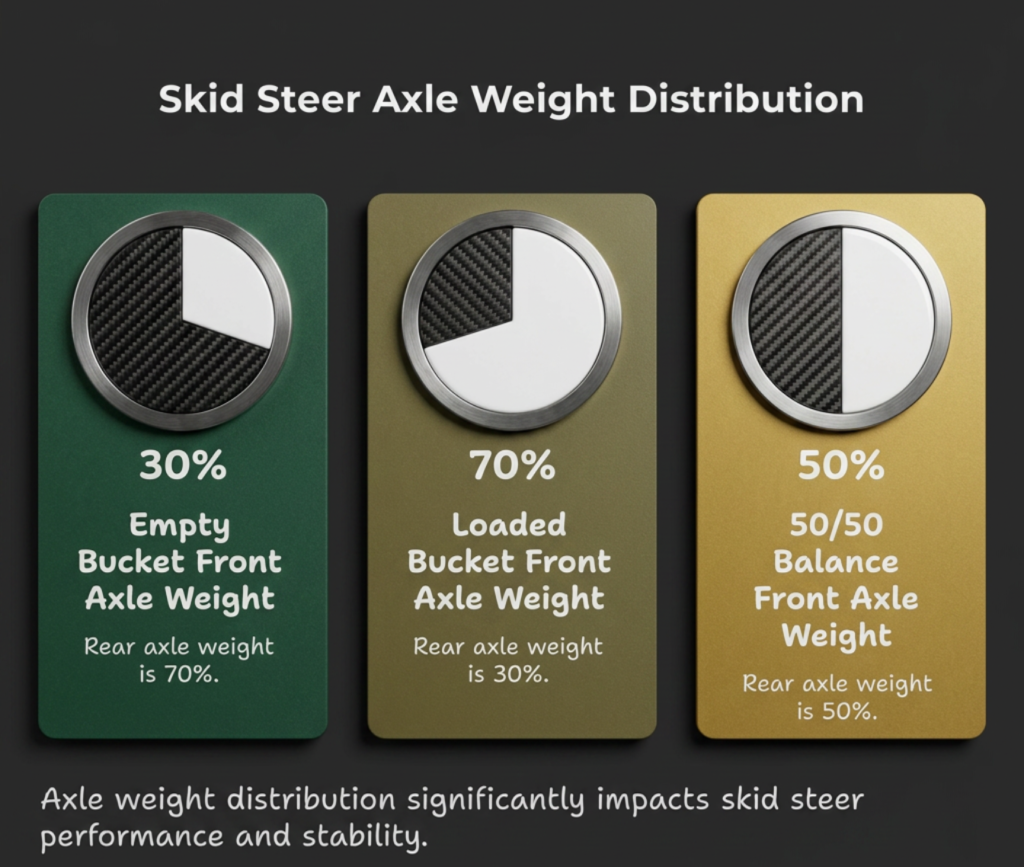
In an empty bucket situation, roughly 70% of the machine’s weight will be on the rear axle and 30% on the front axle. Such a tilt is necessary for:
- Facilitating Turning: The front tires make less contact with the ground due to most of the weight being on the rear side, hence, they are able to “skid” or slide effortlessly while turning.
- Turning on one point: The rear-weighted build makes the rear wheels to be the main pivot, which makes the machine very flexible for small areas.
- Counterbalance: The heavy engine and hydraulic system compartment are placed near the rear to serve as the natural counterbalance for the front-loader bucket loads.
How the 70 30 Rule Skid Steer Shifts Weights on a Loaded Skid Steer
The most interesting thing about a skid steer is that even the 70 30 rule skid steer is a changing factor. Rather than being a fixed figure, it is a ratio that varies based on the machine’s activity. To be safe, it is of paramount to know that this balance changes when the bucket is carrying material.
- Lifting a Rated Load: The center of gravity moves forward with the load. The simplest way to describe this is that the weights almost reverse: 70% weight on the front axle and 30% remain on the back.
- Safety: Carrying a load on the front wheels prevents the machine from tipping backwards when going on slopes
- Traction: Load pressing front tires to the ground, which results in the necessary grip to move heavy materials.
- Component Wear: By staying close to a 70/30 (reversed) split, the machine does not experience the 50/50 ‘flat-footed’ stance, which causes ‘bucking’ and excessive tire wear.
Table: 70 30 Rule Skid Steer
| Condition | Front Axle Weight | Rear Axle Weight | Primary Benefit |
| Empty Bucket | 30% | 70% | Easy turning & agility |
| Loaded Bucket | 70% | 30% | Stability & lifting power |
| 50/50 Balance | 50% | 50% | AVOID: Causes bucking & high tire wear |
Why is a 50/50 Distribution Dangerous?
At first, it may seem that a 50/50 weight distribution between the front and rear axle is ideal for any vehicle, however, a 50/50 split is actually not efficient and could be dangerous for a skid steer. When the machine weight is equally shared by the front and rear axles, the machine becomes ‘flat-footed.’
This results in a number of operational problems, which ultimately slow down your project:
- Increased friction: None of the tires wants to slide, leading to excessive friction, and the machine jumping or “bucking” when turning.
- Drivetrain strain: More effort required at the engine and transmission level to overcome four tires evenly gripping the ground.
- Excessive tire wear: The tires fight each other during turning and wear out faster.
A 70 30 Rule for Transport and Loading of Skid Steers
The 70 30 rule skid steer is the market standard for loading the skid steer onto a trailer. An improper weight distribution on a trailer can cause dangerous “trailer sway” or loss of control of the vehicle.
Safety professionals from SANY and Bobcat recommend that when transporting your machine, you should place most of the weight over the trailer axles or slightly toward the front (the tongue). This is how the 70/30 rule applies to vehicle transportation:
- Ensure 70% of the equipment’s weight is on the main load bearing area of the trailer (usually over the axles).
- The tongue weight of around 30% ensures that the towing vehicle has enough steering control since it has the necessary downward force.
- Always lower the bucket or any attachments to the trailer floor to lower the center of gravity and maintain the 70/30 balance while in transit.
Best Practices to Ensure Proper Balance
Always carrying the 70 30 rule in your mind is a good way to keep your machine long-lived and operators safe. Here is a list of tips with which you can maintain this perfect balance:
- Know your Rated Operating Capacity (ROC): Be committed to your machine model’s weight limit. Exceeding it will make the ratio swing too much forward, and result in a tip-over.
- Keep your Loads Low: The bucket ground position of about 6-12 inches is a perfect way to have a low center of gravity and keep the 70/30 ratio constant.
- Correct Travel on Slopes: When the bucket is empty, always back up hills (keeping the heavy rear uphill). When the bucket is full, drive forward up hills (keeping the heavy load uphill).
FAQ: 70 30 Rule Skid Steer Operation
What happens if I overload the capacity given by 70 30 rule skid steer?
After you overload the front of the machine, the rear wheels might go up off the ground as the machine tips over forward. This is very dangerous and may cause structural damage or operator injury.
Why does my skid steer “buck” when I try to turn?
“Bucking” is mostly a function of weight distribution ending up too close to 50/50. So, all four wheels have high friction and this phenomenon occurs. Either adjust your load or check in case you have the partial load that levels out the weight.
Is the 70 30 rule applicable for tracked skid steers (CTLs)?
Principally, we are talking about the same thing, but Compact Track Loaders (CTLs) distribute weight over a much larger surface area. Nevertheless, they still have a design with a rear-weight bias to allow for the load in the bucket.
How can I figure whether my skid steer is nicely balanced on a trailer?
Have a look at your towing vehicle’s “squat”. The trailer’s tongue if heavier may (more than 30%) lead to the loss of traction of the truck’s front wheels. On the contrary, if it is too light, the trailer will sway.
Does following the 70 30 rule lead to fuel efficiency?
Sure. By letting the machine to pivot on one axle instead of fighting all four tires, the engine requires less power for turning which greatly reduces the fuel consumption.
Will the attachments alter the 70 30 rule?
Definitely. Attachments with significant weight like backhoes or hydraulic breakers will cause the center of gravity to change. You will need to change your driving and loading style accordingly.
Where can I find the specific weight distribution for my model?
Your best bet is the owner’s manual or the manufacturer’s website (just two examples: skidsteerloader.org or Bobcat.com) where you get the technical specs for your exact machine model.
To Sum Up for Operators to follow 70 30 Rule Skid Steer
The 70 30 rule skid steer really reveals how and why skid steers are so famous for their maneuverability. By holding 70% of the weight to the rear when empty, and 70% to the front when loaded, these machines stay stable, efficient, and user-friendly. Balanced machines are safe machines. Always adhere to load limits and transport procedures to keep your job-site running smoothly.