Skid Steer Pallet Forks: Warehouse Tips and Safety Rules
Running a busy warehouse or supply yard isn’t exactly a walk in the park. You’re constantly juggling tight delivery schedules, heavy materials, and the constant pressure to keep your crew safe. You need machinery that hustles just as hard as your team does. That’s exactly where skid steer loaders come into play. But let’s be real—they aren’t just for moving dirt on a construction site anymore. Their skid steer pallet forks work miracles on the ground with effective results.
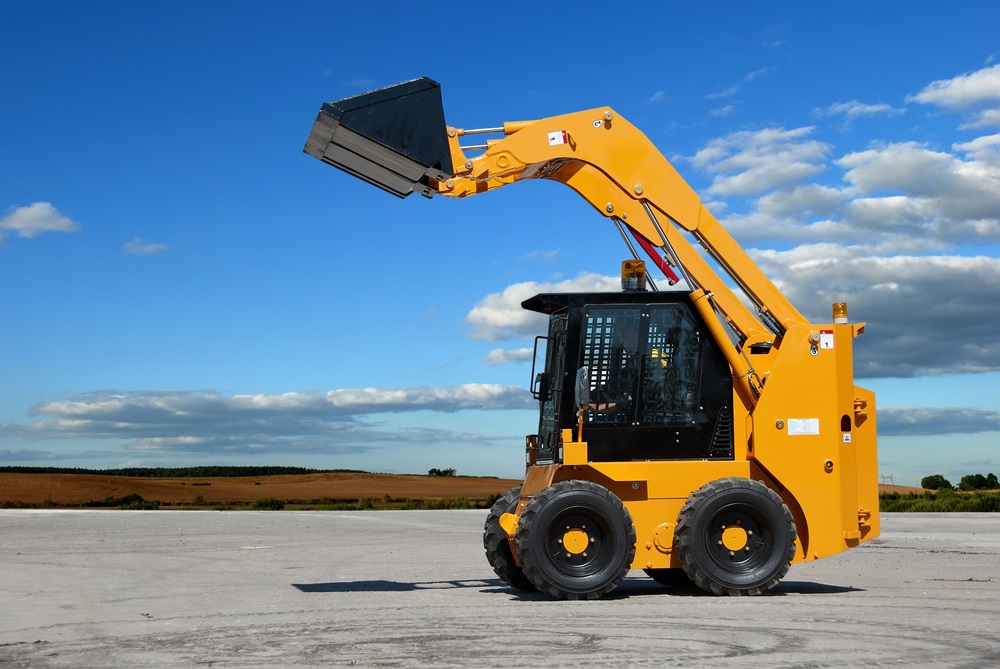
When you snap a set of skid steer pallet forks onto the front of your machine, you instantly transform a standard dirt-pusher into a highly maneuverable, heavy-lifting workhorse. Honestly, in tight indoor spaces, this setup can often out maneuver a traditional forklift.
Whether you are carefully stacking fragile inventory, unloading delivery trucks in the pouring rain, or hauling awkward building materials across a bumpy yard, knowing how to handle this equipment makes all the difference. Let’s break down some practical, real-world tips for getting the most out of your setup while making sure everyone makes it home safe at the end of the shift.
Getting the Most Out of Your Skid Steer Pallet Forks
If you want to speed up your daily operations, adding skid steer pallet forks is a no-brainer. Think about how much time gets wasted trying to muscle things around with manual pallet jacks or waiting for the one working forklift to free up. Unlike a bulky bucket, a good set of forks lets your operator slide cleanly right under a loaded pallet. You lift, shift, and stack without ever messing with the packaging.
In a fast-paced distribution center, saving a few minutes on every truck unloading process adds up to massive labor savings by the end of the week. Plus, you’re saving your workers’ backs. The beauty of this setup is the raw versatility.
You can take a load straight from an indoor warehouse rack, drive it across a rough gravel lot, and load it directly onto a flatbed. Try doing that with a standard warehouse forklift without getting stuck in the mud. Investing in the right skid steer attachments completely changes how you handle your supply chain.
- Ditch the heavy lifting: Replacing manual pushing and lifting with machine power drastically speeds up how fast you load and unload trucks.
- Handle delicate stuff with care: You can safely move sensitive products without shifting the load around—just glide right underneath and lift.
- Go anywhere on the lot: Your machine seamlessly goes from tight indoor warehouse aisles right out into the messy, unpaved outdoor yard without skipping a beat.
How to Pick the Perfect Skid Steer Loaders Attachment
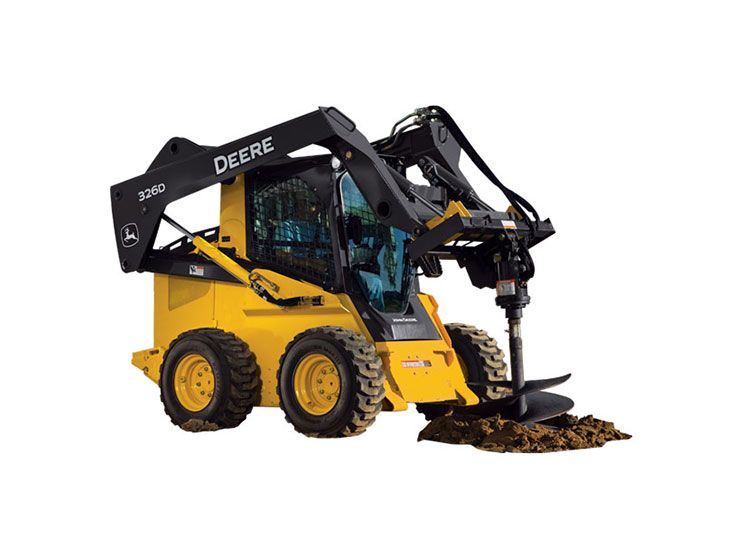
Don’t just go out and buy the first set of forks you find online. Finding the right skid steer loaders attachment takes a little bit of homework about your specific workspace. Most guys go for the universal styles because they use the Skid Steer Quick Attach (SSQA) system. This is great because it means the forks will fit almost any modern loader you have in your fleet.
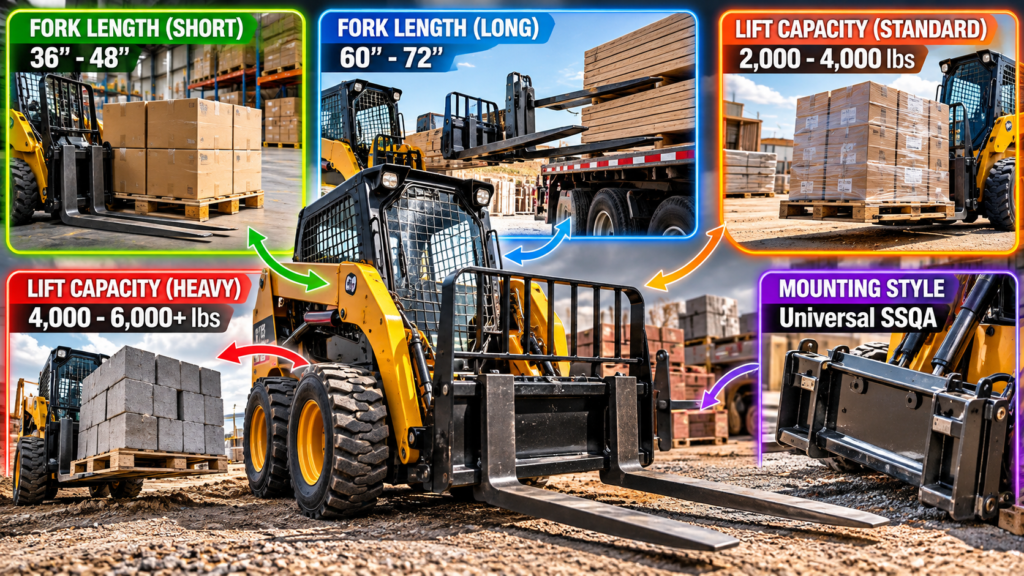
But you really need to look at the specs. How long do the forks need to be? How much weight are you actually lifting on a Tuesday afternoon? Standard forks usually run anywhere from 36 to 72 inches. If your warehouse is packed tight, you want shorter forks so you aren’t knocking over racks when you turn.
If you’re pulling massive crates off a semi-truck, you need the extra length. Also, pay close attention to the headache rack—the back frame of the attachment. You want heavy-duty steel back there so a load of pipes doesn’t accidentally slide backward and smash into the cab window.
- Size it for your space: Go with 36 to 48-inch forks if you work in cramped aisles. Save the massive 72-inch forks for big, bulky outdoor materials.
- Don’t skimp on weight capacity: Always buy forks rated for a bit more than your heaviest typical load. Standard ones handle between 2,000 and 6,000 pounds. Don’t risk snapping a tine.
- Check the backrest design: Look for solid, reinforced steel frames with a good front grid to physically block stuff from tumbling back onto the machine.
Table: Skid Steer Pallet Forks
| What to Look For | The Typical Specs | Where It Works Best |
| Fork Length (Short) | 36″ – 48″ | Cramped warehouse aisles, normal pallets, quick turns. |
| Fork Length (Long) | 60″ – 72″ | Reaching across flatbeds, moving oversized or weirdly shaped loads. |
| Lift Capacity (Standard) | 2,000 – 4,000 lbs | Everyday warehouse goods, retail boxes, light manufacturing. |
| Lift Capacity (Heavy) | 4,000 – 6,000+ lbs | Brick, concrete blocks, heavy machinery parts. |
| Mounting Style | Universal SSQA | Any yard that runs multiple different brands of skid steer loaders. |
Warehouse Safety Rules You Actually Need to Follow
We’ve all seen those crazy warehouse fail videos on the internet. They might be funny on a phone screen, but dealing with a flipped machine or a crushed inventory rack is a nightmare in real life. Running heavy machinery indoors means you have to be totally dialed into safety. The space is tight, people are walking around, and a skid steer moves fast.
The biggest thing to remember with skid steer pallet forks is your center of gravity. It is wildly easy to get overconfident, lift a heavy pallet way too high, hit the brakes, and suddenly find your machine tipping forward. It happens fast. You have to keep the load low while you drive. And before anyone even turns the key in the morning, they need to do a walk-around. Look for cracked metal. Make sure the quick-attach pins are actually pushed all the way down. Building a culture where guys don’t cut corners is the only way to protect your crew and your gear.
- Keep it low to the floor: Whenever you are driving, keep those forks a few inches off the ground. A low center of gravity keeps the machine planted firmly.
- Do the morning walk-around: Check the metal frame, the tines, and the locking levers before you start. Catching a cracked weld early prevents disasters.
- Balance is everything: Make sure the weight on your pallet is spread out evenly across both forks before you try to lift it.
Keeping Your Skid Steer Attachments Alive and Kicking
Equipment is expensive, and waiting on replacement parts while a machine sits broken in the corner is incredibly frustrating. If you want your gear to last, you have to do the dirty work of maintaining your skid steer attachments. Lifting heavy pallets day in and day out puts a crazy amount of stress on the steel carriage and the forks themselves.
It’s really not that complicated, but you have to be consistent. Make sure the sliding rails stay clean so the forks can actually move when you need to adjust them for a weirdly shaped pallet. Keep everything greased up. Pay special attention to the mounting plates. If the quick-attach points get packed with hardened mud or warehouse debris, the skid steer attachment won’t lock on right, and you risk dropping the whole setup. Treat the attachment as well as you treat the engine of the loader, and it’ll pay for itself ten times over.
- Read the manual (seriously): Don’t guess. Follow what the manufacturer says for maintenance schedules and absolute weight limits.
- Grease is your best friend: Keep those carriage rails and adjustable pins lubricated so you aren’t fighting the machine just to widen the forks.
- Clean the hookups: Every single day, check the quick-attach mounting plate to make sure dirt and grime aren’t keeping the locking levers from closing tightly.
FAQs About Skid Steer Pallet Forks
How high can you actually lift stuff with skid steer pallet forks?
It depends on the machine, but most standard skid steers will get a pallet up to about 9 to 12 feet in the air. If you have a specific extended-reach model, you might hit 14 feet. If your warehouse racks are taller than 15 feet, you should probably skip the skid steer and look into buying a dedicated high-reach forklift.
How much weight can a normal skid steer handle with forks?
Your lifting limit is tied directly to the machine’s Rated Operating Capacity (ROC). A mid-sized skid steer can usually handle anywhere from 1,200 to about 3,500 pounds safely. The big track loaders can easily push 5,000 pounds. Just check the door sticker on your machine, and remember that the weight of the attachment itself counts against your total limit.
Do the forks adjust for different pallet sizes?
Yeah, absolutely. Good skid steer pallet forks have sliding tines. You just flip a latch or pull a pin, and you can manually slide the metal forks left or right along the main frame. This is a lifesaver when you go from lifting a standard wooden pallet to grabbing a wide, custom-built shipping crate.
What does maintenance actually look like for these?
It’s mostly common sense. Walk around and look for cracked metal or bent forks. Keep the rail system wiped down and slightly greased so the forks don’t bind up when you try to slide them. And make sure your locking levers aren’t jammed with rust or dirt.
Can I lift things that aren’t on a pallet?
People do it all the time, though you have to be careful. Guys use them to move bundles of PVC pipe, massive landscaping rocks, or even heavy appliances. You just have to make sure whatever you are lifting is balanced and secured so it doesn’t slide off and smash into the ground.
Why does everyone call them “universal” forks?
They get that name because they are built to fit the SSQA (Skid Steer Quick Attach) system. It’s pretty much the industry standard now. That means you can take a skid steer loaders attachment off a Bobcat and snap it right onto a John Deere or a Caterpillar without buying any extra adapters.
Should I just buy a telehandler instead?
If you spend your whole day lifting heavy pallets up to second-story scaffolding or racks that are 20 feet high, yes, get a telehandler. But if 90% of your work is ground level up to about 10 feet, standard skid steer pallet forks are way faster, turn tighter in a warehouse, and cost a fraction of the price.