Skid Steer Rental Pricing: Rates, Insurance, and Terms That Work
Anyone who has ever spent a Saturday morning staring down twenty yards of crushed gravel knows the exact second a shovel stops making sense. You need real hydraulic power, and you need it fast. But stepping onto a commercial rental yard without a clear game plan can bleed a project dry before the machine even rolls off the trailer then the best option is to learn skid steer rental pricing and opting for the best decision.
Between tiered rate sheets, fuel stipulations, delivery surcharges, and confusing waiver options, understanding realistic skid steer rental pricing is the difference between keeping your job profitable and swallowing hundreds of dollars in avoidable surprise fees.
At skidsteerloader.org, we talk to contractors, arborists, and weekend property owners every single day who find themselves blindsided by equipment invoices. Renting machinery shouldn’t feel like negotiating a car purchase in the dark.
Once you pull back the curtain on how rental yards calculate equipment wear, operating hours, and liability, you can easily negotiate terms that protect your wallet. This breakdown cuts straight through the counter jargon to give you the honest numbers, hidden terms, and operational strategies you need to price your next machine rental with absolute confidence.
Breaking Down Standard Rental Rates and Timeframes
Rental houses run on clockwork math, and the easiest mistake you can make is picking the wrong billing bracket. Most yards publish rates across three basic tiers: daily, weekly, and four-week monthly terms.
A standard daily rate buys you a 24-hour possession window, but take a close look at the machine’s hour meter: you are almost always capped at eight running engine hours per day. Put twelve hours on the clock in a single shift, and you will see extra hourly fees tacked on the moment the machine returns. This operating limitation is a cornerstone of standard skid steer rental pricing that catches first-time renters off guard.
If your job looks like it might spill into a third or fourth day, stop looking at the daily rate altogether. A weekly rental generally costs the equivalent of three full days of rental time while giving you forty billable engine hours spread over seven days. That extra breathing room keeps your crew from cutting corners or rushing dangerous grade work just to beat an afternoon return deadline.
- Daily agreements (8-hour cap): Ideal for emergency line repairs, moving a single gravel drop, or drilling post holes across an average residential lot.
- Weekly commitments (40-hour cap): The most practical sweet spot for small crews handling extensive patio prep, site clearing, or small retention ponds.
- Monthly packages (160-hour cap): Deeply discounted per-day rates designed for long-term construction phases, earthmoving jobs, and seasonal snow clearing.
Machine Frame Sizes and Track Configurations
The physical footprint and lift capacity of the loader you select will set the foundation of your base rate. Broadly speaking, skid steer loaders split into three distinct weight classes: small-frame models under 1,750 pounds of rated operating capacity, mid-frame units between 1,750 and 2,200 pounds, and high-output beasts exceeding 2,200 pounds.
While grabbing the biggest rig on the lot feels reassuring, excessive horsepower burns expensive diesel and drives your daily costs through the roof. Conversely, under-sizing your machine means your tires will spin uselessly trying to break hardpan clay, burning clock time and torching your budget.
You also have to decide between traditional wheeled units and tracked machines. Rubber-tired skid steer loaders cost considerably less to rent per day because tires are relatively cheap for rental yards to replace.
Compact track loaders, while superior in wet mud, soft sand, and finished lawns, run on expensive undercarriage systems with rubber tracks that cost thousands to maintain. Yards build that wear and tear straight into their track loader rates, meaning you will pay a 15% to 30% premium just to have tracks underneath you.
- Small-frame loaders: Best for narrow residential side gates, interior barn cleanouts, and light material shifting where ground clearance is tight.
- Mid-frame loaders: The workhorses of the trade, offering enough breakout force to load high-sided dump trucks without tipping.
- Tracked vs. wheeled: Tires save upfront rental cash on paved hardscape and packed gravel, whereas tracks prevent you from bogging down in soup after a spring downpour.
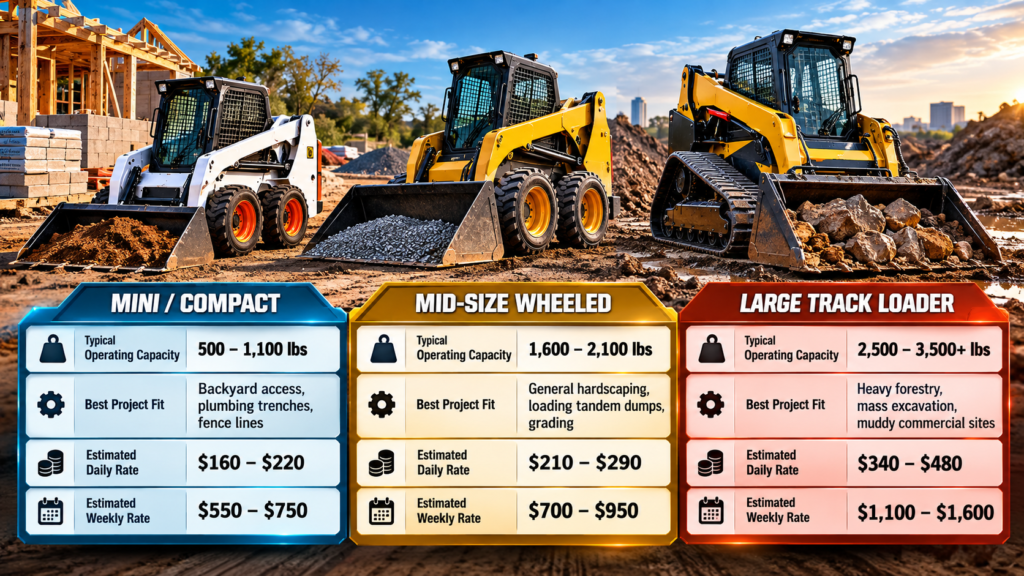
Table: Skid Steer Rental Pricing
| Machine Category | Typical Operating Capacity | Best Project Fit | Estimated Daily Rate | Estimated Weekly Rate |
| Mini / Compact | 500 – 1,100 lbs | Backyard access, plumbing trenches, fence lines | $160 – $220 | $550 – $750 |
| Mid-Size Wheeled | 1,600 – 2,100 lbs | General hardscaping, loading tandem dumps, grading | $210 – $290 | $700 – $950 |
| Large Track Loader | 2,500 – 3,500+ lbs | Heavy forestry, mass excavation, muddy commercial sites | $340 – $480 | $1,100 – $1,600 |
Insurance Requirements and the Damage Waiver Puzzle
Handing over a $45,000 to $90,000 piece of iron requires serious paperwork, and this is where rental companies tighten the screws. If you run a registered contracting outfit, the rental yard will ask for a Certificate of Insurance showing at least $1,000,000 in commercial general liability, along with an inland marine or rented equipment rider listing them as loss payee.
If you are a private property owner or small handyman lacking this specific business policy, you cannot simply skip coverage and drive away.
That leaves you with the yard’s in-house Loss Damage Waiver, typically running an extra 10% to 16% on top of your daily rate. Do not mistake this for real insurance. A damage waiver is simply a contractual promise that the yard will not sue you for repair costs if you accidentally dent a boom arm or scratch the paint.
Read the exclusions with a magnifying glass: almost no waiver covers shredded rubber tracks, punctured tires, burnt electrical harnesses, or roll-over damage caused by outright operator negligence.
- Commercial policy riders: The cheapest route for seasoned builders, allowing you to bypass yard waiver fees entirely by naming the rental branch as an additional insured.
- Loss Damage Waivers (LDW): Essential peace of mind for unbonded operators, protecting your personal finances against catastrophic hydraulic cylinder or boom failure.
- Critical waiver exclusions: Negligence, tip-overs, submerged machines, glass breakage, and tire/track punctures remain your direct financial liability under almost every contract.
Tooling Up: Adding a Skid Steer Loaders Attachment
A loader without tools is just a heavy rolling counterweight. When planning your rental budget, you must treat your tooling as a separate line item. While standard smooth or tooth dirt buckets usually accompany the machine at little to no extra cost, specialized work demands dedicated accessories.
The cost of a skid steer loaders attachment can swing anywhere from fifty bucks a day for simple pallet forks to upwards of four hundred dollars a day for high-flow hydraulic forestry cutters.
This is where planning your workflow saves serious money. If you are clearing land and drilling fifty fence posts, don’t keep an auger and an open grapple sitting idle by your trailer all week.
Schedule your site work in distinct phases. Strip topsoil and dig your post holes on Monday using your rented attachments, return those specific tools early Tuesday morning, and swap over to a standard bucket for the remainder of the week to halt ongoing tool fees.
- Basic mechanical tools: Pallet forks, standard utility buckets, and landscape rakes carry low daily rental tags and rarely run into mechanical trouble.
- Auxiliary hydraulic tools: Augers, hydraulic breakers, and trenchers require standard hydraulic flow lines and carry higher daily rates due to seal wear.
- High-flow monster tools: Cold planers, stump grinders, and brush cutters require high-flow auxiliary systems on the host machine and represent the top tier of tooling costs.
Contract Terms, Transportation, and Hidden Line Items
The base daily quote you hear on the phone is rarely the figure printed at the bottom of the credit card receipt. You need to scrutinize delivery logistics. Unless you own a three-quarter-ton truck paired with a heavy-duty dual-axle trailer and proper load binders, you cannot haul these machines yourself.
Rental yards charge transport based on mileage zones, often billing anywhere from $120 to $300 for a round-trip drop-off and pickup. If the driver arrives and your gate is locked, expect an idle wait-time fee added to your bill.
Then there is the fuel policy. Your loader will arrive with a topped-off diesel tank, and it is your contractual job to hand it back the exact same way. If you return it three gallons shy of full, rental yards will not bill you street fuel prices; they routinely charge $8 to $12 per gallon to have their yard technician top it off. The same logic applies to cleanliness: rolling a loader back onto their yard with six inches of dried clay packed inside the track rollers is an open invitation for a steep pressure-washing fee.
- Round-trip transit fees: Budget heavily for transport unless you hold the proper towing setup, tie-down chains, and DOT-compliant transport permits.
- Fuel surcharge traps: Refuel your rig at a local truck stop using off-road or standard ultra-low sulfur diesel right before pickup to dodge outrageous yard pump fees.
- Return clean standards: Spend fifteen minutes with a spade or pressure washer cleaning out the belly pan, cab footwells, and tracks before the haul truck shows up.
When to Stop Renting: The Case for Owning a Typhon Loader
There comes a point in every growing business or farm management plan where continuous renting becomes an expensive crutch. When you stack up five days of mid-size rental rates, round-trip transport fees, environmental surcharges, attachment costs, and damage waivers, you can easily blow through $2,000 in a single week. Do that four or five times over a single season, and you have burned through the outright down payment of a brand-new compact machine.
That is why we highlight machines like the Typhon Stomp series here at skidsteerloader.org. Rather than burning endless cash on third-party rental yards, owning a dedicated mini loader powered by reliable EPA-certified engines from Honda, Kubota, or Briggs & Stratton puts a permanent, reliable asset in your shop.
You work on your own schedule, skip the weekend counter lines, and build equity in an agile machine capable of running the exact same skid steer attachments you use on the job today.
- Eliminating dead time: Never lose a half-day waiting on a delayed rental flatbed while your paid crew stands around the job site drinking coffee.
- Capital equity: Machine payments build real corporate assets and provide tangible tax write-offs through equipment depreciation rules.
- Universal adaptability: Modern mini loaders take standard quick-attach plates, letting you share tools and buckets seamlessly across your job sites.
FAQs on Skid Steer Rental Pricing
What is the true average cost to rent a skid steer per day?
Base daily rates for standard loaders sit comfortably between $180 and $450 depending on the frame class.
- Compact, stand-on mini loaders run roughly $160 to $230 per day.
- Standard mid-size rubber-tired machines land around $220 to $300 daily.
- Large-frame compact track loaders push between $350 and $480 or more per day.
Can I rent a skid steer without a business insurance policy?
Yes, private individuals and small contractors can rent equipment without an existing commercial policy.
- You will be required to purchase the rental company’s internal Loss Damage Waiver.
- The yard will place a significant pre-authorization hold on your credit card for incidentals.
- Certain high-value commercial machinery may still require verifiable proof of general liability.
Do rental prices include specialized skid steer attachments?
Base machine rental rates almost never include high-end working tools.
- A basic smooth dirt bucket is generally included at no additional charge.
- Common mechanical tools like pallet forks add $30 to $60 to your daily tab.
- Complex hydraulic units like post-hole augers and trenchers add $80 to $180 per day.
Why are tracked skid steers so much more expensive to rent than wheeled models?
Track assemblies carry drastically higher maintenance, rebuild, and parts costs for the rental branch.
- Rubber tracks wear quickly on rocky soil, curbs, and hot asphalt.
- Sprockets, idler wheels, and track rollers require frequent teardowns and greasing.
- Yards pass these elevated wear-and-tear operational expenses directly along in their daily rates.
What are the most common hidden fees on a rental invoice?
Rental quotes routinely leave out secondary line items that appear on the final receipt.
- Environmental compliance charges and mandatory tire disposal surcharges.
- Loss Damage Waiver fees running 10% to 16% of the machine’s base cost.
- Outrageous fuel replenishment penalties if the diesel tank isn’t topped off upon return.
What should I do if a rented skid steer breaks down on my job site?
Stop operating immediately, turn off the ignition, and contact your rental dispatcher without delay.
- Never attempt internal engine repairs or bypass hydraulic safeties yourself.
- Take time-stamped photos of any mechanical alerts, blown hoses, or engine error codes.
- Reputable yards will dispatch a mobile service truck or swap the machine while crediting lost downtime.
How many hours am I legally allowed to put on a rental machine?
Billing periods dictate strict limits on total engine run time.
- A single-day rental strictly allows up to 8 billable engine meter hours.
- A weekly rental contract includes up to 40 operating hours over 7 days.
- Exceeding these meter caps results in steep overtime rates billed per extra hour.