Buying Skid Steer Loader Checklist: Questions to Ask Before You Buy
Let’s be honest for a second—buying skid steer loader a heavy equipment isn’t exactly something you do on a whim. You are putting some serious capital on the line, and the machine you choose is going to dictate how smoothly your job sites run for the next decade.
Here at skidsteerloader.org, we talk to contractors, farmers, and landscaping pros every single day who are trying to cut through the marketing noise. It’s incredibly easy to get lost in glossy brochures, confusing spec sheets, and high-pressure dealership pitches. But here is the reality of the situation: buying skid steer loader the wrong machine doesn’t just drain your bank account; it actively tanks your daily worksite productivity. You need a rock-solid game plan before you even think about signing any financing paperwork.
Skid steer loaders are arguably the most versatile machines you can put on a trailer, acting as the absolute backbone for countless industries. But navigating the modern market requires you to ask some tough, highly specific questions. To help you avoid making a five-figure mistake, we’ve put together a completely no-nonsense buying checklist. We are going to break down everything from hydraulic flow rates to operating capacities so you can buy with total confidence.
What Are Your Core Project Applications?
Before you start looking at horsepower numbers or arguing over which brand paints their equipment the best color, you have to figure out exactly what you’ll be doing with this machine day in and day out.
Every single job site has its own set of headaches. Are you going to be scraping up concrete on a perfectly paved commercial demolition site, or are you trying to grade a muddy, uneven backyard for a new patio installation? Understanding your actual daily grind is the only way to narrow down the playing field. Buying a massive machine for residential fence work is just as bad as buying a tiny, underpowered unit to load massive dump trucks. You have to match the iron to the dirt.
- Pinpoint your primary daily tasks: Sit down and literally write out the top three things this machine will do. If it’s heavy lifting, you need reach; if it’s trenching, you need hydraulic muscle.
- Take a hard look at your terrain: Think about where the rubber meets the road. Hard surfaces love traditional tires, while soft, sloppy, or sandy grounds almost always demand a compact track setup so you don’t spend half your day stuck in the mud.
- Measure your tightest choke points: Get a tape measure and check the residential gates, alleyways, and trailer widths you deal with regularly. A machine that is two inches too wide to fit into a backyard is completely useless to a landscaper.
How Much Lift Capacity and Size Do You Really Need?
When you are looking at skid steer loaders, size and lifting capacity go hand in hand. In the equipment world, we talk a lot about Rated Operating Capacity, or ROC. This number isn’t just a suggestion; it is the absolute maximum amount of weight the machine can safely handle without getting tippy or putting your operator in danger.
The industry basically breaks these machines down into small, medium, and large frames. If you are doing interior demo work, a small frame is your best friend. But if you are moving massive pallets of retaining wall block or pushing heavy wet snow in commercial lots, you have to step up to a large frame. Getting this wrong means you’ll either be nervously balancing heavy loads on two wheels or watching a massive machine sit idle because it can’t fit where you need it to go.
- Do the math on your heaviest loads: Figure out the heaviest thing you lift on a normal Tuesday—like a full pallet of sod—and make sure the machine’s ROC gives you a comfortable buffer above that weight.
- Pick the right lifting geometry: You need to choose between a radial lift (which swings in an arc and is awesome for digging and ground work) and a vertical lift (which goes straight up and is perfect for loading tall trucks).
- Factor in your hauling situation: Don’t forget that a heavier machine requires a heavier trailer and a bigger truck to pull it. Upgrading your loader might accidentally force you to upgrade your entire towing rig.
Are the Hydraulics Powerful Enough for Your Needs?
If the engine is the heart of the machine, the hydraulic system is the nervous system. This is where a lot of first-time buyers totally drop the ball. They look at the engine horsepower and assume the machine can run anything. That is a massive mistake. Standard flow hydraulics are perfectly fine if you just want to run a dirt bucket, a set of forks, or a basic grapple. But what happens if you want to run a cold planer to mill asphalt, a massive snow blower, or a forestry mulcher? Those tools demand an insane amount of continuous hydraulic power, meaning you absolutely must have a high-flow hydraulic system installed straight from the factory. Upgrading standard flow to high flow later on is either impossible or ridiculously expensive.
- Match your gallons per minute (GPM): Always cross-check the hydraulic flow rate of the loader against the specific requirements printed on the side of the tools you want to run.
- Don’t box yourself in for the future: Even if you don’t need high flow right this second, it might be worth the upfront investment if you plan on expanding your business services in a year or two.
- Inspect the physical hookups: Take a look at the quick-disconnect couplers on the boom. You want flat-faced, easy-to-clean couplers that won’t leave your operators covered in hydraulic fluid every time they swap a tool.
What Skid Steer Attachments Will You Utilize?
The entire reason these machines are so incredibly popular is that they are basically the Swiss Army knives of the construction world. By simply dropping one tool and hooking up another, your earth-mover instantly turns into a street sweeper, a forklift, or a post-hole digger.
Buying skid steer loader, the right skid steer attachments is arguably just as important as buying the machine itself. The right tool turns a three-day manual labor nightmare into a quick afternoon job. However, you have to make sure you aren’t getting locked into a weird, brand-specific ecosystem. Having the freedom to rent, borrow, or buy used tools requires a universal hookup. A single, well-chosen skid steer loaders attachment can open up entirely new revenue streams for your contracting business.
- Demand a universal mounting plate: Ensure the machine uses a standard, universal quick-attach system. If a dealer tries to sell you a proprietary hookup, walk away immediately.
- Map out your starting lineup: Figure out the exact tools you need on day one to keep your business running, and don’t get distracted by shiny tools you’ll only use once a year.
- Think about operator convenience: Decide if you want a manual locking lever that requires the operator to step out in the mud, or a hydraulic quick-attach that lets them lock in the tool from the comfort of the cab.
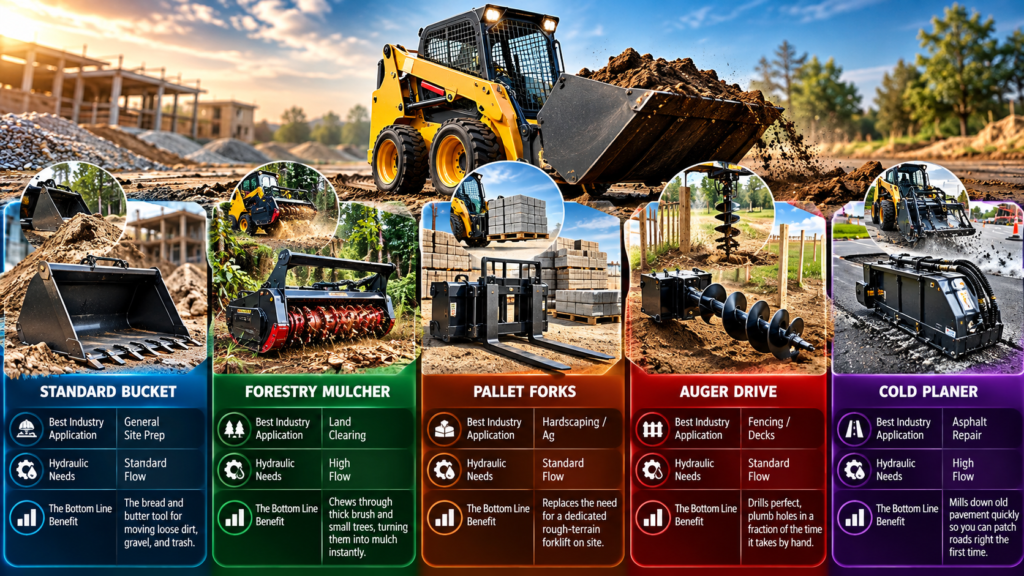
Table: Buying skid steer loader checklist
| Attachment Type | Best Industry Application | Hydraulic Needs | The Bottom Line Benefit |
| Standard Bucket | General Site Prep | Standard Flow | The bread and butter tool for moving loose dirt, gravel, and trash. |
| Forestry Mulcher | Land Clearing | High Flow | Chews through thick brush and small trees, turning them into mulch instantly. |
| Pallet Forks | Hardscaping / Ag | Standard Flow | Replaces the need for a dedicated rough-terrain forklift on site. |
| Auger Drive | Fencing / Decks | Standard Flow | Drills perfect, plumb holes in a fraction of the time it takes by hand. |
| Cold Planer | Asphalt Repair | High Flow | Mills down old pavement quickly so you can patch roads right the first time. |
Should You Buy New or Used Equipment?
This is the great debate that keeps business owners awake at night. Do you take the financial hit on depreciation to get that shiny new machine smell, or do you roll the dice on the used market to save cash? Brand-new skid steer loaders give you incredible peace of mind.
You get a factory warranty, the latest creature comforts inside the cab, and better fuel efficiency. But that monthly payment can be tough to swallow during the slow winter months.
Buying used can literally save you tens of thousands of dollars, freeing up cash to buy more tools or hire more guys. But a used machine with a shady maintenance history can quickly turn into a money pit that spends more time in the shop than out making you money.
- Crunch your realistic numbers: Look hard at your cash flow. Sometimes the higher payment of a new machine is actually cheaper than fixing a blown hydrostatic drive on a used rig.
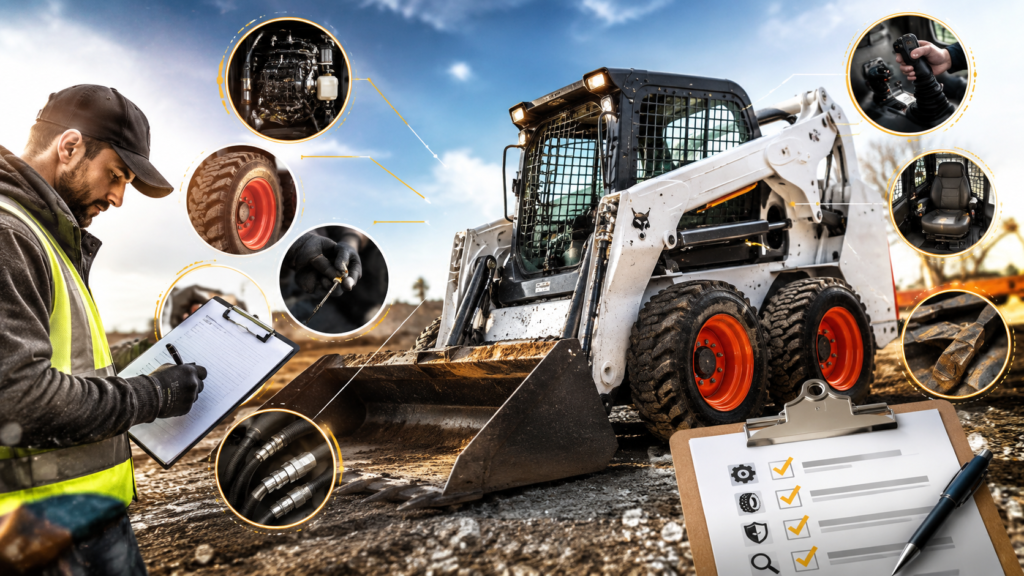
- Become a temporary detective: If you go used, demand the service logs. Look for cracked welds on the loader arms, check the pins for sloppy movement, and smell the hydraulic fluid for a burnt odor.
- Weigh the value of operator comfort: Newer machines have sealed, pressurized cabs with amazing A/C, Bluetooth radios, and backup cameras. A comfortable operator is a highly productive operator.
What Post-Purchase Support and Maintenance is Available?
You can buy the toughest piece of iron on the planet, but eventually, something is going to break. It’s just the nature of the construction business. When you are standing in a foot of mud with a machine that won’t start and a client breathing down your neck, your relationship with your dealer becomes the most important thing in your life.
Do not buy a machine from a dealership that treats you like a stranger after the check clears. You need to know exactly what happens when things go sideways. If you have to wait three weeks for a proprietary sensor to ship from halfway across the world, you are going to lose money, and potentially lose the job entirely.
- Interrogate the parts department: Ask them point-blank what their shelf stock looks like for routine wear items like filters, tracks, and hydraulic hoses.
- Decode the warranty coverage: Don’t just accept that it has a “three-year warranty.” Find out what voids it, what the deductible is, and if travel time for mechanics is covered.
- Demand mobile field service: You want a dealer who has service trucks that can come directly to your job site to fix the issue in the dirt, rather than forcing you to drag a dead machine across town.
FAQs About Buying Skid Steers
How many hours is considered too much for a used skid steer?
Once a machine crosses the 4,000 to 5,000-hour line, it’s generally considered high hours. But here is the catch: I would much rather buy a 5,000-hour machine from an owner-operator who obsessively greased the pins and changed the oil than a 2,000-hour machine that was beaten to death by a dozen different rental yard customers. Maintenance records beat the hour meter every time.
What is the difference between a radial lift and vertical lift?
Think about how the arms move. A radial lift swings up in an arc, meaning it has the furthest reach right at truck-bed height or ground level, making it awesome for digging and grading. A vertical lift linkage keeps the load closer to the machine as it goes up, and it shines when you need to lift heavy pallets straight up high to load over the sides of tall dump trucks.
Wheels vs. tracks: which is actually better?
Neither is “better”—they just do different jobs. Wheeled machines are fantastic on hard surfaces like concrete or asphalt; they run faster and the tires are way cheaper to replace. Tracked loaders (CTLs) dominate in mud, soft sand, and uneven hills because they float over the junk and give you crazy good pushing traction.
Do I need a special license to operate one?
In the US, you don’t need a state-issued CDL to run one on a private site. But do not let that fool you into thinking it’s a free-for-all. OSHA requires employers to formally train, evaluate, and certify their operators. If someone gets hurt and you don’t have that training documented, you are going to be in a world of legal trouble.
How much do new skid steer loaders actually cost today?
Sticker shock is real right now. A totally bare-bones, small-frame machine might run you between $30,000 and $45,000. But if you want a massive, large-frame beast with high flow, a sealed cab, ride control, and a fancy display screen, you can easily blow past $80,000 and push into the six-figure territory.
Why is operating capacity more important than horsepower?
Horsepower tells you how fast you can do the work, but Rated Operating Capacity (ROC) tells you if you can actually lift the weight without tipping the machine on its nose. If your ROC is too low for the pallets you handle, having 100 horsepower won’t save you from face-planting into the dirt.
How long do these machines typically last on average?
If you don’t treat it like a rental and you actually keep up with the preventative maintenance schedules, you can easily squeeze 5,000 to 8,000 hours out of a good machine before it needs a major engine or hydro rebuild. For a guy putting 500 hours a year on it, that’s over a decade of hard work.
Wrapping It All Up – Buying Skid Steer Loader
Pulling the trigger on heavy machinery is a massive milestone for any business, whether you are running a two-man landscaping crew or a massive civil construction firm. If you stick to this checklist, you are protecting your cash flow and ensuring the iron you buy actually makes your life easier.
Figure out what materials you move the most, don’t skimp on the hydraulic flow if you plan to grow, and build out a solid arsenal of skid steer attachments to keep the machine busy all year long. At the end of the day, a good dealer and a solid maintenance habit will keep your crew moving dirt instead of turning wrenches.