Make Money with a Skid Steer: 7 High-Paying Side Hustles
In today’s world, adaptability, productivity, and quick physical problem-solving skills are the upmost value, making heavy machinery ownership a highly profitable path. If you want a dependable way to increase your earnings, learning how to make money with a skid steer is one of the easiest and best-paid side jobs you can get into right now.
These small, nimble machines are the hidden champions of construction, farming, and property maintenance, enabling one person to do the equivalent of a whole manual crew’s work in a very short time.
Why is it important to have a Side Hustle and Make Money with a Skid Steer?
Since lots of homeowners and small businesses neither have the budget nor the space for owning the heavy equipment, they end up paying the independent operators who can get there and do tough jobs very quickly at premium rates. By using the machine efficiently, you can turn hardware in a very profitable business based on independent operation.
To fully unlock your financial potential and figure out how to make money with a skid steer, you need to recognize that your machine is not simply a vehicle but a tool carrier capable of numerous roles. Its real strength lies in the very versatile quick-attach system, so you can change tools in minutes to get ready for an extremely wide range of profitable jobs.
You can make the most money no matter if you are running a wheeled unit on smooth asphalt or a tough tracked loader over muddy terrain, because the key is your adaptability.
This detailed guide will help you learn the seven best money-making side hustles that will increase your cash flow, while at the same time, you will learn about required equipment, how to do the job, and safety considerations you cannot overlook.
Top 7 Ways High-Paying Side Hustles with a Skid Steer
1. Professional Landscaping and Site Grading Services
Development of residential and commercial properties is an extremely profitable industry where site preparation is always necessary. Property owners and construction companies are always in need of precise earthmoving, making landscaping and grading two of the best ways to make money with a skid steer.
An experienced operator can, within only a few hours, change a patch of rough and uneven ground into a perfectly smooth one, ready for laying of grass, building foundations, or installation of drainage systems.
The main objective when grading is to control the flow of water and provide solid bases. Selecting proper loader horsepower guarantees that you will have enough force to push through hard clay and heavy topsoil without the engine stalling.
This is the reason why clients pay well for an operator who is skilled in making slopes and levels properly, as badly graded land results in foundation rot and water pooling.
- Key Tools: A standard dirt bucket for heavy digging, a hydraulic four-in-one bucket for grabbing and scraping, and a landscaping raking attachment specially designed to pick up stones and debris from roots.
- Charges: Per hour rates from $120 to $180, or for residential sites, flat-rate contracts from $1,500 to $3,500 based on total square footage and volume of materials.
- Operator Advice: Before excavation, always locate underground utilities with the help of local service lines; this precaution will save you from great damage. Besides, check load charts of machines to uphold perfect stability on steep residential slopes.
2. Residential and Commercial Snow Removal Contracts
When winter storms bring snow, many businesses and residential complexes become inaccessible and open to accident liabilities. Seasonal snow removal service is a prime means to make money with a skid steer while the construction season is off, as well as, it is a way to fell high-paying and high-priority emergency contracts.
Furthermore, compact loaders are capable of 360 degrees turns within their own footprints, so they are highly efficient for snow clearing of small parking lots, winding driveways, and narrow alleys where huge city snowplows just cannot reach.
Efficiency in this sector of business is heavily dependent on quickness, dependability, and correct installation of equipment changes for poor weather. Operators often switch from wheels to caterpillar tracks or winter tires when they need to have better grip on slippery surfaces. By securing annual commercial contracts before the arrival of first snow, you set yourself up for steady revenue stream that will quickly repay your machine’s operating costs.
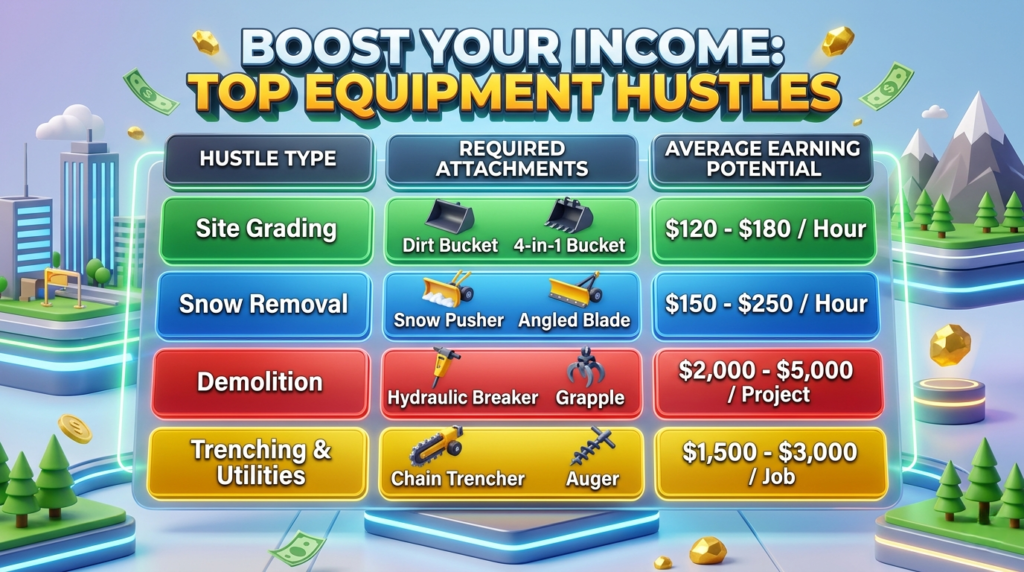
Table: Side Hustle Examples to Make Money with a Skid Steer
| Hustle Type | Primary Attachments Needed | Average Earning Potential |
| Site Grading | Dirt Bucket, 4-in-1 Bucket | $120 – $180 / Hour |
| Snow Removal | Snow Pusher, Angled Blade | $150 – $250 / Hour |
| Demolition | Hydraulic Breaker, Grapple | $2,000 – $5,000 / Project |
| Trenching & Utilities | Chain Trencher, Auger | $1,500 – $3,000 / Job |
- Key Equipments: Heavy-duty snow pusher boxes to remove enormous volumes of snow, angled plow blades to create rows, and hydraulic salt spreader for ice control.
- Pricing Model: For parking lots, monthly commercial retainer fees begin at $2,000, or charge per-event rates $150 to $250 per hour during blizzards.
- Professional Tip: During the fall, mark all virtually invisible curbs, fire hydrants, and landscaping islands with very visible colored stakes to be able to operate safely on the property when completely covered by large snow drifts.
3. Small-Scale Demolition and Debris Removal
Sheds, detached garages, concrete slab patios, or wooden decks all have limited lifespan and may even pose a problem for suburban properties as they require heavy manual effort for dismantling and removal. You only have to make money with a skid steer by advertising yourself as mechanized demolition and clean-up specialist.
Homeowners, in particular, prefer an independent operator with a compact loader against large demolition crews simply because your equipment causes the least disturbance to the ground while accomplishing the pull-down in one afternoon.
Demolition side hustles really require you to know the machines very well and feel the working environments. Breaking structures down produce unseen falling hazards, so your machine as a minimum must be equipped with structures certified and designed in protecting the operating cab.
You will be probably packing roll-off dumpsters with debris after you have mutlipleely crushed and sorted them, this way you will save thousands of dollars in labor costs for your clients as well as keep the very high margins for your own business.
- Key Tool: Industrial heavy grapple buckets to clamp and haul structural debris, and heavy hydraulic concrete breakers to pulverize old patios, sidewalks, and pool surrounds.
- Charges: Comprehensive bids covering entire projects at a range of $2,000 to $5,000 per residential demolition structure are great, but always face your local landfill disposal fees when quoting prices.
- Operating Tip: Polycarbonate windows and special debris guards over cooling radiators help protect your machine against flying concrete pieces, rebar going rogue, and splinters of wood during demolition operations.
4. Trenching, Excavation, and Utility Line Prep
Irrigation system installation, home construction, and backyard utility development projects all require trenches making for laying pipes, electrical cables, and drainage systems. Offering these specialized services gains you a high level of expertise and a very profitable masketing opportunities to make money with a skid steer.
Many contractors and homeowners continuously need to trench for electrical cables, water mains, fiber-optic cables, and French drains to manage stormwater effectively.
When you work in utility installations, accuracy and maintaining same depth throughout the trench are much more important than being fast. Having the right tools helps you cut through even heavily-compacted and rocky areas to make neat trenches without having to deal with the destruction of the manual digging.
Due to the fact that this work is related to buildings, it is extremely important to maintain good visibility and control of your machine at all times to comply with the local building codes concerning digging depths.
- Key Tools: High-torque planetary drive augers for boring structural footers, heavy-duty chain trenchers capable of reaching depths down to 48 inches, and compact backhoe arms for detailed excavation.
- Pricing Strategy: Charge an industry standard rate of $3.50 to $7.00 per linear foot dug, or maintain a standard flat daily machine operational rate of $1,200 to $1,500 plus transportation fees.
- Guide Tip: Never run a hydraulic system without the protection of the interlocking system provided on the machine. Also, always keep utter communication with the spotter whenever you are digging in close proximity to existing infrastructure.
5. Post Hole Boring and Commercial Fencing Installation
Fencing is a must-have for anyone who deals with land management, residential or commercial security. As manual hole digging is so arduous, many times it is easy make money with a skid steer by just partnering up with local fence builders or farmers that need cattle fencing.
Your machine’s hydraulic system can drill a perfect 4-foot post hole in less than 30 seconds, effectively turning what manually would have been a week’s work, into a day’s quick operation only.
The repeatability and high volume are what make this side hustle work. You may be doing miles of fencing for a farmer or putting up privacy pickets on a home owner’s property. Your compact loader can exert the constant downward force needed to punch through the hard clay and root layers of the soil. To reach the highest level of productivity you will precisely match the bit to the post size that the client has chosen.
- Key Tools: planetary heavy-duty auger drives, a wide range of auger bits from 6-inch diameter to 24-inch diameter, and specialized hydraulic post-pounder attachments for metal T-posts.
- Price Policy: You can set your rate from $25 to $45 for every post hole bored or negotiate comprehensive fencing contracts varying from $25 to $60 per linear foot based on the material types.
- Pro Line: It is very crucial to look at your vertical level gauge very frequently during the boring process as this will enable you to get perfectly plumb holes for your posts each and every time. This way, you can avoid the common issue of crooked fences which not only are an eyesore but also compromise the structural integrity.
6. Forestry Mulching, Land Clearing, and Brush Management
Wild, unmaintained acreages, invasive species, and dense undergrowth significantly lower property values and also pose a great hazard to wildfires throughout rural areas. Property owners are always searching for those who understand how to make money with a skid steer by providing forest mulching and brush management services.
Unlike traditional land clearing when bulldozers remove the root systems and cause large piles of debris for burning, a mulching head quickly chiptrs the standing trees and brush into a nice, naturally beneficial, ground cover layer.
Forestry mulching is one of the highest paying side hustles out there but it requires a high-horsepower machine with excellent hydraulic flows. The cutting drums (high RPMs) require an uninterrupted power of the highest magnitude in order to grind down hardwoods without giving the loader’s engine a chance to overheat.
Real estate developers preparing lots, park departments maintaining hiking trails, and utility companies keeping their right-of-ways clear are all major clientele of this service.
- Key Tools: Forestry mulching heads with high hydraulic flow, industrial brush cutters for tall grass and saplings, heavy-duty tree shears for safely dropping large timber.
- Pricing Strategy: Give market rates of $200 to $300 per hour of operation, or acreage clearing contracts of $1,500 to $3,500 per acre based on vegetation density.
- Insider Advice: You will run into a lot of wood dust and other organic debris during forestry work, so make sure to clean your machine’s engine bay and cooling clusters often over the course of the day.
7. Agricultural Support, Arena Grooming, and Hay Bale Transport
Farmers’ busy days leave zero room for equipment handling delays, so offering agricultural support part-time is a great way to make money with a skid steer. Amongst your potential customers will be equestrian centers, hobby farms, or commercial dairies.
The reason is that large agricultural tractors are just too wide to get into the barn lanes for emptying the stalls or operating inside horse training arenas; thus your skid steer is the perfect solution.
Out of all the services you offer, equestrian facilities are the most profitable clients simply because horse arenas need to be groomed regularly and precisely so that the soil footing is loose and level, which can prevent injuries to even the most highly trained and valuable horses. Lifting round hay bales, moving pallets of feed, or clearing out manure packs from livestock corrals in the height of the harvest are some other ways to make money with your machine.
- Equipment Essentials: Arena drag and conditioner tools, bale spear for round bales, utility buckets equipped with manure tines.
- Charging Strategies: Offer long-term arena maintenance service to equestrian facilities for $500 to $1,200 per month, or price the agricultural equipment operation by the hour at $100 to $140.
- Expert Tip: Always make sure you know where your machine’s center of gravity is and its safe rated operating capacity before you start lifting big loads like round hay bales of wet organic fertilizer.
FAQs – Make Money with a Skid Steer
How much money can you make owning a skid steer?
Owning a skid steer can be really lucrative, with a lone owner-operator able to make anywhere from $75,000 to $150,000 a year in top earning niches like forestry mulching and excavation. How much you make depends a lot on things like demand in your area, which special attachments you use, and your machine’s uptime. Operators who set high hourly rates not only make the investment in their equipment back faster but also reach profitability quicker.
Is a skid steer side hustle profitable after expenses?
Skid steer businesses actually stay quite profitable even after expenses, often reporting net margins as high as 60% to 70% on projects. Diesel fuel, maintenance, and insurance are just the running costs, which you can easily cover by charging typical commercial rates. The smart way to go about is always to factor your equipment depreciation into the price you give to your customers, thus leaving no risk to your profit.
Which is better for a side hustle: a wheeled or tracked skid steer?
Compared to wheeled skid steers, tracked ones normally are put at a higher rate of operation by virtue of the fact that they are more stable and good working even in the muddy or wet conditions. Wheeled ones are perfect on hard surfaces like asphalt, have lower tier costs, but weather conditions especially bad ones might lead to their getting sidelined. If you’d go for the tracked model, you’ll be able to get more days out of your calendar billable and hence extend your working season through early spring and late winter.
What is the highest-paying skid steer attachment to buy first?
The forestry mulcher and the hydraulic grapple bucket are the agents of highest revenue generation according to the users. Mulcher lets you get great rates for land clearing ($200+/hr) as it replaces the functionalities of a whole crew of manual workers. A grapple bucket is the most appropriate first buy for de-molition and storm clean-up jobs if your machine is a standard flow one.
How do I find consistent clients for an equipment side hustle?
One of the best shortcuts to locating clients is to form sub-contractor working ties with locally based home builders, landscapers, and pool builders who might need your services when they are overwhelmed by the workload. Besides that, things like making your business profile on Google Business and showing your work through before-and-after project videos will consistently bring in home owner leads.
Do I need a CDL to haul a skid steer?
Usually, you will not be required to have a commercial driver’s license (CDL) provided the total vehicle weight rating (GVWR) of your truck and trailer combination remains under 26,000 pounds. The typical mid-sized loader along with a dual-axle utility trailer will likely come within legal towing weight for a modern three-quarter-ton truck. Nevertheless, you must always check with your local Department of Transportation for weight limit regulations in order to make sure you are operating within the law whenever transporting equipment.
What type of insurance is mandatory for a skid steer business?
With at least $1 million coverage limit, you should have General Liability Insurance policy which is all-inclusive to cover the possibility of property damage or injury. Besides, through inland marine insurance the owner can protect the physical machine and hydraulic attachments from being stolen or any accidents during transit.