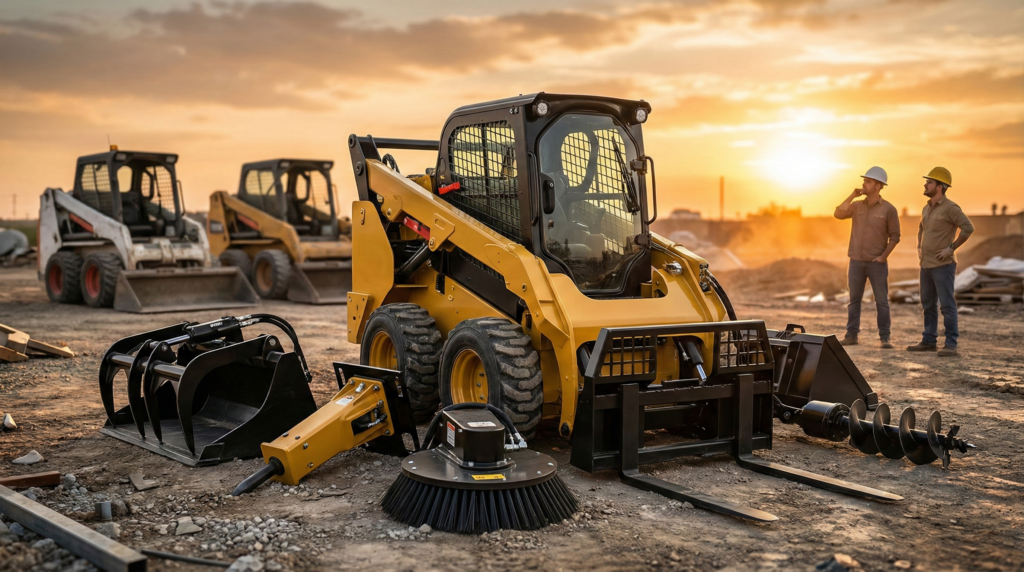
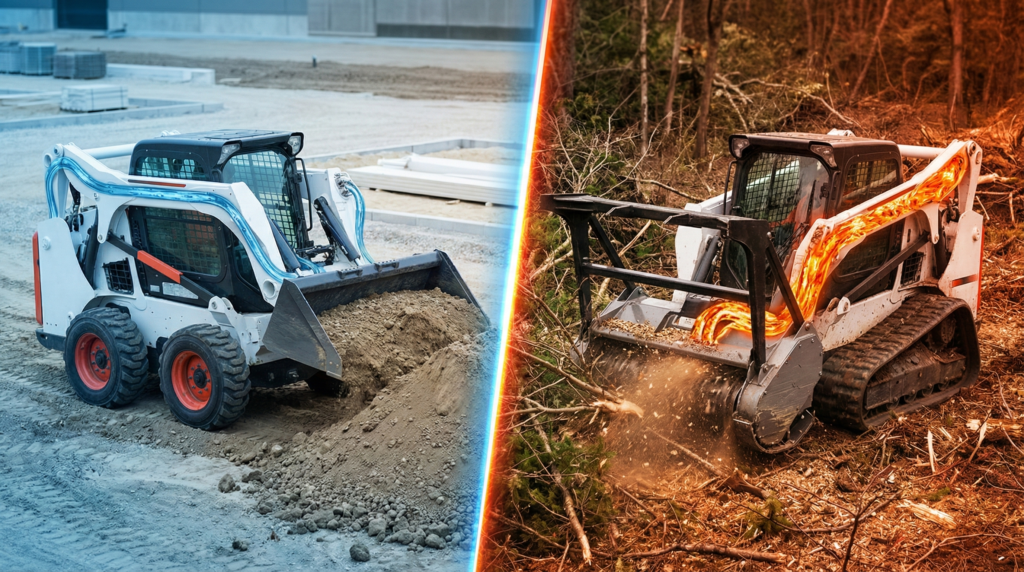
Skid Steer Loaders in Municipal Work: Roads, Parks & Utilities
Municipalities have the significant and continuing responsibility of providing inhabitants with a clean, functioning and attractive environment. City maintenance staff need adaptable, powerful and compact machines to get the job done swiftly, whether it’s pothole-riddled roadways, overgrown community parks, or intricate underground utility repairs. This is when the real benefit of working with skid steer loaders for municipalities becomes very evident.
Nimble, engine-powered workhorses built to maneuver in confined city areas, turn in their own tracks and effortlessly adapt from one duty to a completely other one with a wide variety of specialist attachments. We know that local governments are always looking for ways to get more out of taxpayer dollars without sacrificing the quality of public services.
For municipal fleets, skid steer loaders enable the replacement of many single-purpose equipment with one extremely versatile vehicle, significantly saving long-term maintenance costs and downtime. Skid Steers are the perfect blend of brute strength and finesse, whether you’re cleaning off a mountain of snow from downtown junctions, grading a community sports field or trenching for new water lines.
Roadwork and Street Maintenance Gets a Makeover
Maintaining urban infrastructure is one of the most resource-intensive jobs of any local government, and roadwork and street maintenance are at the top of the list. Municipal work with skid steer loaders totally changes the way road workers approach their everyday job, enabling them to execute intricate asphalt repairs, street sweeping and seasonal snow removal like never before.
Traditional roadwork usually includes large, bulky equipment that takes up several lanes of traffic and disrupts the public. But a skid steer loader can work comfortably in a single lane or on narrow neighborhood streets, using attachments such as cold planers to grind damaged asphalt or sweeper brooms to clean up construction waste.
These vehicles may also be quickly adapted with snowblowers, V-blades and salt spreaders to maintain critical emergency roads and pedestrian pathways safe and open throughout the severe winter months. The flexibility of these little vehicles means that road maintenance staff are never left behind due to weather or changing project demands.
Municipal fleet managers may be certain that the loader they design will be capable of year-round roadway maintenance, with reliable knowledge from skidsteerloader.org.
- Fast Asphalt Milling and Repair: With cold planer attachments, operators may mill damaged asphalt sections precisely to prepare potholes and eroded street margins for repaving right immediately, eliminating the need to bring in heavy, specialist milling equipment.
- Comprehensive Street Sweeping: High-capacity broom and sweeper attachments enable municipal personnel to rapidly collect seasonal debris, gravel and construction trash from streets and sidewalks, avoiding drainage blockages and keeping a tidy urban area.
- Winter Weather Management: With a simple attachment change, a skid steer loader can be converted into a powerful snow removal vehicle, plowing, blowing and salting snow in narrow cul-de-sacs and pedestrian routes where regular snowplow trucks just can’t fit.
| Attachment Type | Primary Municipal Function | Key Operational Benefit |
| Cold Planer | Asphalt milling and pothole repair | Eliminates the need for large, single-use milling machinery |
| Sweeper Broom | Street and sidewalk cleaning | Maintains public cleanliness and prevents storm drain blockages |
| Snow V-Blade | Winter snow clearing | Provides versatile, multi-angle plowing for tight urban streets |
Landscaping Best Practices for Parks & Recreation
Municipalities rank highly on maintaining public parks that are lively, pleasant and safe and landscaping using skid steer loaders makes this much more doable for recreation departments.
Public green areas need ongoing maintenance including soil grading, tree planting, bush cleaning and walkway building. A skid steer loader, especially a small track loader, can traverse fragile lawns, sports fields and golf courses without ripping up the grass or creating deep harmful ruts.
The devices enable small municipal crews to do heavy-duty landscaping jobs that would normally need a lot of human effort or giant, disruptive farm tractors. For instance, when a major storm blows branches and trees down in a municipal park, a skid steer with a grapple attachment may quickly remove the heavy debris and restore public access in record time.
Park maintenance staff can handle many landscaping difficulties non-stop throughout the workday because the ability to move from a grading bucket to a root grapple or a stump grinder in just minutes is explained by the resources at skidsteerloader.org.
- huge Duty Debris and Brush Clearing: Sturdy grapple attachments allow operators to effortlessly lift, carry and stack huge tree branches, storm debris and heavy brush to maintain community parks clean and safe for public use.
- Precision Soil Grading and Leveling: Park staff can perfectly level soil for new sports fields, playgrounds or flower beds. With grading bars and specialized landscaping buckets, park personnel ensure optimum water drainage and aesthetic appeal.
- Tree Care and Removal: Attachments such as stump grinders, rotary brush cutters and tree spades let municipal workers securely remove dead trees, grind down trip-hazard stumps and transplant young saplings without employing costly outside arborists.
Optimizing Utility Projects and Subsurface Infrastructure
Underground utilities are the hidden lifeblood of every modern city, but patching and replacing water mains, sewage pipes and electrical conduits in crowded urban settings is notoriously difficult.
Municipal skid steer loader work handles these complicated utility projects with the massive hydraulic breakout force required for excavation, all in a very small footprint. Unlike huge excavators or backhoes that often struggle to move in small alleys or between closely spaced residential structures, a skid steer can readily enter constrained worksites to accomplish crucial digging and trenching.
When a city has to put in new fiber optic cables or repair a damaged water pipe, operators may connect trencher or backhoe implements to their skid steer to dig the required area with precision and little interruption to the infrastructure around it.
Once the utility repair is done, the same equipment may backfill the trench, compress the earth and even help with repaving the surface. The adaptability that is so often addressed on skidsteerloader.org indicates that skid steers aren’t merely surface-level equipment; they are vital instruments for maintaining and extending crucial subterranean municipal services.
- Precision Trenching for Cables and Pipes: High-flow trencher attachments enable utility personnel to slice through difficult, compacted urban soil to put down electrical conduits, fiber optic cables, and water pipes with pinpoint accuracy.
- Confined-Space Excavation: The zero-radius turning of a skid steer enables it to work in small alleyways and cramped residential easements, adding substantial excavation force to situations where standard backhoes cannot be safely operated.
- Easy Backfill and Compacting: Following the utility repairs, operators may utilize buckets and vibratory roller attachments to backfill the dug trenches swiftly and safely compact the dirt, avoiding further ground shifting.
Wheeled and Tracked Models for Urban Environment Navigation
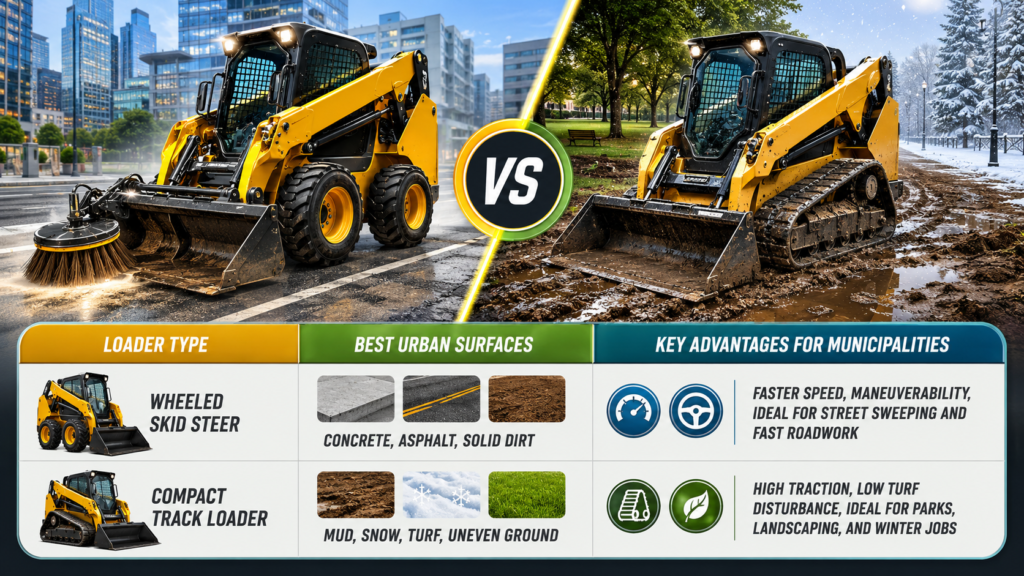
One of the most important choices to be made about new equipment investments by governments is whether to go with a regular wheeled type or a compact track loader (CTL). Both types are very important for maximizing municipal operations with skid steer loaders.
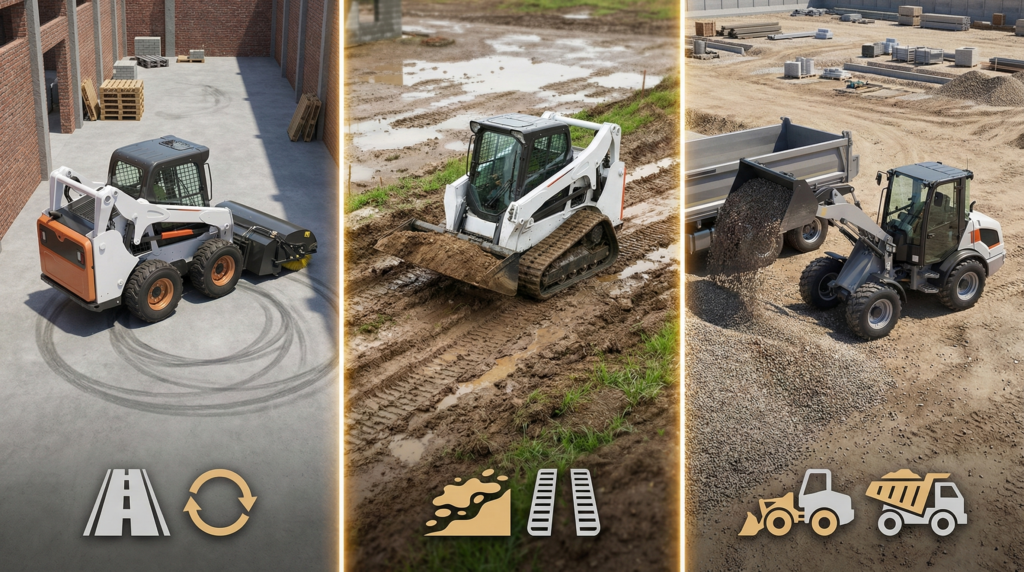
But their varied undercarriages are designed for completely different environmental issues. The wheeled skid steer is the perfect option for street sweeping, road repairs, and warehouse loading, being mobile and agile on solid paved surfaces like asphalt, concrete, and compacted gravel roads. But when those municipal projects go off road to muddy parks, snow-covered paths or soft building sites, compact track loaders are the kings.
Tracks spread the weight of the motorcycle across a considerably greater surface area, giving you unmatched grip and dramatically reducing ground pressure. The floating effect avoids the equipment from sinking into the mud, or damaging the delicate park grass.
At skidsteerloader.org, we constantly tell city fleet managers to really look at their main operating settings before they buy to make sure they get the right mobility type that best fits their most common municipal jobs.
- Wheeled Loaders for Hard Surfaces: Four-wheel-drive units are best for urban pavement, with higher travel speeds, better maneuverability in tight spots and much cheaper maintenance costs when operated largely on concrete and asphalt.
- Tracked Loaders for Soft Terrain: Rubber-tracked CTLs give great grip and stability on uneven, muddy or snowy terrain, making them perfect for off-road park maintenance, forestry work and rainy weather operations.
- Minimize Surface Damage: Compact track loaders balance their weight across a wider footprint, which translates to very low ground pressure and no expensive rutting or surface damage while working on groomed municipal lawns or golf courses.
| Loader Type | Best Urban Surfaces | Key Advantages for Municipalities |
| Wheeled Skid Steer | Concrete, Asphalt, Solid Dirt | Faster speed, maneuverability, ideal for street sweeping and fast roadwork |
| Compact Track Loader | Mud, Snow, Turf, Uneven Ground | High traction, low turf disturbance, ideal for parks, landscaping, and winter jobs |
Versatile Attachments Stretch Fleet Budgets
The universal quick-attach system is the distinctive quality that makes work with skid steer loaders so financially sensible for municipalities. It converts a single machine into an entire fleet of specialized construction vehicles. municipal finances are usually tight and it is not financially viable to buy a particular equipment for each and every municipal maintenance job .
City governments may benefit from great return on investment getting the most out of public money in the purchase of a dependable skid steer loader and wise investment in a wide range of accessories. Today’s skid steers have hydraulic systems that can operate everything from a simple bucket or set of pallet forks to sophisticated high-flow hydraulic attachments such as forestry mulchers and cold planers.
So the same vehicle that plows snow in January may grind stumps in April, pave roads in July and sweep fallen autumn leaves in October. According to the detailed recommendations at skidsteerloader.org, the last keys to unlocking this unrivaled adaptability are adequate attachment maintenance and operator training, so city personnel can switch equipment safely and quickly in the midst of a challenging municipal job.
- Best Return on Investment: Municipalities may save hundreds of thousands of dollars compared to buying separate, single-purpose heavy equipment for each seasonal activity by acquiring one base machine with many accessories.
- Fast tool change: Modern quick-coupler systems enable operators to quickly change from a material handling bucket to a hydraulic trenching tool in a matter of minutes – greatly minimizing expensive downtime on municipal projects.
- All-Season Use: With a range of attachments available, municipal skid steers keep busy in the fleet garage. They’re always productive assets in all four seasons, responding to changing weather conditions.
Skid Steers for Municipal Work: FAQs
Can a skid steer loader be used effectively indoors?
Okay. One of the primary benefits of a skid steer loader is its small size and zero-radius turn radius, making it ideal for interior demolition, warehouse management, or indoor municipal facilities. But if you’re using it inside you’ll want to make sure you have sufficient industrial ventilation to avoid harmful exhaust build up or you can go with an electric skid steer type.
What is the lift capacity of a skid steer loader?
The rated operating capacity (ROC) is the lifting capability and varies substantially dependent on the frame size of the machine. Small-frame skid steers usually have lift capacities between 700 and 1,750 lbs. They’re excellent for minor landscaping. Mid-size frames are rated from 1,750 to 2,200 pounds, and are often suited for municipal work. huge frame versions lift from over 2,200 lbs to well over 3,500 lbs, a must for heavy demo, huge pallets and thick roadwork materials.
What is the ideal attachment for snow removal on the municipal level?
Municipalities depend on a mix of specialized accessories to deal with winter weather. The snow pusher or snow bucket is perfect for swiftly moving large amounts of snow in parking lots. Angle brooms do a wonderful job of sweeping light powdery snow off of pedestrian walkways without hurting the concrete. Finally, there are heavy-duty snow blowers with V-blades that blast through thick, compacted snow banks and quickly clean municipal roads.
How long does it take an operator to learn to run one?
Skid steers use a joystick or dual-lever steering method that is unfamiliar at first, but surprisingly easy to master. Most operators can master the basic driving and lifting controls within a few hours of concentrated practice. But learning to operate sophisticated hydraulic attachments, grade land to a level grade and work safely in tight, dangerous municipal worksites will need a good deal more time and specialized training.