Common Skid Steer Accidents and How to Avoid Them
Skid steers are used on construction sites, farms and landscaping projects around the globe. They’re very adaptable, powerful and vital devices. Every year, preventable skid steer accidents inflict serious injuries, costly equipment damage and heartbreaking workplace deaths.
Whether you’re a veteran operator with thousands of hours under your belt, or a total newbie getting into the equipment for the first time, recognizing the dangers involved with these compact loaders is extremely vital. At skidsteerloader.org, we think the greatest protection against workplace tragedy is education, situational awareness and stringent safety procedures.
This complete book will cover the most common skid steer accidents and provide you practical, humanized advice on how to avoid them. Whenever you are on a construction site, your number one concern must always be the safety of you, your committed staff, and your costly equipment and learning how to minimize skid steer accidents is the first essential step.
Common Skid Steer Accidents List
Crushing and Pinning: Deadliest Skid Steer Accidents
Skid steers have a distinctive architecture, with the operator’s seat positioned immediately between the hefty lift arms and behind the attachment. The particular design of this allows any sudden or inadvertent movement of the raise arms to instantly crush or pin catastrophically.
These terrible incidents involving skid steer loaders happen regularly when an operator or bystander is operating underneath a lifted unsupported bucket or when the operator leans their body out of the protected cab. Many sad examples reported by occupational safety boards are of people trying to get out of the machine with the engine still running and accidently bumping the sensitive joysticks or foot controls, sending the heavy bucket crashing down instantaneously.
The hydraulics that operate these multipurpose machines are quite unforgiving. The physical weight of the steel attachments is absolutely zero margin of error. The only way to protect yourself and your colleagues from these catastrophic skid steer accidents is to follow maintenance recommendations and operating safety procedures to the letter.
- Always use lift-arm support devices: Never allow yourself or anyone else to operate under a lifted bucket or attachment without correctly engaging the manufacturer certified mechanical lift-arm lockout mechanism to physically prevent the arms from falling.
- Do not lean out of the protective cab: When the machine is switched on or the hydraulic arms are actively lifted, always keep your head, arms, legs and feet safely inside the operator’s safety compartment.
- Safe entry and departure: Never enter or leave the skid steer until the bucket is level on the ground, the engine is totally off and the parking brake is engaged.
Rollovers and tip over: understanding machine balance
A standard skid steer loader has a very small wheel base and a somewhat fluctuating center of gravity, particularly when it is hauling a large, full bucket. This blend of structure makes them quite vulnerable to scary rollovers and tipping events.
Rollovers involving skid steer loaders frequently happen when drivers go irresponsibly down steep slopes, haul loads too high off the ground, or drive too fast over uneven, rocky terrain. When a skid steer hoists a heavy cargo up in the air, the center of gravity of the skid steer moves swiftly, upwards and forwards.
A concealed pothole, a huge boulder or a soft spot of sinking mud is enough to dramatically upset the delicate balance of the vehicle and pitch it fiercely forward or roll it sideways. And, purposely exceeding the rated operational capacity of the equipment is a definite method to create unmitigated catastrophe on the job site.
Every operator must have a full regard for the natural laws of physics and meticulously comply to the manufacturer’s structural constraints to fully avoid these catastrophic skid steer mishaps.
- Travel with the bucket low: Keep the bucket or attachment as low to the ground as safely practicable (about 8 to 12 inches) while traveling around the site to keep the center of gravity low and stable.
- Correct method of ascending or descending a steep slope: When ascending or descending a steep slope, always maintain the heavier end of the machine facing uphill. Never try to drive sideways over a high slope, only straight up and down.
- Adhere to load limits: Do not exceed the maximum rated working capacity indicated in your machine’s operator handbook, and refrain from making abrupt stops or quick, jerky twists when transporting heavy objects.
Backing Incidents and Run-Over: Managing Blind Spots
Visibility is a well recognized, important issue in operating any small track or wheeled loader. The thick structural pillars of the cab, the large steel lift arms and a fully laden bucket may be a major obstruction to the operator’s field of sight, producing highly hazardous blind areas directly in front of, immediately behind and to the sides of the heavy machine.
Run-over skid steer incidents sometimes occur when a distracted ground worker accidentally walks into the path of a moving skid steer, or when an operator aggressively backs up without first examining their immediate surroundings.
And skid steers, especially, are engineered to be able to swivel 360 degrees on one location without moving from that spot, so they may change directions in an instant, giving the poor spectators little valuable time to get out of the way. The only way to actively reduce the significant danger of these run-over skid steer accidents is by continual and unrelenting attention by the alert operator in the cab and engaged staff on the ground.
- Maintain spatial awareness: ALL times, keep your eyes pointed in the direction you are travelling, make good use of your fitted side mirrors, and if your contemporary machine is equipped with back up cameras, check them regularly.
- Communicate with ground crew: Make direct, unambiguous eye contact and utilize universal, standard hand gestures with ground personnel before moving the heavy equipment at all.
- Establish Safe Working Perimeter: Require all ground workers to wear high-visibility, high-reflective apparel and to keep a safe, predetermined distance from operating skid steers at all times.
Hydraulic System Failures and Amputations
Although horrifying rollovers and crushing occurrences are often covered in safety briefings, mechanical and hydraulic system failures are equally scary causes of catastrophic skid steer accidents.
The normal skid steer has a sophisticated hydraulic system that runs under massive, bone-crushing pressure, frequently well surpassing 2,000 PSI. While it may seem to be a typical rubber hose, a tiny breach that seems inconsequential may readily and violently shoot the highly pressured fluid through human skin, delivering lethal hydraulic oil straight into the circulation.
Such catastrophic damage necessitates emergency life-saving surgery and may easily lead to severe tissue necrosis and even complete limb amputation. In addition, fingers, hands or limbs may get inadvertently trapped in the fast moving elements of attachments like as spinning augers, deep trenchers or heavy grapples, resulting in catastrophic mechanical injuries.
To avoid these life changing skid steer accidents, regular detailed maintenance and a deep healthy respect for the sheer strength of pressurized hydraulic systems is absolutely important.
- Safe search for unseen leaks: Never feel around for hydraulic leaks with your naked, unprotected hands, always use a piece of cardboard or a tiny mirror and always use heavy duty gloves and protective safety goggles.
- Prevent hazardous pressure accumulation before maintenance: Always shut down the roaring engine entirely and carefully release all hydraulic system pressure before making, breaking or doing any in-depth repair on hoses.
- Avoid contact with moving parts: Make sure all factory installed guards and safety shields are firmly in place and never try to manually free a persistent jam in an attachment while the machine is operating.
Ignoring Safety Features – A Deadly Deliberate Error
Today’s skid steers are engineering marvels, specifically designed with many built-in safety features such as heavy duty Rollover Protective Structures (ROPS), Falling Object Protective Structures (FOPS), rugged seatbelts, electronic interlocking control systems and heavy pull down safety bars.
Tragically, a shockingly high number of fatal skid steer incidents may be directly and unequivocally traced to operators knowingly circumventing, purposefully disabling, or wantonly disregarding these life-preserving mechanical safeguards.
Whether it’s hot-wiring a seatbelt switch because it feels a little restricted or illegally deactivating a safety bar to get out of the truck quicker, messing with these essential elements is inviting total tragedy. If the interlocking safety controls are turned off, a small unintentional bump of the sensitive joystick will cause the hefty lift arms to tumble down instantaneously as you step out of the tiny cab.
Don’t give up your valuable life for a few seconds of ease. A culture of safety inside the organization and highly stringent administrative enforcement of safety are necessary to prevent these utterly preventable skid steer catastrophes.
- Never tamper with or unlawfully bypass any safety mechanism at any time: All safety features from the basic seatbelt to the complicated interlocking safety bar must be seen as an essential, non-negotiable prerequisite to everyday operation.
- Perform a detailed daily pre-operation inspection: Before you begin your daily job, ensure the ROPS/FOPS is entirely free of damage, the seatbelt clicks firmly and operates perfectly, and the electrical safety interlocks activate precisely as they are supposed to.
- Always wear your seatbelt properly: No matter how brief your trip is, always use your seatbelt to keep your body safely within the protective steel cage in case of a rollover or forceful accident.
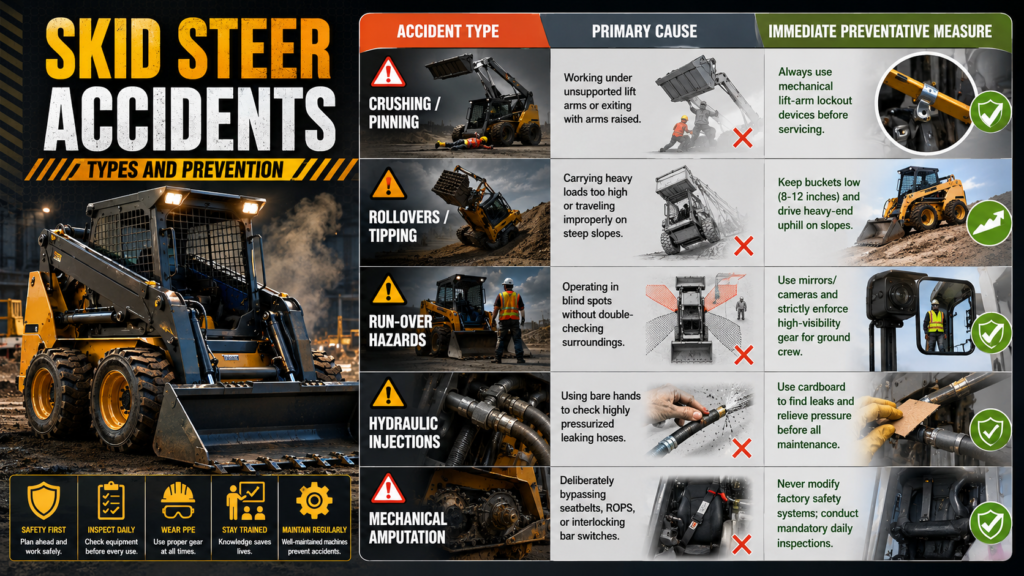
Table: Skid Steer Accidents: Types and Prevention
| Accident Type | Primary Cause | Immediate Preventative Measure |
| Crushing / Pinning | Working under unsupported lift arms or exiting with arms raised | Always use mechanical lift-arm lockout devices before servicing |
| Rollovers / Tipping | Carrying heavy loads too high or traveling improperly on steep slopes | Keep buckets low (8-12 inches) and drive heavy-end uphill on slopes |
| Run-Over Hazards | Operating in blind spots without double-checking surroundings | Use mirrors/cameras and strictly enforce high-visibility gear for ground crew |
| Hydraulic Injections | Using bare hands to check highly pressurized leaking hoses | Use cardboard to find leaks and relieve pressure before all maintenance |
| Mechanical Amputation | Deliberately bypassing seatbelts, ROPS, or interlocking bar switches | Never modify factory safety systems; conduct mandatory daily inspections |
Skid Steer Accident – FAQs
What is the most frequent mishap with a skid steer?
The most common and perhaps the deadliest skid steer incidents are crushing and pinning. This usually occurs when an operator or bystander is unfortunately caught right between the heavy lift arms and the solid frame of the machine, most commonly due to an illegally bypassed safety interlock or an operator leaving the machine with the bucket dangling precariously in the air.
How to Stop a Skid Steer From Rolling Over?
The bodily balance has to be correct to avoid a rollover. Always carry your big things as close to the ground as you can safely. Also if you must go on hills, always drive straight up or straight down the hill with the heaviest element of the machine (either the loaded bucket or the heavy rear counterweights) oriented straight upward.
Can you survive a skid steer rollover?
Yes, you have a good chance of surviving a rollover but only if you are rigorously following safety procedures. The operator must be securely belted into his/her seat and the machine’s Rollover Protective Structure (ROPS) must be totally functional and unaltered. The seatbelt will keep the operator firmly in place, preventing them from being forcibly ejected from the protected cab and, sadly, crushed by the immense weight of their own vehicle.
What to check Before using a skid steer?
Operators should do a careful visual examination before turning the key. You need to inspect all hydraulic lines for harmful fluid leaks, check the tires or tracks for proper pressure and visual damage, ensure all safety interlocks are functional, and ensure the ROPS, FOPS and strong seatbelts are in perfect shape.
What kind of PPE does a skid steer operator need?
Proper Personal Protective Equipment (PPE) is essential. Operators and ground workers in the vicinity must constantly wear ANSI-approved hard helmets, high-visibility apparel that is highly reflective, steel-toed work boots, shatter-proof safety glasses, and sufficient hearing protection to protect themselves from the loud boom of the massive diesel engines.
Are skid steers hazardous machines?
Yes, if you drive foolishly they are really hazardous. But they are very efficient and vital equipment. However, the great hydraulic force, terrible blind spots and heavy weight of skid steers mean that a single short failure in human judgement may swiftly lead to disastrous skid steer accidents. They can only be securely used with careful continuing expert training.