Operating Heavy Machinery: When to Replace Filters, Hoses, and Bushings on Your Skid Steer Loaders
Sometimes, giving your heavy equipment a thorough visual inspection might not be enough to spot issues. Even if your machine is running smoothly, there are hard and fast rules for when critical components should be replaced in the interest of safety and efficiency. This article pinpoints the exact timing for changing your skid steer loaders filters, hydraulic hoses, and pivot components to help you avoid costly repairs and extend equipment life by thousands of hours.
Reacting to breakdowns is costly, time-consuming, and frustrating. In fact, pushing your machine to its limits while not paying attention to changes in fatigue of components is very likely to result in an unscheduled and expensive downtime. The truth is, a well-maintained loader will continue to deliver the rated breakout force and highly responsive handling that you depend on to get through tough jobs.
The Ultimate Guide to skid steer loaders Filter Replacement Intervals
To keep the internal parts of your engine and hydraulic system in pristine condition, your loader relies on a complex system of filters to keep dirt particles away. Your approach to maintenance should be to categorize filters according to the working conditions to which they are exposed, thereby halting contamination at the very source.
- Engine Oil Filters (Every 250 Hours): A 250-hour skid steer loaders maintenance schedule is recommended to include an engine oil filter change to ensure that important engine internal lubricating pathways are kept clean and free-flowing. Deferring this maintenance action results in an increased accumulation of soot and metal particles that can lead to accelerated wear of exposed engine surfaces.
- Hydraulic and Hydrostatic Filters (Every 250 to 500 Hours): Your loader’s hydraulic system is under high pressure. As a result, the elements of the hydraulic system need to be kept clean to prevent issues that include valve sticking, pump cavitation, and motor failures due to the hydrostatic unit.
- Primary and Secondary Fuel Filters (Every 500 Hours): Injector tip scoring depends heavily on how clean the fuel is supplied to the engine. The act of changing not only your primary water separator but also your secondary fine particle fuel filters protects your fuel system from moisture and saves your fuel pump.
- Engine Air Filters (Every 250 Hours or via Indicator): You need to keep an eye on both your primary outer and secondary inner air filtration elements since, in a dusty environment, they are most likely to clog quickly. Your cab restriction gauge or the periodic checking of these elements at normal intervals, should be relied upon to make sure that no dirt enters the combustion chamber.
Spotting the Critical Warning Signs of Failing Hydraulic Hoses
Hydraulic hoses are responsible for supplying high-pressure fluid to the operations that you perform, such as raising and lowering arms, tilting mechanisms, and other skid steer loaders attachments. Since these rubber hoses are usually twisted and bent, besides being exposed to pressure spikes, and changing weather conditions, it is necessary that their condition is checked diligently during the daily walk-around.
- Outer Cover Cracking and Blistering: Being exposed to sunlight and ozone will result in hardening of the outermost layer of synthetic rubber and, eventually, cracks. If the design and structural layout are deteriorated, and if the internal wire mesh is even exposed, then replacing the hose is a must to prevent high-pressure blowout.
- Abrasive Rubbing and Internal Kinking: Moving parts against the frame and any structural steel plate will cause the lost area to wear quickly. Besides this, the loss of the outer protective jacket will be expedited. Making sure that the routing clamps are securely fastened and that the hoses are replaced upon signs of local thinning, flattening, and structural kinking should be incorporated into your periodic maintenance routines.
- Weeping Fittings and Coupler Leaks: The appearance of little fluid or wet dust rings around crimped hose ends normally means that the internal seal is starting to break down. If this situation is uncovered during routine maintenance, changed these weeping tires will avoid unexpected fluid loss and environmental contamination penalties.
Evaluating Pins and Bushings for Excessive Play
Each articulating point of lift arms, tilt links, and quick change attaching couplers is fitted with a hardened steel pin that rides within a bushing – a sacrificial sleeve. In addition, these components experience very heavy usage and, thanks to their design, are able to take the brunt. However, without skid steer loaders maintenance through regular greasing and the replacement when necessary will most probably cause damage to the loader’s main frame.
- Noticeable Sloppiness and Attachment Slop: You will hear a clunk or notice excessive movement when you are loading a heavy scoop or pushing a pile if your bushings have worn to beyond tolerance levels. By replacing them before they go out of round, you will save yourself from having to line bore the whole structural assembly later.
- Grease Refusal and Dry Shuddering: When a grease fitting does not take lubricant during your daily visual condition check, the internal canals probably contain solidified dirt. In that case, operating a dry pivot point will result in extreme heat due to friction, which will lead to the metals being welded together and destruction of the structural sleeve within a few hours.
- Visible Metal Shavings and Scoring: If you find silver shiny flakes of metal or deep scoring marks at your loader arm joints, it is a serious warning sign. This observation points to the fact that your bushings have worn through completely and that the steel pin was now sawing into the softer structural steel material of your loader frame.
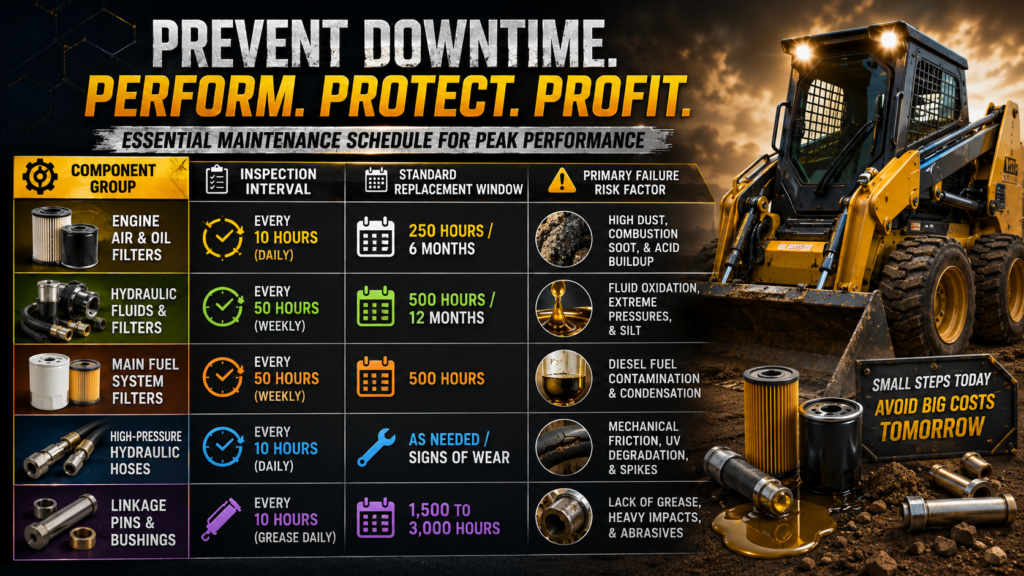
Preventative Maintenance Schedule Matrix
To make your shop hectic days work better, this key interval overview tells you when to check and change major components during running hours, a reference guideline only, always compare with your manufacturer’s manual.
| Component Group | Inspection Interval | Standard Replacement Window | Primary Failure Risk Factor |
| Engine Air & Oil Filters | Every 10 Hours (Daily) | 250 Hours / 6 Months | High Dust, Combustion Soot, & Acid Buildup |
| Hydraulic Fluids & Filters | Every 50 Hours (Weekly) | 500 Hours / 12 Months | Fluid Oxidation, Extreme Pressures, & Silt |
| Main Fuel System Filters | Every 50 Hours (Weekly) | 500 Hours | Diesel Fuel Contamination & Condensation |
| High-Pressure Hydraulic Hoses | Every 10 Hours (Daily) | As Needed / Signs of Wear | Mechanical Friction, UV Degradation, & Spikes |
| Linkage Pins & Bushings | Every 10 Hours (Grease Daily) | 1,500 to 3,000 Hours | Lack of Grease, Heavy Impacts, & Abrasives |
Step-by-Step Filter and Hose Replacement Process
Carrying out an effective replacement involves following a strict cleaning process. This will help to ensure that the exterior dirt does not contaminate the internal parts. Ge these efficient steps lined up for you next repair visit so that you keep your product as reliable and effective as ever.
1.Secure the Machine and Relieve All System Pressure: Prerequisite Safety
Take your machine to stable, flat ground, fully lower lift arms on the frame, switch off the ignition, and operate the auxiliary hydraulic controls to release the system pressure.
2.Thoroughly Clean the Target Component Area: Contamination Prevention
Before you undo connections, get a high-pressure degreaser or brake cleaner and use it to remove the dirt from around the filter housings or hydraulic hose fittings.
3.Remove the Worn Component and Inspect Adjacent Seals: Disassembly Analysis
Take off the used filter or damaged hose and selectively along the removal inspection for foreign metal particles, also be sure that old O-rings or gasket seals have been completely removed from the mounting area.
4.Pre-lubricate and Correctly Torque the New Parts: Final Installation
Spread new, clean oil on the gasket of the new filter or use a thread sealant on the hose fitting, hand-thread them smoothly, and finalize by tightening according to manufacturer torque specs.
FAQ Solutions – Skid Steer Loaders
How often should you grease skid steer pins and bushings?
All pivot pins and bushings should be greased every 8 to 10 hours of operation or during your daily walk-around inspection. Environments with high moisture, mud, or abrasives will require greasing twice a day to help expel packed grit and protect internal metal surfaces.
What happens if you don’t change your hydraulic filter on a loader?
The hydraulic filter plugs up and causes the system bypass to be opened to allow flow of unfiltered abrasive fluid directly to your precision pump and hydrostatic motors. This can lead to systemic scoring, component overheating, slow response of lift arm, and eventual multi-thousand-dollar system failure.
How do you tell if a hydraulic hose needs to be replaced immediately?
Exposed hydraulic steel wire braids, localized exterior bubbling, weeping fluid near the crimped fitting, or severe physical kinking are all defects that mean your hydraulic hose needs immediate replacement. Operating in this condition exposes you to high pressure blowouts and unplanned downtime.
Why are my skid steer loaders bucket controls feeling loose or sloppy?
Typically, loose or unresponsive bucket controls are due to worn-out pivot pins and bushings at the quick-attach work place or lift arm joints. When these sacrificial sleeves get worn, they create physical gaps which result in your attachments clunking and shifting unevenly during tough cycles.
Can you wash and reuse an inner engine air filter on a skid steer?
Definitely, NO inner engine air filter that is secondary and safety element should be attempted for cleaning and reuse because washing or blowing it will damage its microscopic fiber structure. This delicate inner safety element is made to be discarded immediately if it shows visible signs of dust or contamination.
How long do factory hydraulic hoses typically last under standard use?
Mild working conditions will see factory-installed hydraulic hoses last for between 4,000 and 5,000 hours of machine running hours. Nevertheless, frequent and direct exposure to strong UV rays, extreme temperatures and physical scrapes can drastically reduce their lifespan.
What is the average lifespan of loader boom arm bushings?
Year by year under normal operation, it is expected that loader boom arm bushings should last you between 1,500 and 3,000 hours. Greatly, your daily greasing habits will determine how long you get out of these sacrificial sleeves. Working with little to no lubrication or repeatedly in gritty sand and rock conditions will wear these out in under 1,000 hours.
Proactive Fleet Upkeep: Maximizing Equipment Longevity
Giving a lot of your attention to structural aspects of your daily checkouts guarantees maintenance that is normally manageable and minor will never get to the point where huge failures of the components bring your whole project to a halt. Besides keeping up with every filter change, hose inspection, lubrication of pins and so forth, as important and stand-alone events, you will still have your machine run at its full capacity and you will be able to keep the resale value intact down the road.
Together with logging your hourly intervals very meticulously, keeping your ear tuned to the loader during operation for any signs, and maintaining a well-stocked shop with essential high-grade replacements, a well-maintained machine is a highly productive, safe asset that will reliably anchor your fleet operations for years to come.