Top 5 Skid Steer Loader Safety Features That Could Save Lives
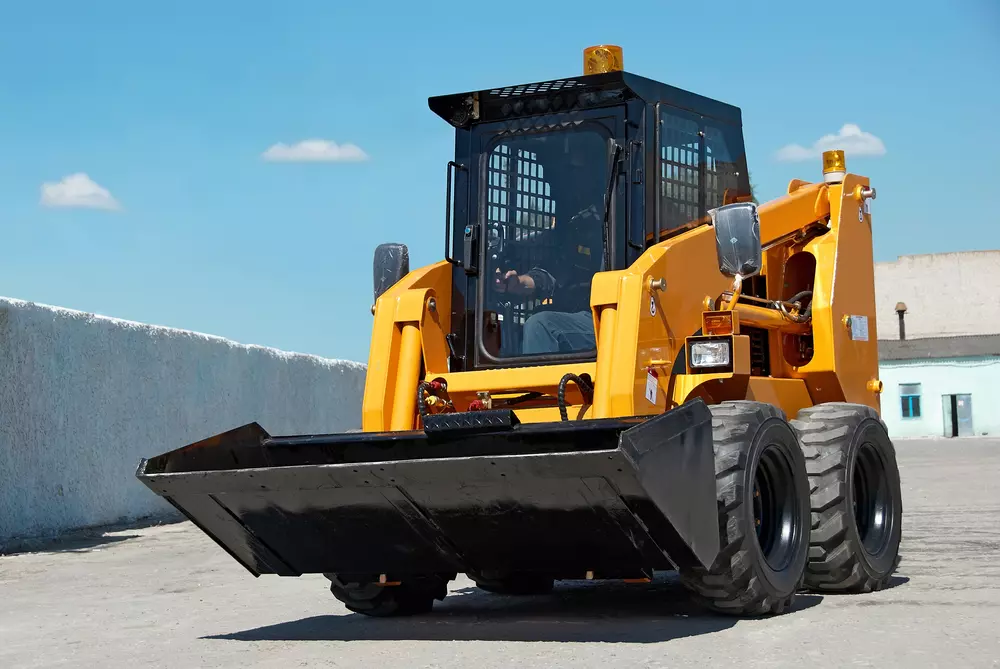
Skid Steer Loader is at the heart of construction, agriculture, and landscaping work nowadays. The compact size of skid steer loaders and their ability to turn a full 360 degrees have made them lead sources of work, however, these very features in combination with the closeness of the operator to the moving lift arms, present unique hazards which should be protected with the skid steer loader safety.
Skid Steer Loader Safety Importance
At skidsteerloader.org, we are of the opinion that getting the engineering of the machine thoroughly gradually getting to the first piece of the zero-accident environment. Not just regulatory checkboxes, modern Skid Steer Loader Safety Features are actually complex systems that are able to intervene in the case of human error.
These days, operator survival rates in highly dangerous environments have been significantly improved thanks to the introduction of reinforced structural cages and intelligent hydraulic interlocks, among other features.
Driving a skid steer means dealing with heavy loads, rough surfaces, and confined spaces where visibility is quite dim. Without the correct safety measures and features built into the machinery, an everyday chore can become a calamity, whether due to crushing or tipping over.
In this extensive guide, we discuss the vital Skid Steer Loader Safety Features that shield operators and ground workers, making sure that all work shifts run smoothly and safely. Technologies have been considered as a priority by fleet managers and individual owners so that they can greatly decrease the likelihood of fatal accidents.
Top 5 Skid Steer Loader Safety Tips
1. Rollover and Falling Object Protection
The-heavy duty cab frame is the most recognized safety feature on a skid steer loader. These frames create a “safe zone” that can stay intact even in the worst situations.
- ROPS (Rollover Protective Structure): A ROPS is a heavy-duty framework that is intended to maintain a “safe space” around the operator if the vehicle falls over. This structure is aimed at stopping the heavy weight of the loader from crushing the person inside.
- FOPS (Falling Object Protective Structure): The FOPS is basically a hardened top that will shield the user from flying debris or falling loads that could bounce off the bucket and hit the operator in the head.
- Side Screens: Heavy-duty steel mesh here will stop a worker from extending their limbs out of the cab and thus could be getting them trapped in the moving lift arms or pinched against the frame.
2. Integrated Safety Interlock Systems
These days, one of the chief reasons for mishaps is when operators attempt to manipulate the controls while leaving or entering the cab. Skid Steer Loader Safety Features also refer to incredibly complex interlocks that “dead-man” the machine unless a few particular conditions are fulfilled.
- Operator Presence Systems: A good example of this system is the pressure sensors in the seat or floor that are used to prevent the machine from being operated without a driver on the seat. This can prevent unexpected or unintended movements of a machine if a lever is bumped.
- Seat Bar Interlocks: The bar that goes over the operator’s lap is actually a secondary switch. If the bar is raised, then the hydraulic functions for lift and tilt are either electronically or mechanically locked.
- Seat Belt Sensors: Some loaders nowadays will prevent the brake from being released or the engine from being turned on to access high hydraulic flows until the seat belt is fastened.
3. Advanced Visibility and Blind Spot Technology
The engine in most compact loaders is at the rear which in combination with the lift arms on the sides usually means that occupants find it really difficult to spot ground workers.
- 360-Degree Camera Systems: High-resolution cameras placed on the rear and sides offer a wide view that is shown on the in-cab monitor and this helps to reduce/eliminate blind spots.
- Vertical Lift Paths: In comparison with old and bulky designs, the new ones are usually narrower or radial, and thus they provide better sight lines to both the tires and the corners of the bucket.
- Convex Mirrors: When they are positioned cleverly, operators can keep an eye on the rear and “swing zone” of the machine without having to twist their body.
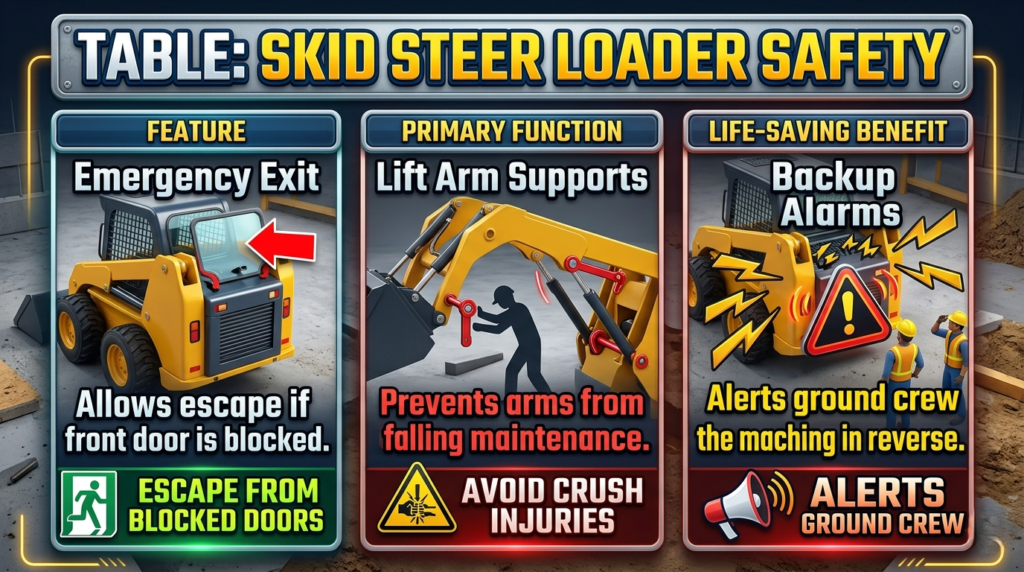
Table: Skid Steer Loader Safety
| Feature | Primary Function | Life-Saving Benefit |
| Emergency Exit | Rear window or roof hatch removal | Allows escape if the front door is blocked by the loader arms. |
| Lift Arm Supports | Mechanical pins or struts | Prevents arms from falling during maintenance, avoiding crush injuries. |
| Backup Alarms | High-decibel audio warning | Alerts ground crew that the machine is moving in reverse. |
4. Hydraulic Safety and Control Stability
What might be disastrous is the release of hydraulic pressure or the failure of hydraulics. The current Skid Steer Loader Safety Features are aiming at giving extra safety to these pressurized systems even when the engine is not running.
- Dead-Engine Lowering Valve: In case you have a stall of the engine with the bucket raised, you have the possibility inside the cab to use the manual valve for lowering the arms and safely getting the load down.
- Speed Management: This is done by using variable displacement pumps that also provide smoother acceleration and deceleration and thus, no jerks leading to a fall over on slopes.
- Automatic Leveling: This keeps the bucket level while lifting and hence mops against the issue of materials rolling back over the lift arms and onto the operator’s cab.
5. Ergonomic Design to Combat Operator Fatigue
Fatigue kills silently at the workplace. When an operator gets exhausted, their reaction slows down, and they become the most dangerous person on the site because they are very likely to skip even the basic rules.
- Pressurized Cabs: A hermetically sealed cab is not only quieter but it also keeps dust and allergens outside so the operator can concentrate and keep alert and go on for longer times.
- Joystick Controls: A joystick that needs little effort to operate will drastically reduce the amount of physical strain on the operator’s upper limbs (particularly the shoulders and arms) as compared to traditional foot pedals and hand levers.
- Adjustable Seating: The idea of nicely contoured and padded and high-back suspension seats is to help support the operator’s spine, minimize shaking due to the road surface and to reduce discomfort levels so that there is less physical weariness.
Frequently Asked Questions: Skid Steer Loader Safety
What are the most important skid steer safety features?
Probably the ROPS/FOPS protective cab, the safety interlock system (your seat bar and your seat belt), and the lift arm support devices for when you do maintenance. These things are directly related to the common causes of deaths in this equipment: rollovers and crushing.
Can I bypass the seat bar or seat belt sensor on a skid steer?
Don’t do it. Bypassing or disabling safety interlocks will greatly raise the risk that the loader arms will be accidentally started, which is a major factor in crushing fatalities. OSHA and the manufacturers are very antithetical to modification of these systems.
How does a “Zone of Protection” work in a skid steer?
Simply put, the “Zone of Protection” means the space inside the ROPS/FOPS cab. As long as the operator is buckled in and keeps their head, arms, and legs inside the frame, they are protected from being crushed by the machine’s moving parts or a rollover.
What should I do if my skid steer engine stalls with the bucket raised?
You exit the machine using the emergency “dead-engine” lower valve. Most machines will have a knob or pull cable inside the cab which, when activated, slowly releases hydraulic pressure and lowers the arms.
Why is the rear-view camera so important for skid steer safety?
The location of the engine on a skid steer means that there are major blind areas, especially to the rear. By the use of a rear-view camera, the driver can see ground workers or obstacles that cannot be seen in the seat and so avoid run-over accidents.
What is the “Three-Point Contact” rule for skid steers?
During entry or exit from the cab, you should always keep three points of contact on the machine’s grab handles and steps (i.e., two hands and one foot, or two feet and one hand) so that you prevent slipping and falling.
Are there safety features specifically for skid steer attachments?
Indeed. Hydraulic “Quick-Tach” systems with locking pins as well as the use of in-cab displays or visual indicators that confirm the attachment has been properly locked in place are features commonly found in machines nowadays.