How to Safely Operate a Skid Steer on Slopes and Uneven Ground
You need to be very focused, skilled, and dedicated to following safety rules when you operate heavy machinery. When it comes to learning how to Safely Operate a Skid Steer on slopes and uneven ground, the stakes are much higher than when driving on a flat, paved road.
Importance on Safely Operate a Skid Steer on Slopes and Uneven Ground
Skid steer loaders are very powerful and flexible machines that can turn 360 degrees and lift heavy loads. This makes them essential for construction sites, farms, and landscaping projects. But because they have a short wheelbase and a high center of gravity when loaded, they can quickly become dangerous if you don’t know how to handle them on uneven ground, steep hills, or muddy slopes.
As experts in the field at skidsteerloader.org, we can say that the best way to avoid rollovers, tip-overs, and loss of traction is to understand how your machine works in real time. Knowing how to Safely Operate a Skid Steer on slopes and rough ground is not only about getting the job done quickly; it’s also about making sure that you and everyone else on the job site get home safely at the end of the day.
You need to understand the basic ideas of machine stability and being aware of your surroundings before you even turn the key in the ignition. Every slope has a limit, and every load changes the balance of your skid steer loader.
If an operator treats a 20-degree muddy slope the same way they treat a flat warehouse floor, they are asking for trouble. You can confidently drive through tough terrain if you change how you drive, keep your load balanced, and keep your machine in good shape.
- Know what your machine can and can’t do: To find out the maximum slope rating for your exact model, always check your operator’s manual.
- Make sure the operator has the right safety gear: Always wear a seatbelt, lower the restraint bar, and make sure the Rollover Protective Structure (ROPS) is working properly before using a skid steer.
- Know how the terrain changes: Before you go, walk around the site to find hidden dangers like soft soil, hidden ditches, or slippery rocks that could make it harder for you to get traction.
Check for uneven ground before you start working
Before you even start the engine, you need to think about how to Safely Operate a Skid Steer on slopes and uneven ground. The most important thing you can do to keep mechanical failure from happening at a bad time is to do a thorough inspection before you start working.
When a machine is tilted on an incline, the fluids move, the tracks or tires get a lot of lateral stress, and the hydraulic system is pushed to its limits. If a hydraulic hose breaks while you’re carrying a heavy load up a hill, the sudden loss of pressure could make the bucket drop or the machine lurch, which could cause it to roll over.
So, you need to carefully look at every hose, fitting, and connection for signs of wear, tear, or leaks. Do not touch hydraulic leaks with your bare hands because the fluid is under a lot of pressure and can get through your skin.
Also, how well your undercarriage is working will affect how well you grip the ground. When using a wheeled skid steer, the tire pressure must be just right. If the tires are too low or too high, it will change the machine’s center of gravity and make it harder to drive on uneven dirt.
Track tension for compact track loaders (CTLs) must be kept within the limits set by the manufacturer. When you go across a side hill, loose tracks can easily slip off their rollers, leaving you stuck and off balance. Also, make sure that your engine oil and coolant levels are full. If they are low, the engine or pump may not get enough fluids when you need them most, which could cause sudden stalls.
- Check the tire pressure or track tension: Make sure that wheeled models are evenly inflated and tracked models are properly tightened to keep maximum ground contact.
- Carefully check the levels of fluids: Make sure that the engine oil, hydraulic fluid, and coolant are all full so that the fluids don’t run out when the vehicle is at extreme angles.
- Check all safety features: Before you go into the danger zone, make sure the cab door latches securely, the ROPS is not broken, and the seatbelt mechanism locks tightly.
The best ways to drive on slopes
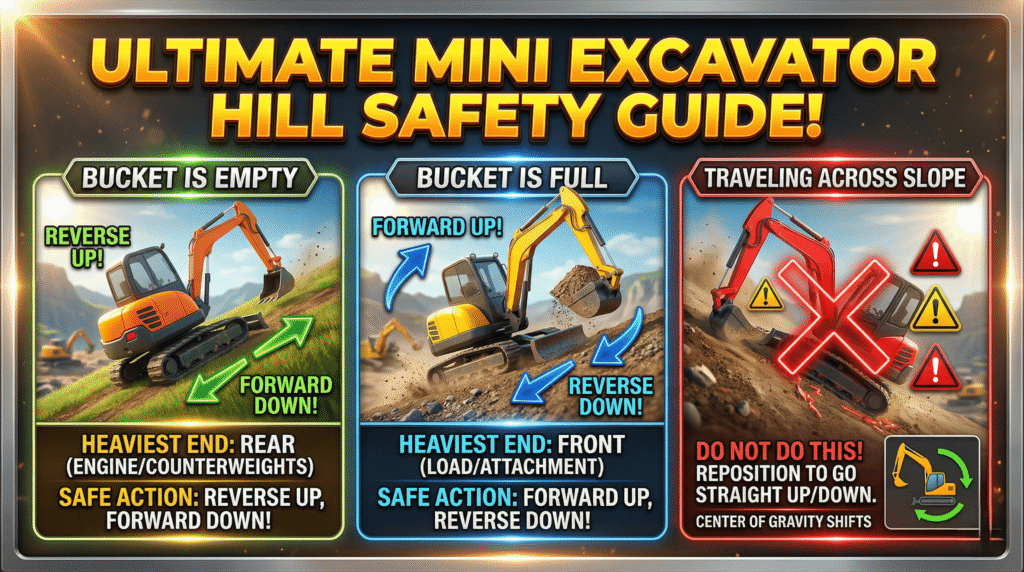
When learning how to Safely Operate a Skid Steer on slopes and uneven ground, the most important thing to remember is to always go straight up and down the slope, never across it. When you drive sideways down a slope, the machine’s heavy center of gravity moves to the downhill side, which makes a lateral rollover very likely.
You should always keep the heaviest end of the skid steer pointed uphill when you go up or down a hill. The back of a skid steer is weighted down to balance out the weight of the front attachments. This means that the heaviest end changes depending on whether your bucket is empty or full.
The front of the machine is the heaviest when the bucket is full of heavy stuff like gravel or wet dirt. In this case, you should go up the hill and then back down the hill. If your bucket is empty, on the other hand, the back engine compartment is the heaviest part. This means that you should back up the hill and drive down it.
Another important thing to think about when driving a skid steer over rough ground is how fast you go. The machine can bounce, lose traction, or buck forward if you suddenly speed up, brake hard, or push the joystick too hard. You need to use smooth, planned, and proportional inputs on your controls.
Always keep your machine in the lower gear when you’re on an incline or rough ground if it has a two-speed transmission. This gives you the most torque and stops the machine from running away from you when you go down.
If you have to turn on a slope, do it as slowly as you can. Don’t do the sharp, zero-radius pivot turns that skid steers are known for, because these can easily dig into the ground and make your platform unstable.
- Always go straight up and down: Never drive sideways or diagonally across a steep grade, as this could cause the machine to tip over.
- Keep the heavy end pointed uphill: Change the way you drive depending on whether your attachment is full or empty to keep it balanced.
- Don’t make sudden, jerky movements: Use slow, proportional control inputs and low-speed settings to keep the machine from bucking and to keep traction steady.
| Condition / Load Status | Heaviest End of Machine | Safe Driving Action |
| Bucket is Empty | Rear (Engine/Counterweights) | Reverse up the hill; Drive forward down the hill. |
| Bucket is Full | Front (Load/Attachment) | Drive forward up the hill; Reverse down the hill. |
| Traveling Across Slope | N/A (Center of gravity shifts) | DO NOT DO THIS. Reposition to go straight up/down. |
Handling Loads and Finding the Center of Gravity
When trying to figure out how to Safely Operate a Skid Steer on slopes and rough ground, the most common mistake operators make is raising their load too high. The center of gravity of your machine changes as you raise the lift arms.
A skid steer with a heavy pallet of blocks two inches off the ground is very stable. But if you put that same machine with the same pallet six feet in the air on a slight incline, it will roll over.
You should keep all of your attachments, buckets, and loads as low to the ground as possible, but they should be at least a few inches above the ground to avoid rocks and other debris. You should only raise the boom when you are dumping or stacking the material on a flat, level, and stable surface.
Also, you need to strictly follow the machine’s Rated Operating Capacity (ROC). The ROC is based on flat, solid ground. When you move a skid steer onto uneven ground or a slope, the safe lifting capacity goes down because gravity pulls the weight at an angle.
If you put too much weight in the bucket on a hill, the machine will instantly lose its balance and the back wheels will lift off the ground. Make sure that the load is evenly spread out inside the bucket or on the pallet forks at all times.
An off-center load will pull the machine to one side very hard, making the stabilizing counterweights useless and making it very dangerous to tip over as soon as you hit a bump or rut.
- Keep attachments as low as you can: Move all of your materials just a few inches off the ground to keep your center of gravity safely down.
- Never go over the Rated Operating Capacity: Keep in mind that the slope makes it less safe to lift things; when going up hills, carry smaller, lighter loads.
- Evenly distribute the weight: Make sure that the materials are perfectly centered in the bucket or on the forks so that the machine doesn’t pull to one side.
Picking the Right Tracks and Attachments
One of the most important things to know about how to Safely Operate a Skid Steer on slopes and uneven ground is how to make your equipment fit the environment. There is a big argument between wheeled skid steers and Compact Track Loaders (CTLs), but it usually ends when you hit soft mud or steep grades.
Tracked undercarriages are much better for uneven ground because they spread the weight of the machine over a much larger area. This lower ground pressure keeps the machine from sinking into soft soil, mud, or snow, and gives it aggressive, steady traction that wheels can’t match on a wet slope.
If you often work on hills, you need to get a tracked machine or over-the-tire steel tracks for your wheeled loader to make it safer.
The attachments you choose also have a big effect on how stable you are overall. When you use a low-profile bucket instead of a high-capacity bucket, the load has to sit closer to the machine’s frame.
This makes your center of gravity tighter and gives you more room for error. When you’re moving heavy, awkward things like logs or demolition debris, a grapple bucket lets you clamp down on the load and keep it from moving, bouncing, or rolling back onto the cab while you go down a bumpy slope.
Adding rear counterweights that are approved by the manufacturer can also give your machine the extra weight it needs to safely lift heavier attachments while keeping your grip on the dirt.
- Use tracked undercarriages on soft ground: Tracks spread the weight out better and give you better grip, which makes it much less likely that you’ll slide on muddy or uneven hills.
- Choose low-profile buckets for tighter gravity: Low-profile attachments keep the material closer to the machine’s body, which stops the heavy end from pulling you forward.
- Add counterweights when you need to: Use official, manufacturer-approved rear weights to balance out heavy front attachments and keep all four corners firmly planted.
What to Do If You Can’t Get a Grip or Stay Stable?
Even the most experienced professionals who know how to Safely Operate a Skid Steer on slopes and rough ground can run into problems they didn’t expect. The ground can give way, the mud can be slicker than you thought, or a hidden stump can make the machine unstable.
If you feel the back tires or tracks start to lift off the ground or the machine starts to tilt dangerously to one side, you need to act quickly. You need to quickly lower the lift arms and drop the bucket or attachment flat on the ground.
When you drop the bucket, your center of gravity drops right away, and it acts as an emergency anchor, keeping the machine stable and stopping it from rolling all the way over.
Don’t slam on the controls or try to whip the machine around if it starts to slide down a slick hill. Instead, lower the bucket so it drags on the ground to create friction, and then gently steer into the slide to get traction back, just like you would if your car hit a patch of ice.
The most important thing to do in an emergency when the vehicle loses stability is to stay inside the cab. If your skid steer starts to tip over, you should never unbuckle your seatbelt or try to jump out.
The ROPS cab is a safety cage that was built to keep you safe in case of a rollover. Most of the time, people die in skid steer accidents without basic knowledge on how to safely operate a skid steer when they try to jump out of the way and are crushed by the rolling machine or the boom arms that are coming down.
- Lower the bucket right away: If you think the machine is tipping, let the attachment fall to the ground to lower your center of gravity and act as an emergency brake.
- Steer slowly into a downward slide: Don’t move the joystick quickly or in a panic; instead, drag the bucket and try to get the track to grip again.
- Never try to jump out of the cab: Never try to jump out of the cab; keep your seatbelt on and stay inside the protective ROPS cage. Jumping out greatly increases the risk of being crushed.
FAQs About How to Safely Operate a Skid Steer Slope Safety
Can a skid steer go down hills?
Yes, but you have to be very careful when you do it. You should stay away from slopes that are steeper than what the manufacturer says is safe, which is usually around 30 degrees or a 2:1 slope. Never go diagonally; always go straight up or down.
How steep can a skid steer go down a hill?
Skid steers are generally only safe to use on slopes of 30 degrees or less, but you should always check your specific operator’s manual. Going up too steeply puts you at a very high risk of tipping over or losing all traction.
Which way should you go when driving a skid steer on a hill?
Always point the heaviest end of the skid steer uphill. Drive up the hill with your bucket full and then back down it. If your bucket is empty, go back up the hill and then down it.
Which is better for rough ground: tracks or wheels?
For rough, soft, or sloped ground, tracked skid steers (also called compact track loaders) are much better. Compared to regular wheels, the tracks have a bigger surface area that helps distribute weight better, gives better traction, and lowers the center of gravity.
Why shouldn’t you drive up a hill?
When you drive horizontally or laterally across a slope, the machine’s heavy center of gravity moves to the downhill side. Skid steers are very likely to roll over sideways because their wheelbase is narrow.
What does the three-point contact rule mean?
To keep people from slipping and falling, the three-point contact rule is a safety standard for getting in and out of the cab. This means that you must always have either two hands and one foot or two feet and one hand firmly on the machine’s grab handles and steps.
Do you need a special license to drive a skid steer at work?
You don’t need a special driver’s license, like a CDL, to drive a skid steer in most places. OSHA does require, though, that employers make sure that all operators are properly trained, tested, and certified to use the specific machines they will be using.