Safety Gear and PPE for Skid Steer Loader Operators
Climb into the cab of a skid steer, and things happen fast. You’re dealing with tight spaces, heavy loads, flying gravel, loud engines, and blind spots all at once. On any job site—whether you’re grading a backyard, clearing demolition rubble, or hauling feed on a farm—wearing the right PPE for skid steer loader operators isn’t just about ticking a box for the safety manager. It’s what keeps a routine Tuesday from turning into a trip to the ER.
A lot of guys treat safety gear as an afterthought until a hydraulic hose blows or a rock kicks up off the bucket. This guide walks through the actual gear you need, why it matters on the ground, and how to keep it in working shape.
Why Skid Steer Loader Safety Gear Matters
A skid steer might look small next to an excavator, but don’t let the footprint fool you. These machines tip the scales anywhere from 4,000 to 10,000 pounds. That’s roughly double the weight of a full-size pickup.
Because you sit right between the lift arms, there isn’t much room for error. Pinch points, overhead debris, blown hydraulic lines, and uneven ground are part of the daily grind. OSHA requires heavy equipment operators to wear proper personal protective equipment, and for good reason: the machine won’t forgive a slip-up. Good skid steer loader safety gear buys you a margin of safety when things go sideways.
- Crushing hazards are real: With up to 10,000 pounds of steel moving around you, proper gear is your first line of defense against severe impact.
- OSHA isn’t optional: Federal job site rules mandate specific PPE whenever you’re operating or working around heavy machinery.
- Pinch points cause most injuries: Roughly three out of four skid steer accidents involve someone getting pinned between the frame, lift arms, or bucket. Proper gear and strict habits cut down how bad those incidents get.
Essential Skid Steer PPE Requirements
Knowing your skid steer PPE requirements means understanding what each piece of gear actually stops. You might need extra equipment depending on the attachment you’re running or the site you’re on, but the six items below are your daily baseline. Don’t start the engine without them.
1. Hard Hat and Head Protection
If you’re working around overhead beams, low ceilings, or anything that can drop from above, a hard hat is a must. Grab an ANSI-rated Class E or Class G helmet—they handle both heavy impacts and electrical hazards. You should always check your clearance around pipes, lights, and doorways before moving, sure, but a hard hat saves your skull when a tight squeeze catches you off guard.
- Wear an ANSI-rated hard hat or bump cap anytime you’re running a skid steer, indoors or out.
- Give the shell and suspension straps a quick once-over before your shift. Cracks, dents, or frayed webbing mean it’s done.
- Took a hard hit? Toss the helmet and get a new one, even if the plastic looks fine from the outside.
2. Safety Glasses and Eye Protection
Dust, wood chips, concrete dust, and high-pressure hydraulic spray don’t care how experienced you are. ANSI Z87.1-rated safety glasses or goggles are a core part of PPE for skid steer loader operators, especially during trenching, grinding, or demo work. Even if you’re running an enclosed cab with side screens, you’re still stepping out to check pins and hook up hoses. Keep your eyes covered.
- Stick to ANSI Z87.1 impact-rated lenses to stop flying grit and fluid splatter.
- If you’re working in hot, humid weather, get anti-fog lenses or vented goggles so you aren’t tempted to take them off to see.
- Grab a pair with side shields (or wraparound frames) when you’re working near demolition or cutting crews.
3. Hearing Protection
Engine roar and hydraulic whine add up fast. Most skid steers run between 85 and 100 decibels, which blows right past OSHA’s 85 dB limit for an eight-hour shift. Hearing loss doesn’t hurt while it’s happening, which is why so many PPE for skid steer loader operators skip ear protection until they’re dealing with permanent ringing. Foam plugs, over-ear muffs, or electronic headsets all do the job.
- Look for earplugs or earmuffs with a Noise Reduction Rating (NRR) of at least 25 dB.
- Electronic muffs are worth the money if you need to hear ground spotters and backup alarms while blocking out engine noise.
- Don’t let a quiet cab fool you—hours of low-grade rumble still wreck your hearing over time.
4. Steel-Toed Safety Boots
Climbing in and out of a cab all day on mud, gravel, or slick concrete is an easy way to roll an ankle or smash a foot. You need ASTM F2413-rated steel-toe or composite-toe boots with solid, slip-resistant treads. Go for a high-ankle boot—the extra support pays off the first time you step off the machine onto an uneven rock.
- Always wear ASTM F2413 steel-toe or composite-toe boots with oil- and slip-resistant soles.
- High-ankle lace-ups help prevent sprains when you’re mounting, dismounting, or walking rough terrain.
- Working demo or scrap yards? Get boots with puncture-resistant midsoles so nails and rebar stay out of your feet.
5. Work Gloves
Swapping skid steer attachments, greasing zerks, and checking hydraulic couplers will tear your hands up fast. Sharp metal edges, hot exhausts, and abrasive concrete are everywhere. A solid pair of leather or synthetic work gloves protects your skin without making your fingers too clumsy to run the joysticks or tighten a fitting.
- Use cut-resistant gloves (Level A4 or higher) when swapping buckets, running pre-op checks, or doing wrench work.
- Keep chemical-resistant gloves in the truck for handling hydraulic fluid, diesel, or solvents.
- Fit matters—bulky, loose gloves wreck your grip and make controls harder to handle safely.
6. High-Visibility Clothing
On a busy site, seeing the ground crew is only half the battle—they need to see you, too. An ANSI Class 2 or Class 3 hi-vis vest, jacket, or shirt keeps you visible to truck drivers, other operators, and spotters, especially at dawn, dusk, or in bad weather. Most commercial and road sites won’t even let you past the gate without it.
- Wear an ANSI Class 2 or Class 3 vest on road jobs, municipal sites, or anywhere with heavy vehicle traffic.
- Running night shifts or working in fog? LED-lit hi-vis gear makes a massive difference.
- Pair your vest with long sleeves and heavy work pants to keep scrapes, sunburn, and flying debris off your skin.
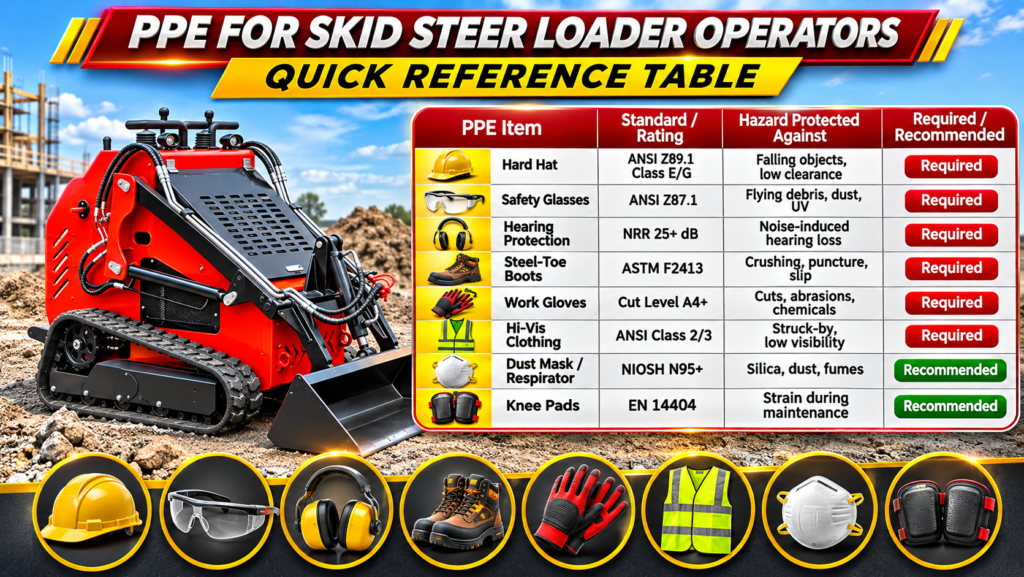
Table – Quick Reference: PPE for skid steer loader operators Requirements
| PPE Item | Standard / Rating | Hazard Protected Against | Required / Recommended |
| Hard Hat | ANSI Z89.1 Class E/G | Falling objects, low clearance | Required |
| Safety Glasses | ANSI Z87.1 | Flying debris, dust, UV | Required |
| Hearing Protection | NRR 25+ dB | Noise-induced hearing loss | Required |
| Steel-Toe Boots | ASTM F2413 | Crushing, puncture, slip | Required |
| Work Gloves | Cut Level A4+ | Cuts, abrasions, chemicals | Required |
| Hi-Vis Clothing | ANSI Class 2/3 | Struck-by, low visibility | Required |
| Dust Mask / Respirator | NIOSH N95+ | Silica, dust, fumes | Recommended |
| Knee Pads | EN 14404 | Strain during maintenance | Recommended |
Respiratory Protection for Dusty and Chemical Sites
If you’re breaking up concrete, moving dry dirt, or working inside an old renovation, the air can be just as dangerous as the machinery. Silica dust, diesel fumes, asbestos, and chemical vapors wreck your lungs over time. A NIOSH-approved N95 mask is the bare minimum for dusty work, while chemical spills or heavy fumes call for a half- or full-face respirator with organic vapor cartridges. Don’t assume an enclosed cab filters everything out—especially the second you pop the door open.
- Put on a NIOSH N95 (or better) whenever you’re kicking up silica dust, demo debris, or heavy agricultural dust.
- Switch to a cartridge respirator rated for organic vapors if you’re dealing with fuel leaks, solvents, or chemical spills.
- Get your respirator fit-tested every year, and always check the seal before stepping into a hazardous area.
Seat Belts and Operator Restraint Systems
It’s bolted to the machine instead of your body, sure, but the seat belt and lap bar are just as critical as your boots or helmet. OSHA rules are crystal clear here: stay seated, buckle up, and pull the lap bar down before you turn the key. Some operators try to bypass the interlock switch to save a few seconds. Don’t do it. Getting thrown out during a rollover is one of the fastest ways to get killed on a skid steer.
- Buckle the seat belt and lower the restraint bar before starting the engine—every single time.
- Never tamper with or bypass the safety interlock. It’s there to stop accidental movement and keep you inside the roll cage.
- Keep your arms, legs, and head inside the cab while moving. The ROPS (Rollover Protective Structure) only works if you stay inside it.
Frequently Asked Questions: PPE for Skid Steer Loader Operators
What PPE is required for skid steer loader operators?
At a minimum, you need a hard hat, safety glasses, hearing protection, steel-toe boots, work gloves, and high-visibility clothing. If you’re working in heavy dust or around chemicals, add a NIOSH-rated respirator like an N95. Make sure all your gear carries the proper ANSI or ASTM ratings.
Do skid steer operators need to wear a seat belt?
Yes. OSHA mandates that you wear the seat belt and engage the lap bar whenever the machine is running. Bypassing the interlock is illegal on regulated sites and puts you at serious risk of being ejected during a tip-over.
What type of boots should skid steer loader operators wear?
Go with ASTM F2413-rated steel-toe or composite-toe boots with slip-resistant soles. High-ankle boots are best for uneven ground, and puncture-resistant midsoles are a smart call if you’re working around demo debris or scrap metal.
Is hearing protection required for skid steer operators?
Yes. Skid steers usually hit 85 to 100 dB, which is loud enough to cause permanent hearing damage over a standard shift. Wear earplugs or earmuffs with an NRR of 25 dB or higher.
What safety gear should be worn when changing skid steer attachments?
Wear cut-resistant gloves (Level A4 or up), steel-toe boots, and safety glasses. Always shut the engine off and relieve the hydraulic pressure before touching any couplers or pins. Never swap attachments with the machine running.
Are safety glasses mandatory inside a skid steer cab?
They’re strongly recommended—and required on most sites—even in an enclosed cab. You’re constantly getting in and out for inspections, fueling, and attachment swaps, where dust and flying debris are always a threat.
What are OSHA’s PPE requirements for skid steer loader operators?
OSHA doesn’t have one standalone “skid steer” rule, so it enforces general construction and industry standards instead—mainly 29 CFR 1926.95 (PPE) and 29 CFR 1926.302 (hand and power tools), along with machine guarding rules. Under these rules, your employer has to assess site hazards and provide required PPE at no cost to you.
Wrap-Up: Protect Yourself on Every Shift: PPE for skid steer loader operators
Putting on the right PPE for skid steer loader operators takes two minutes at the start of the day, and it’s the easiest way to make sure you walk off the site in one piece. Check your gear regularly, replace anything that’s worn out or damaged, and treat your seat belt and interlock bar with respect. At SkidSteerLoader.org, we’ve seen plenty of close calls that only stayed “close” because the operator was wearing the right gear. Stay sharp, follow OSHA standards, and make sure your whole crew is geared up before the first bucket hits the dirt.