Skid Steers for Erosion Control and Riverbank Restoration Projects
Environmental stabilization of natural waterways and shoreline integrity involves the use of precision engineering, environmental safety measures, and specialized machinery. If left unchecked, natural water movement, extreme weather, and human activities accelerate soil loss and damage fragile ecosystems known as riparian zones. In fact, traditional heavy civil excavators are often too large, excessively destructive, and very costly when working on these delicate projects. This is why the incredible versatility of compact machinery is so important for Skid Steers for Erosion Control and Riverbank Restoration Projects.
The contemporary restoration site implies a variety of needs from a single piece of equipment as they may be called to perform both the most delicate, material placement and the most aggressive, earthmoving.
A skid steer loader can meet these contradictory requirements due to its small size and the highly effective skid-steering system. Moreover, by combining a machine with the extensive range of hydraulic attachments, multi-phase restoration procedures can be carried out by one unit – from clearing the initial area and stabilizing slopes to reinforcing the structures and replanting the native species. Knowing how to utilize these agile vehicles can be the key to ensuring the project is completed on schedule, under budget, and environmentally compliant.
Top Features of Skid Steers for Erosion Control
1. Getting through delicate riparian zones with small physical footprint
The banks of the rivers are very sensitive to compaction, tracking, and deep rutting, which ultimately damage native root systems and cause erosion problems to get even worse. Digging earth with heavy bulldozers or full-sized excavators causing immense ground pressure that crushes soil structure and turns the previously stable bank into slipping grounds.
Taking advantage of skid steers for erosion control and riverbank restoration projects will remedy the problem of providing SMEs in developing areas with high horsepower packed into a lightweight frame that can navigate tight, forested shorelines.
Choosing the best track or tire set up comes first in minimizing the environmental impact of your project. Track machines, often called compact track loaders (CTLs), are capable of spreading the machine’s operating weight over a lot wider area than wheeled models. This, in turn, results in a much lower pounds per square inch (PSI) exerted on the ground, to the point that the machine remains afloat even on waterlogged banks and marshy floodplains.
- Low Ground Pressure: Tracked skid steers can reduce ground pressure to approximately 3 to 4.5 PSI. This enables them to move over soft, water-saturated river silt without developing any destructive ruts or deep soil compaction.
- Zero-Turn Agility: The famous skid-steering system means the equipment can turn completely without space around it. This way, even wide, multi-point turns that scar how fragile the banks are can be eliminated completely.
- Tight-Space Navigation: The small size makes it easy for the operator to avoid mature trees, boulders, and existing structures while along the narrow stream corridor without having to clear a wide access road.
2. Advanced grading and slope stabilization skills
Vertical scars on the waterside of the riverbank that store eroding materials need to be smoothed and modified properly so that this slope remains stable and sustainable. Due to falling rainwater, these vertical holes or gulleys regularly wash sediment for the support of aquatic creatures downstream.
River banks are normally vertical and reinstating them through the use of skid steers for erosion control and riverbank restoration projects will allow the team to extend the walls into easy manageable sloping.
With integrated avoid grading features, a small loader based operator can use it in a very precise manner as if a sculpting tool. It is possible to cut down steep walls, fill empty places, and spread topsoil with only accurate movements. After the works, standard smooth surfaces required for erosion control materials such as blankets, geafabrics, and seeded hydro-mixes can be installed.
- Bank Re-shaping: Operators can use six-way dozer blades and grading buckets to chop down unstable, vertical river cliffs to gentle slopes at 3:1 or 4:1 ratios that naturally reduce wave and current energy.
- Precision Backfilling: At this stage, the operator is able to safely backfill, compact, and smooth out deep undercuts caused by fast-moving currents without taking the risk of tipping over the machine because that the lift arm is so agile that it can reach over the bank edge.
- Gully Mitigation: By backing into eroded drainage channels, operators can quickly fill, compact, and flatten the terrain in order to prevent the headcut from moving forward and destroying properties.
3. Sophisticated material handling for the reinforcement of the shore
It is mainly a problem of handling very heavy and hard materials that are sometimes very big such as boulders, logs, etc. It is very hard indeed to move the materials needed for the stabilization of river banks and river restoration. Skid steers for erosion control and riverbank restoration projects become an assistant in eliminating hard manual labor by being the ultimate logistics vehicle on the site.
Due to these machines’ low center of gravity and optimum weight distribution, they can remain very stable while moving heavy loads over rough and sloping terrains. In fact, a skid steer can lift the load completely off the ground instead of dragging through the bank, which usually results in damage.
- Heavy Rock Placement: Operators can pick and place large stones for the bottom of the slope to absorb the energy of water with the help of heavy-duty rock buckets and hydraulic grapples.
- Bioengineering Integration: Pre-fabricated coir (coconut fiber) logs, willow wattles, and brush mattresses are only a few examples of delicate bioengineering materials that can be easily handled by pallet forks and utility grapples without damaging them during transportation.
- Structural Anchoring: The log vanes and root wads can be positioned at depth into the riverbed by crew members who have lifting CAPACITYs quite high; these artificial structures deflect large currents that flow towards vulnerable banks.
4. A wide range of Hydraulic Attachments for Restoration
Compact loaders have an amazing capability to alter their functions completely within a very short time. Advanced quick-attach coupler systems give the operator the ability to switch from the earthmoving bucket to a specialized hydraulic tool without even opening the cab window.
Among the reasons why skid steers for erosion control and riverbank restoration projects are so productive are the environmental factors and the correct matching of hydraulic attachments with tasks.
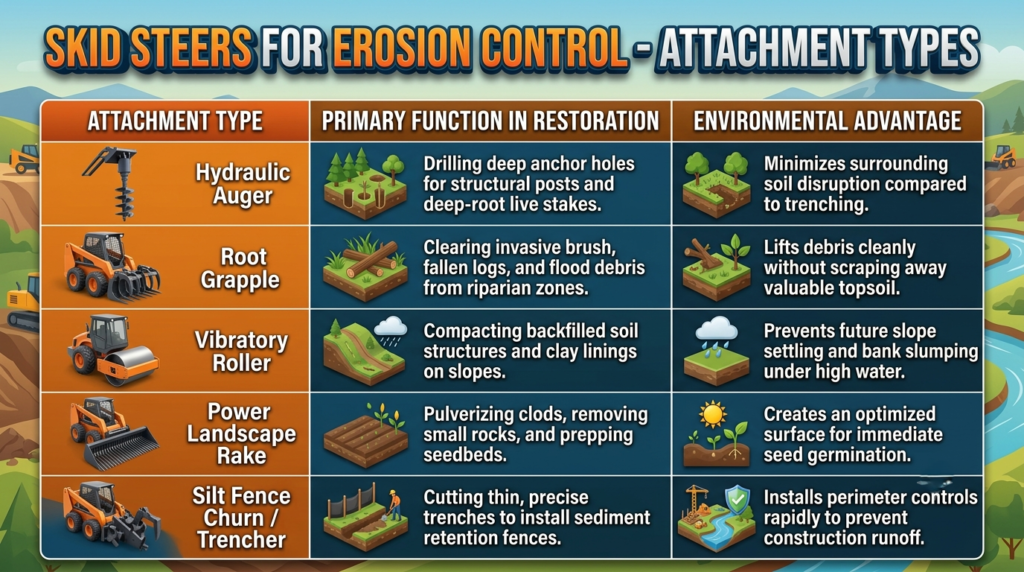
Most of the power-intensive hydraulic attachments used for this type of work can still be run at high-level performance continuously during the long, hard workdays in very wet conditions with modern machines’ high-flow hydraulics option. The table below contains the most commonly used attachments for a standard shoreline restoration operation:
Table: Skid Steers for Erosion Control – Attachment Types
| Attachment Type | Primary Function in Restoration | Environmental Advantage |
| Hydraulic Auger | Drilling deep anchor holes for structural posts and deep-root live stakes. | Minimizes surrounding soil disruption compared to trenching. |
| Root Grapple | Clearing invasive brush, fallen logs, and flood debris from riparian zones. | Lifts debris cleanly without scraping away valuable topsoil. |
| Vibratory Roller | Compacting backfilled soil structures and clay linings on slopes. | Prevents future slope settling and bank slumping under high water. |
| Power Landscape Rake | Pulverizing clods, removing small rocks, and prepping seedbeds. | Creates an optimized surface for immediate seed germination. |
| Silt Fence Churn / Trencher | Cutting thin, precise trenches to install sediment retention fences. | Installs perimeter controls rapidly to prevent construction runoff. |
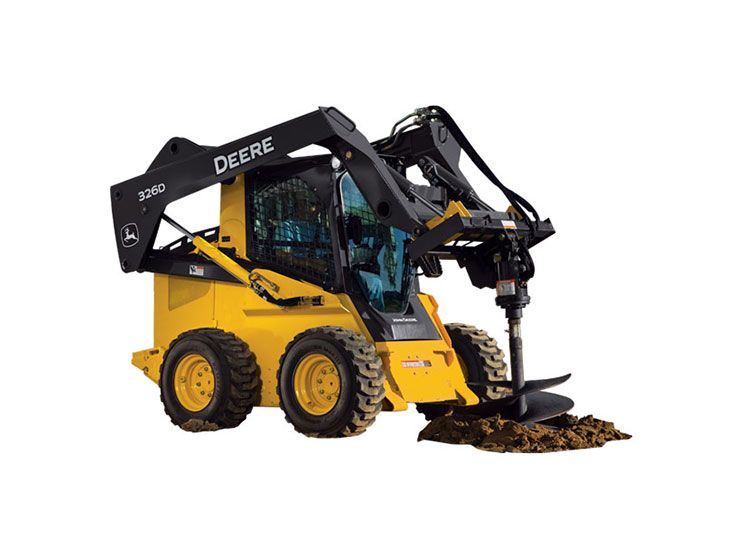
- Auger Accuracy: The machine drills perfectly straight holes deep into very hard rocky shorelines, setting the foundation for log walls or planting large vegetation that is capable of withstanding strong currents and water flow.
- Grapple Usability: A pair of hydraulically operated claws is used to pick up awkwardly shaped objects such as root wads and timber. The machine can then transport these loads across rough, inclined terrains with safety and efficiency.
- Preparatory Finishing: Power rakes prepare the surface of the soil in a way that makes it ideal for the germination of native seeds, a crucial element in achieving the successful re-establishment of native vegetation.
5. Maximizing Vegetation Control and Re-establishment
Mechanical structures, such as large rocks and logs, provide a very immediate level of protection, but long-term, sustainable erosion control depends on deep, extensive root networks of native vegetation, as is standard knowledge.
Unfortunately, banks can be taken over by invasive plant species that have shallow roots and provide no bank stability, which can result in massive land drops during floods of the season. Skid steers for erosion control and riverbank restoration projects are a huge help in reducing the tedium of removing unwanted vegetation and re-establishing native green zones.
Skipping over the messy preparation for the main show of transplanting trees and shrubs by going right to the point with the skid steer, which can be equipped with a forestry mulcher that will get through thick brush and share beneficial layers of mulch after just one pass. Mulch stays on slope and acts as a kind of blanket, retaining here that water and preventing erosion.
- Invasive Species Eradication: Using powerful forestry mulchers and durable brush cutters, non-native invasive species growing on river banks are removed by grinding them down to the ground level.
- Soil Amendment Spreading: For bare slopes, wide-profile, light buckets deposit organic compost, mulch, and targeted topsoil layers in a spread manner to kickstart the natural recovery process.
- Large Tree Transplanting: A skid steer that has been fitted with the correct tree spades or booms can carry out tasks related to relocating, digging, and placing large native trees in the upper part of the bank, thus providing an immediate canopy and deep root stabilization.
6. Most Important Operator Safety and Stability Measures on Slopes
Being located adjacent to a moving body of water poses significant safety risks that are completely absent in a typical, flat construction site setting. Muddy terrain, shifting soils, saturated banks, and steep drop-offs make for an unpredictable environment where the machine can easily slide or tip over if one is not careful in its operation.
Safety should always be the first priority and the limits of the machine must always be strictly adhered to when operating skid steers for erosion control and riverbank restoration projects.
Machine stability, center of gravity, and rated operating capacities (ROCs) are among the deepest knowledge bases that operators should have. River banks are by their nature inclined, therefore the center of gravity will constantly change during operation. Checking the stability of the bank by the structural engineers first before putting heavy equipment near a soft edge is a must in the context of safety protocols.
- Respecting Slope Limits: It is safer to operate the machine moving vertically up or down the steep slopes rather than moving horizontally after these slopes because the latter significantly increases the risk of rolling over.
- Monitoring Rated Operating Capacity: Load charts must be strictly followed to ensure that during the lifting of heavy rip-rap or wet logs, the payload level is kept low and the machine is not overloaded.
- Utilizing ROPS/FOPS Cabs: Certified and fully equipped ROPS and FOPS cabs must be used by the operator consistently and any bank collapse that is unexpected is very unlikely to lead to serious injuries to the operator.
7. Cost-Efficiency and Project Time Gains Against Heavy Plant
On account of the fact that in most environmental restoration projects, equipment mobilization and site remediation costs come as the two biggest expenditure items, heavy excavators along with long-reach cranes necessitate the presence of wide access roads, heavy-haul permits, and restoration of lands post-project completion on a massive scale and at significant costs.
Taking advantages associated with skid steers for erosion control and riverbank restoration projects offers a very highly economic alternative that triples and even quadruples the advantage of just one capabilities while being the least expensive and most powerful day to day a part of the work.
In fact, only one small loader can do the job of three or four pieces of heavy equipment in a site. The ability to convert from a loader to a trencher, an auger, or a grader means less equipment sitting idle and racking up expenses.
At the same time, with these machines being as gentle as they are on the land, there are very few, if any, damages to the access roads, which results in fewer expenses and less downtime to do repairs.
- Lower Mobilization Costs: Compact equipment can easily be hauled on a standard utility trailer that is pulled by a regular pickup truck – thereby completely eliminating the need for heavy hauling permits and special rigs which seriously add to the cost.
- Reduced Labor Expenses: Because even a change in hydraulic attachments can change the task, it is possible for a single operator to cover a large variety of work thus reducing crew sizes and labor costs directly.
- Minimized Site Remediation: The fact is, the gentle nature of tracked models (as far as the impact on the site is concerned) means that once the job is done, there are hardly any issues of mounds and ruts or wholesale destruction of the terrain etc. And hence, the crews can swiftly wrap up and move on.
FAQs – Skid Steers for Erosion Control
Tracked or wheeled skid steers which one is better for riverbank restoration?
Riverbank restoration projects should preferentially use tracked skid steers (compact track loaders) as they produce a significantly lower ground pressure (usually 3 to 4.5 PSI) which helps in preventing them from sinking into soft, wet river soil and also from damaging sensitive riparian roots. Furthermore, the tracks give the necessary traction to safely move on slippery muddy slopes and shorelines where wheeled vehicles would lose control causing severe rutting of the ground.
What are the skid steer attachments which help the most in controlling soil erosion?
Some of the highest performers in the category will include buckets which can be used for grading plus six-way blades which make it possible to convert vertical walls into gentle slopes; hydraulic augers which are used for installing live stakes and posts; vibratory rollers that are used for compacting loose backfill; and power landscape rakes which are used for the preparation of seed beds. Last but not least have silt fences and preparatory trenchers are vital for setting barriers to contain sediment runoff.
What steps skate steers take to reduce environmental damage when they are used in sensitive wetlands?
Skid steers cause the least environmental damage due to their compact footprint, capability of zero turn maneuverability, and availability of wide rubber tracks. Even spreading of the machine’s operating weight is achieved by the wide tracks, thus, preventing deep soil compaction which is generally detrimental to plant health. Because these machines can turn 360 degrees within their own length, they do not have to clear large pieces of land just to turn around, thus preserving native vegetation and reducing overall site disturbance.
Can a compact skid steer be used for handling heavy rip-rap granite installation?
Indeed. Skid steers of modern medium-to-large-frame sizes have such impressive lifting capacities that they can easily manage the heavy rip-rap material placement task. When equipped with a hydraulic root grapple or a rock bucket which is heavy-duty, an operator can safely pick up, transport, and accurately place huge stones right at the toe of a riverbank slope which serves the purpose of a tough armor layer protecting against currents.
What precautions related to safety should be taken by operators who work on steep river banks?
To prevent side rollovers dangerous, operators are given the advice to go always with the upslope or downslope, never with the cross slope when on steep slopes. During transport, keep all heavy loads near the ground for stability. Besides, you must comply with the Rated Operating Capacity (ROC) charts of the equipment, wear a certified ROPS/FOPS enclosed cab, and check for bank undercuts before going to the edge.
What are the benefits and costs of using a skid steer in a river restoration projects?
Skid steers significantly reduce project costs by doing away with the need for permits for heavy-freight mobilization which are very expensive, cutting down on labor requirements due to only a small crew being necessary, and preventing post-project extensive landscape restoration costs. One equipment type can easily be transformed into various tools by simply changing hydraulic attachments thus saving a lot of money on both rentals and hauling of multiple single-purpose machines.
What is the function of a forestry mulcher attachment in skid steer soil erosion control?
Forestry mulcher has an essential role to play by speeding up the removal of hollow-rooted brush and thick growth dominating a shoreline. Rather than exposing the area completely to erosive forces by leaving it bare, the mulcher mixes cleared material into a heavy organic mulch layer. This mulch is then kept on the slope as a protection against erosion due to wind and rain as well as to hold moisture for the newly seeded vegetation.