Skid Steer Buying Checklist: What to Check Before Buying
Heavy gear is never a modest investment and in terms of flexible machinery there is nothing like a skid steer in everyday use. Whether you are looking to grow your landscaping fleet, take on big demolition projects, or upgrade agricultural equipment, the appropriate option will influence your production for years to come. Thus, it is important to have a profound information on skid steer buying checklist benefits.
Here at skidsteerloader.org, we know that a row of gleaming new or nicely used loaders may be quite daunting for purchasers. The difference between buying a very lucrative asset and incurring an expensive responsibility is in the exact technical elements you examine before signing on the dotted line. This is precisely why a detailed skid steer buying checklist is absolutely non-negotiable for seasoned pros.
Heavy equipment is a huge financial investment. The used market is filled with machines that seem good on the surface with a new coat of paint but may have hydrostatic pumps on their last legs or critically abused engine parts below. The wise purchasers are those who go through a comprehensive assessment procedure, the others are those who wind up with on-site downtime all the time.
This blog goes into depth on the precise methods, mechanical checks, and operational factors that industry veterans swear by. Our ultimate skid steer buying checklist, from determining rated working capacity to checking the intricate hydraulic lifelines, will enable you to purchase with 100% confidence and get the right equipment for your specific job site requirements.
Top skid steer buying checklist to note:
- Evaluate Your Job Site and Core Operational Needs
The first stage in any professional Skid Steer Buying Checklist is to aggressively evaluate your individual work site demands, before you ever set foot on a heavy equipment dealer’s lot or search online machinery markets. A professional isn’t simply buying a piece of metal. He is buying a solution, custom fitted to a particular set of everyday operating problems.
Knowing whether you need a very nimble small-frame loader for confined residential backyards or a large-frame beast for aggressive grading can help restrict your purchase alternatives right away.
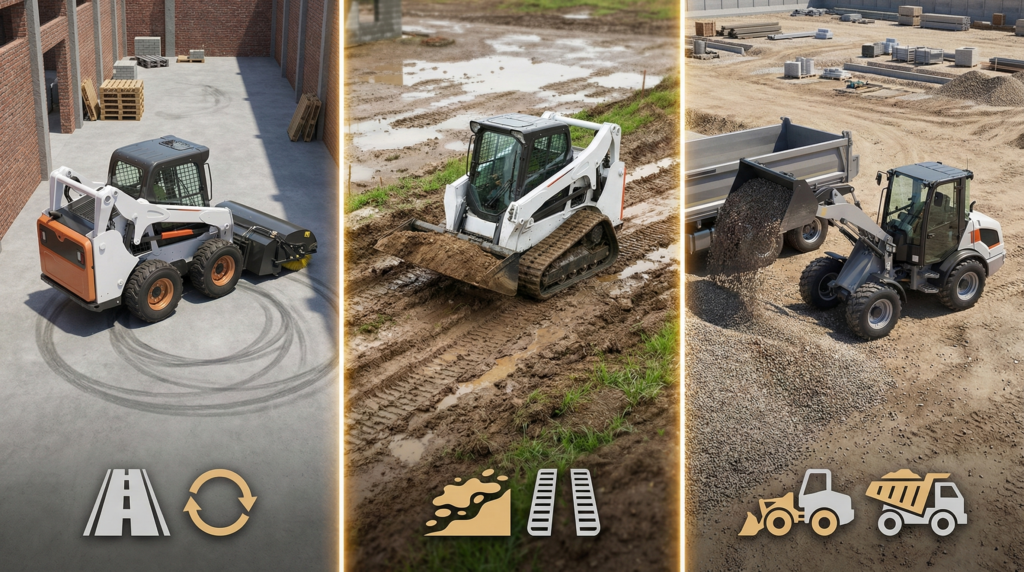
Before starting skid steer buying checklist, You need to be sure to accurately estimate your projected lifting needs, often called the Rated Operating Capacity (ROC), to prevent buying a loader that’s too weak or too costly to fuel and operate. In addition, knowing the area you will be working on will let you to know whether you need wheeled models made for firm surfaces, or tracked models (compact track loaders) suited for muddy, uneven fields.
When you take the time to really look at these core components, it guarantees that the remainder of your inspection process is very focused and fiscally responsible. And you have to think about how the equipment is really going to be moved from site to site. A heavy-duty transport trailer and a big tow vehicle are needed for a large-frame loader, which greatly increases your total operating logistics and costs.
Setting these precise requirements before you start shopping will remove the deadly temptation to acquire a machine because of a pretty price tag, and instead, it will ensure that it is a great fit with your day-to-day company operations.
- Calculate the ROC: Always know what your heaviest daily load is to estimate the Rated Operating Capacity (ROC) that you need so you never push the machine beyond its safety limitations and risk a tipping danger.
- Assess Job Site Surfaces: Make a strong decision on the agility and cheap running cost of wheels vs the better grip and flotation of heavy rubber tracks for your principal job site surfaces.
- Assess Space Constraints: Assess common space restrictions such as gate widths, trailer sizes, and inside space restrictions to determine the right frame size that won’t harm property.
- The Mechanical Core: Drivetrain, Emissions and Structural Integrity
When you are at the formal physical inspection phase of your skid steer buying checklist, the pounding heart and hefty bones of the machine need your full expert attention. The engine is the heart of your everyday performance and expert mechanics may see the subtle indicators of neglect or imminent catastrophic failure.
You should always insist on a cold start since this will show up any genuine starting problems, exhaust smoke of abnormal colours and internal rattles that a warm engine would readily disguise. Today’s diesel engines also have very complicated emissions systems such as Diesel Particulate Filters (DPF) and Diesel Exhaust Fluid (DEF) systems that need tight, uncompromising maintenance to work properly.
Outside of the engine area, look for hairline cracks, amateur re-welds or apparent bends in the steel chassis and main loader arms, since these are all tell-tale signs that the previous owner used the equipment in abusive, overloaded circumstances. You should also check the condition of the metal pins and bushings aggressively.
Excessive loose play in the loader arms is a sign that the machine was used for hard digging without regular daily lubricating. This is a labor hard and pricey repair. If you still want to buy it, you need to immediately take this into account in your price discussions. Replace damaged pins and bushings.
- Require Cold Start: Need to be cold engine start to check for excessive white or blue smoke, harsh idling or immediate warning lights flashing on the digital dashboard.
- Check Structural Welds: Carefully examine all boom arms, pivot points and the main frame for non-factory welds, severe structural corrosion, or stress fractures that might pose a safety hazard to the operator.
- Check Emissions Maintenance: confirm emissions systems are current with their status and maintenance records to confirm required DPF regenerations have been conducted actively on the manufacturer schedule.
- Hydraulic System and attachment compatibility evaluation
In essence, a skid steer is a mobile hydraulic power station on wheels or tracks. So the overall health of the hydraulic system is one of the most important checkpoints on any expert skid steer purchase checklist. This machine’s absolute and unequaled adaptability comes straight from its ability to operate dozens of attachments perfectly, from basic mud buckets to big, power-hungry forestry mulchers.
To operate these specialist equipment properly, you need to verify that the auxiliary hydraulic flow matches the precise attachments you want to run on your sites. Standard hydraulic flow is acceptable for simple digging and lifting, but heavy-duty, continuous-use attachments such as cold planers, trenchers or snow blowers need high flow hydraulics.
A physical examination of the machine is a must, and when you’re looking for hydraulic fluid leaks, examining the outside condition of the rubber hoses for dry rot or deep abrasions, and testing the universal quick-attach plate mechanism, you’ll be looking for signs of wear or damage.
A huge delay in the reaction while raising or tilting a highly filled bucket is a huge red sign that the main hydraulic pump could be on its very last legs. Another insider tip is to take a close look at the colour and smell of the hydraulic fluid in the reservoir. Milky oil indicates that outside water has sadly made its way into the closed system.
An oil with an aggressive burned smell indicates the machine has been operating much too hot and there is significant internal component damage which will cost thousands to repair.
- Check Hydraulic Flow Rate: Make sure your machine has standard or high flow hydraulics to be sure it will work with your present and future heavy-duty task attachments.
- Look for Hidden Leaks: Check for leaking fluid, deep scratches or bulging lines on any metal hydraulic cylinders, rubber hoses and connecting points. These are indicators that emergency repair is required.
- Test Load Responsiveness: Move the heavy loader arms and bucket through their complete vertical range of motion with a heavy load to observe smooth functioning, holding power, and any indications of hazardous hydraulic drift.
- CabLayout, Operator Comfort and Critical Safety Features
It is a well-known and recognized truth in the heavy construction sector that a comfortable operator is a highly productive and intrinsically safe operator. So professional site contractors and fleet managers alike strongly advocate the addition of deep cab conditions to your skid steer buying checklist criteria.
When your personnel are bouncing about a hectic, uneven job site for eight to ten arduous hours a day, the overall ergonomics of the cab quickly become a critical problem of physical health and endurance.
Modern skid steers are very good at providing many control patterns for operating the machine including the ISO, H-shaped or classic hand and foot controls. It is essential that the equipment be tailored to the operators learning preferences for instant efficiency on the work site.
The cab should also be sealed to offer great view all around to avoid accidents, should have good air conditioning for the hot months, and should have outstanding safety features. Trained professionals will always check the integrity of the Roll-Over Protective Structure (ROPS) and Falling Object Protective Structure (FOPS) since risking life saving safety to save a few dollars is a gamble you just can’t afford to take.
Also be sure to listen to the noise level inside the enclosed cab with the door securely closed and engine running at high idle. Too much engine noise means operator fatigue, which equates to a huge decrease in task site productivity. And premium, sealed cab environment is not an optional luxury; it is a necessary, money-making element of increasing the daily production of your personnel.
- Test Joystick Ergonomics: Test the joystick controls for responsiveness and physical ergonomics, making that they are digitally selectable patterned if there are to be many operators of the system at some point.
- Verify Climate Control: Verify cab climate control systems (HVAC) are working properly and blowing cold air, and suspension seat provides enough shock absorption for harsh terrains.
- Inspect Safety Framework: Make that all standard safety features are in place including digital back-up cameras, electronic seatbelt lockouts, emergency escape windows, and the physical integrity of the ROPS/FOPS heavy steel cage.
- Estimate of Long-Term Ownership Cost and Maintenance History Study
The last but maybe most financially important investigation step in your Skid Steer Buying Checklist is to dig deep into the documents presented and precisely forecast the total cost of ownership over the long run.
A very inexpensive skid steer with a very neglected history will quickly become an extremely costly nightmare lying broken down in the service bay. Smart specialists usually have service records available to check on fluid changes, filter changes, and obligatory greasing schedules to be sure the prior owners were attentive.
Realistically, you have to look at the future and not the machine’s murky history. How soon can you get replacement parts for this particular make and model in your immediate local area? Buying a weird niche brand may save you thousands of dollars immediately, but if your machine is sitting absolutely idle for 3 weeks just waiting for a proprietary hydraulic part to come, those initial savings go out the window.
Before you make your final binding investment choice, check out the local dealer assistance, factory warranty transferability and the general industry rep of the manufacturer. Always examine the undercarriage system or tires carefully. A pair of massive solid flex tires or heavy duty rubber tracks cost a fortune to replace.
If these big wear products are showing that they are coming to the end of their working life, then you need to heavily discount for the future replacement costs from the seller’s present asking price.
- Review Service History: Obtain and carefully review the detailed service history to ensure that the engine oil, hydraulic fluid and main air filters were replaced at the manufacturer’s specified intervals.
- Check Parts Availability: Avoid protracted and costly downtime during crucial project stages by verifying the availability of local dealer support networks and replacement parts.
- Wear Items Budget: Check the physical condition of all wear items including tire tread depth, track undercarriage sprockets, and bucket cutting edges to budget for quick post purchase replacements.
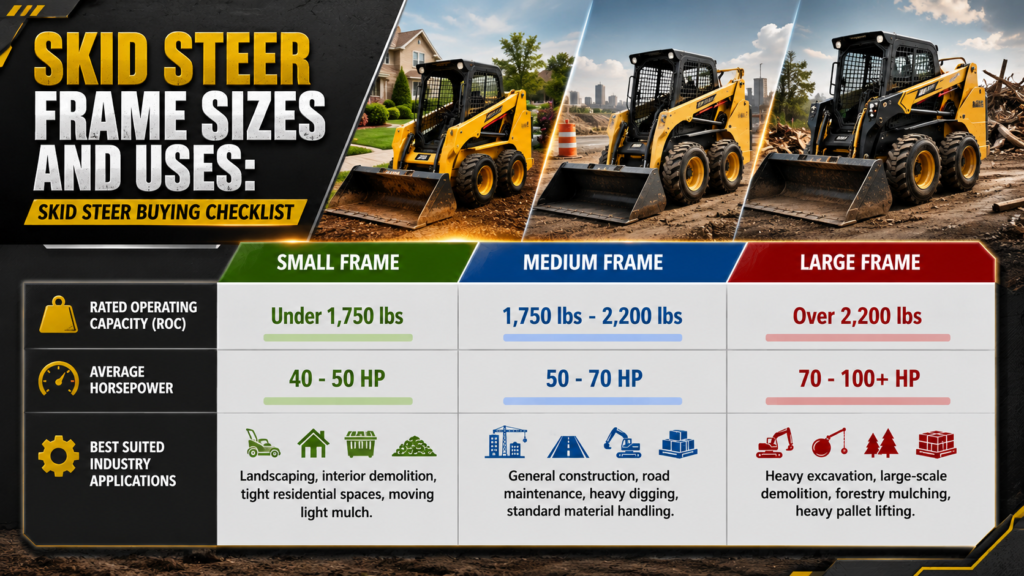
Skid Steer Frame Sizes and Uses: Skid Steer Buying Checklist
| Skid Steer Frame Size | Rated Operating Capacity (ROC) | Average Horsepower | Best Suited Industry Applications |
| Small Frame | Under 1,750 lbs | 40 – 50 HP | Landscaping, interior demolition, tight residential spaces, moving light mulch. |
| Medium Frame | 1,750 lbs – 2,200 lbs | 50 – 70 HP | General construction, road maintenance, heavy digging, standard material handling. |
| Large Frame | Over 2,200 lbs | 70 – 100+ HP | Heavy excavation, large-scale demolition, forestry mulching, heavy pallet lifting. |
FAQs on Skid Steer Buying Checklist
What is a skid steer loader?
Its name is derived from its unusual steering system. Unlike a normal automobile, the wheels or tracks on each side are independent, so the machine drags or “skids” over the ground to pivot in position.
What sort of skid steer is better for construction versus landscaping?
Smaller, lighter-weight variants are used for landscaping to avoid damage to the lawn. Construction needs medium to big frame loaders with high ROC to transport heavy debris easily.
Do I need a CDL or special license to operate a skid steer?
You normally do not require a Commercial Drivers License (CDL) to operate on a private work site. But if the overall weight is beyond state limitations, you will definitely require a CDL to use the equipment on public roadways .
Wheeled skid steer or compact track loader (CTL)?
Which one to go for? Wheeled skid steer loaders are better suited for hard, flat surfaces such as concrete and provide cheaper maintenance expenses. Track Loaders Track loaders provide excellent floatation and are the best for muddy or very uneven ground.
What is Rated Operating Capacity (ROC)?
The ROC is the ultimate maximum weight that the skid steer can safely lift and manage without the hazardous risk of tipping forward. It’s a crucial step to match a machine with your day-to-day work.
- Conclusion: Invest in Your Skid Steer with Confidence
Your heavy equipment purchase adventure ends with a lot of patience, rigorous due diligence, and tight, unyielding adherence to the expert skid steer buying checklist we have thoroughly highlighted above.
At skidsteerloader.org, we’re dedicated to making sure that hard-working contractors, farmers and property managers make wise equipment purchases that move their companies ahead, not deplete their crucial maintenance budgets. Never allow a very eager vendor to pressure you into a quick examination of the machine.
Be prepared to walk away quickly if the hydraulic condition or maintenance history of the machine is not quite to your liking. A very wise last step in any secondhand equipment acquisition is to get an independent, qualified heavy equipment mechanic to provide a thorough, impartial examination.
In the end, if you invest the time to truly match your job site needs with the proper frame size, take a good look at the complicated mechanical pieces and ensure the operator is comfortable for the long haul, you will be left with a dependable machine that will deliver the best return on your total investment for many years into the future.
- Be Prepared to Walk: Know when to walk away from a contract if the vendor can’t produce good maintenance records or if the machine fails the first cold start examination.
- Get a technician: Seriously consider having a licensed independent heavy diesel technician do a digital diagnostic and sign off on the engine’s integrity before you purchase.
- Insurance and Transport: Have the proper heavy equipment insurance coverage and safe, weather-proof transportation plan in place before the machine officially arrives.
Skid Steer Buying checklist