Skid Steer Loaders in Farming Applications Agricultural Uses
Skid Steer Loaders have basically revolutionized how current agricultural activities are undertaken around the world. Skid Steer Loaders in Farming – Gone are the days of farmers and ranchers relying on just big, unwieldy tractors to get every single duty done around the land.
These powerful machines have shown themselves to be necessary workhorses, able to access confined locations, handle enormously large loads and switch between entirely different duties in a matter of seconds.
Whether you are moving huge round bales of hay, emptying out small barns, excavating trenches for irrigation or preparing the soil for the next planting season, the sheer adaptability of a skid steer means that it can be easily suited to practically any seasonal or daily demand on a farm.
The correct equipment, when used by agricultural specialists, may make a huge difference in the overall productivity of the farm, easing back-breaking physical work and significantly minimizing downtime on the job.
Benefits of Using Skid Steer Loaders in Farming
When talking about Skid Steer Loaders in Farming, it is hard to overlook the various operational benefits this very powerful equipment provide in a farm environment. One of the biggest and most immediate pay-offs is their unmatched agility.
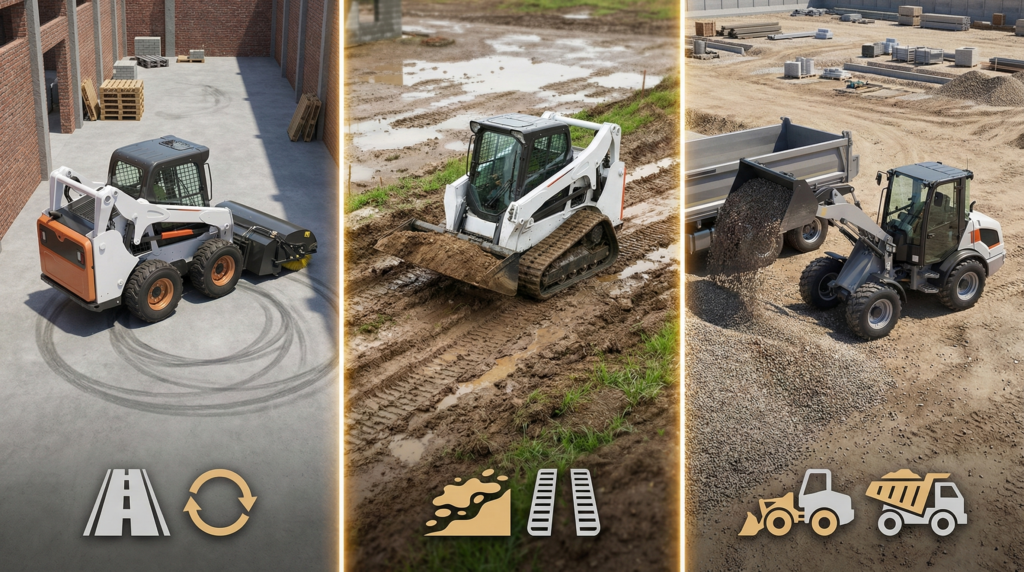
Unlike standard farm tractors that need a large turning radius and plenty of open space, skid steers can practically turn on a dime, making them perfectly ideal for operating within small dairy buildings, tiny animal feedlots or densely packed orchards.
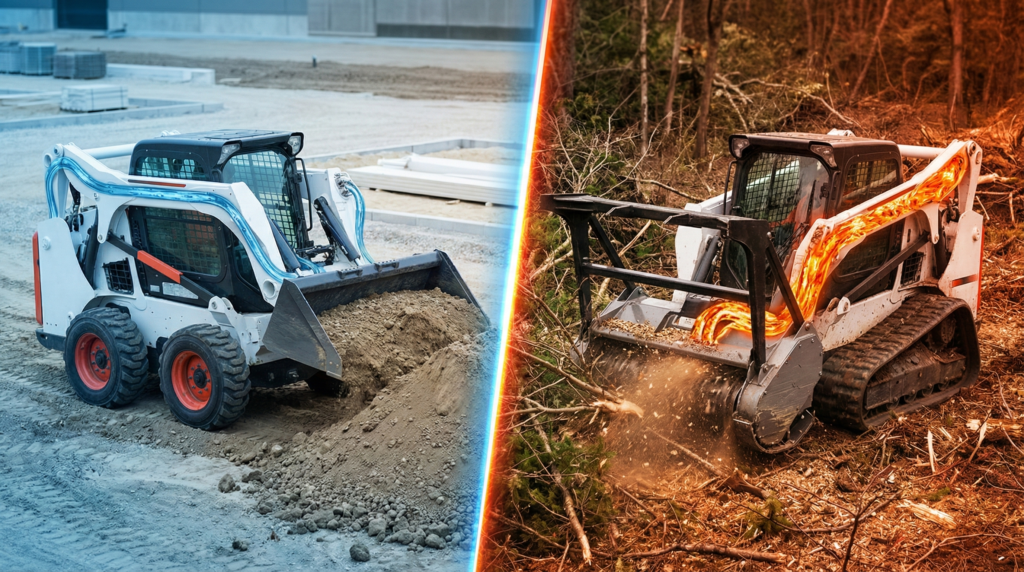
Plus they have an unbelievably small footprint without sacrificing their raw engine power or hydraulic capabilities. Skid steers, in the medium and large frame sizes, are capable of securely lifting massive pallets of feed, hauling big bales, and even running high-flow hydraulic attachments that can make extremely short work of recalcitrant tree stumps or deeply compacted, rocky soil with the right setup.
The combination of tiny physical size and high operating power greatly minimizes the manual work on a farm, saving countless hours and considerably increasing the total productivity and profitability of the enterprise.
- Unmatched maneuverability: Easily maneuvers through tiny barn doors, tight feed alleys and small storage spaces that a conventional, wide-body tractor just cannot safely pass through.
- Amazing Flexibility: Just by changing the hydraulic attachment, one machine can accomplish dozens of completely different agricultural activities, considerably eliminating the need to buy a number of other specialist vehicles.
- Time and Labor Efficiency: Skid steers assume the physical work and repetitive manual chores, freeing farmers to concentrate their resources on more strategic and time-sensitive crop management activities.
Skid Steer Loaders in Farming – Key Attachments
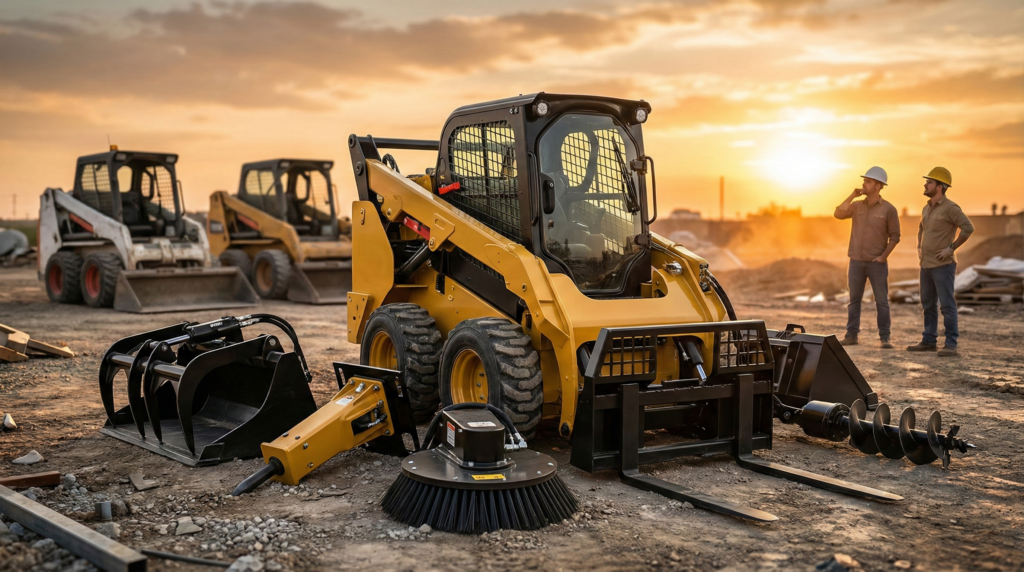
The genuine and indisputable charm of Skid Steer Loaders in Farming is contained in the wide variety of specialized attachments that are available for these machines. A skid steer itself is nothing more than a localized power source; add the correct attachment, and you have an immediate highly specialized agricultural instrument.
Getting the appropriate attachment in the right place might be the difference between a lengthy, grueling struggle and a quick, easy finish before lunch. Daily farming is often done by a few trusted groups of farmers who efficiently manage daily maintenance, livestock care and large scale land management.
The versatility is second to none, from high-duty augers that drill accurate holes for miles of long-lasting livestock fence to tough grapple buckets that effortlessly remove heavy brush, deadwood and big boulders. It is very important for operators to ensure that the hydraulic flow (Standard vs. High Flow) and rated operating capacity (ROC) of their individual skid steer is carefully matched to the attachment selected so that they may achieve optimum safety and avoid catastrophic mechanical wear.
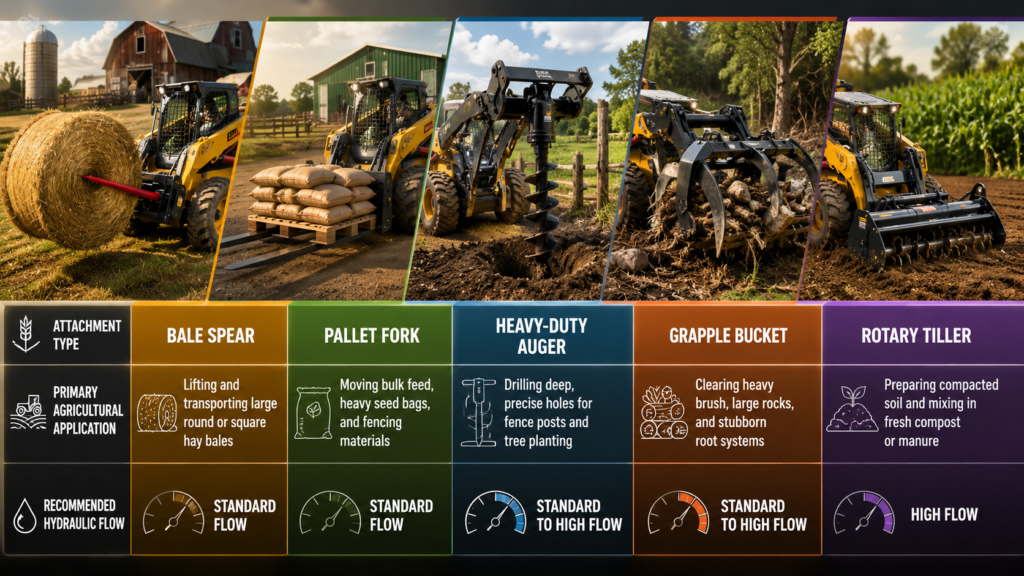
- Bale Spears and Pallet Forks: Essential for securely lifting enormous hay bales, hauling important feed for livestock and moving large pallets of fertilizer over rough agricultural ground.
- Augers & Trenchers: Ideal for swiftly building new perimeter fence lines, or digging shallow trenches for required irrigation pipes, without disturbing large, unneeded areas of the precious land.
- Grapple Buckets and Tillers: Easily remove out roots and boulders from tough ground with grapple buckets, and prepare compacted soil for planting with tiller attachments that fully mix in vital nutrients and compost.
Table: Skid Steer Loaders in Farming
| Attachment Type | Primary Agricultural Application | Recommended Hydraulic Flow |
| Bale Spear | Lifting and transporting large round or square hay bales | Standard Flow |
| Pallet Fork | Moving bulk feed, heavy seed bags, and fencing materials | Standard Flow |
| Heavy-Duty Auger | Drilling deep, precise holes for fence posts and tree planting | Standard to High Flow |
| Grapple Bucket | Clearing heavy brush, large rocks, and stubborn root systems | Standard to High Flow |
| Rotary Tiller | Preparing compacted soil and mixing in fresh compost or manure | High Flow |
Skid Steer vs. Tractor in Agricultural Applications
It is a very popular and hotly disputed subject within the farming world as to whether Skid Steer Loaders in farming can totally replace the conventional necessity for ordinary farm tractors. In actuality, these devices have different but extremely complimentary tasks on a modern farm.
Tractors are constructed heavy and made expressly to haul huge equipment, plow huge swathes of open fields and do high-horsepower work over extraordinarily long distances. They will always provide good results in large-scale crop production when the raw pulling force is the most important and critical need.
However, in terms of agility, handling materials in very tight areas, and doing several tasks quickly on diverse kinds of terrain, the skid steer is the best. Many contemporary, highly efficient farms have taken a hybrid strategy, using huge classic tractors for broad-acre field work, while depending largely on smaller skid steers for the day-to-day logistical duties, barn upkeep and heavy lifting around the farmyard.
Knowing the special limits and amazing capabilities of each machine makes sure the farmer is using their precious equipment in the most cost-effective and operationally successful way possible.
- Task Specificity: Tractors are clearly the greatest for heavy-duty hauling, deep plowing, and broad-acre tilling. Skid steers are definitely the finest for lifting, loading, and confined-space maneuvering.
- Cost and Ease of Attachments: Both sophisticated machines need different attachments, but skid steer attachments are far more standardized and much faster to switch on the fly to move between important assignments quickly.
- Maneuverability Differences: Skid steers are able to do real zero-turn movements easily and are the much better alternative for inside barn work and confined feedlot operations over a normal tractor that has an enormously large turning radius.
Keep your equipment in good shape for continuous farming
To constantly get the maximum most out of Skid Steer Loaders in Farming, a rigorous, rigid and regular maintenance regimen is extremely important to your success. All kinds of heavy equipment have a harder time surviving in agricultural situations.
Without adequate, regular maintenance, thick dust, deep muck, caustic manure and continual, high vibration may rapidly destroy vital engine components and hydraulic seals.
Any operator should be used to doing regular daily checks before operation, carefully checking critical fluid levels, tire pressure or track tension, and the physical condition of any hydraulic lines.
Farm use generally runs these little tractors to the max of their rated operating capacities, and maintaining the internal engine and complex hydraulic systems in top working order completely removes catastrophic failures during the busiest and most critical times of the year such as the fall harvest or spring planting.
Just a few minutes of devoted preventative maintenance each day can greatly increase the useable life of the skid steer and keep it as a highly dependable, lucrative companion on the farm.
- Daily Fluid and Filter Checks: In the most dusty and demanding agricultural conditions, checking hydraulic fluid, engine oil and engine air filters on a regular basis is important to avoid instant engine suffocation.
- Grease All Moving Parts: Apply high-quality grease generously to all pivot points, lift arms and heavy attachment joints on a regular basis to minimize unnecessary wear and tear from continual heavy lifting and metal-on-metal friction.
- Tire and Track Maintenance Focus: Regularly checking tire pressure on wheeled models and track tension on compact track loaders maintains maximum grip in the mud and avoids expensive undercarriage repairs.
New Applications in Contemporary Agriculture
With the fast development of worldwide technology, the very new uses related with Farming using Skid Steer Loaders also progress. Today’s top-tier versions have secure, very complex, high-pressure hydraulic systems, vastly upgraded operator comfort features (think enclosed, climate-controlled cabins, for example) and even smart, real-time data-tracking capabilities.
Farmers are finding some really imaginative, outside-the-box methods to use these huge machinery well beyond the conventional scooping, scraping and lifting of the past. Skid steers, for example, are now used frequently and safely on big dairy and cattle operations to effectively handle massive quantities of waste with highly specialized rubber manure scraper attachments, resulting in much improved farm cleanliness and a greatly reduced danger of airborne diseases.
They are also significantly used in large scale landscaping and sophisticated orchard management for exact quick tree planting, heavy duty stump grinding and rapid uniform mulch application across enormous area.
Skid steer technology has steadily and impressively evolved to a place where they will only continue to wildly expand in their vital role in global agriculture. Skid steers provide dynamic solutions to complex challenges that once required intense back-breaking manual labor or heavily specialized single-use equipment.
- Advanced Waste Management: Using specialized heavy-duty scrapers and rotating sweepers to deep clean very clean feedlots and barns that greatly enhance overall herd health and cleanliness.
- Precision Landscaping & Forestry: Running high-flow hydraulic stump grinders, giant tree spades and broad mulch spreaders to attractively manage big fruit orchards, farm perimeters and extensive agricultural estates.
- Fast-Tracking Infrastructure Development: Actively aiding in the quick and cost-effective building of new farm roads, flawlessly leveling the ground for new giant storage silos, and smoothly putting down tons of gravel to provide paths for heavy equipment.
FAQs: Skid Steer Loaders in Farming
What are the top attachments for Skid Steer Loaders in Farming?
Bale spears, adjustable pallet forks, heavy duty hydraulic augers, tough grapple buckets and rotary tillers are the absolute most important accessories for effectively completing the great bulk of everyday agricultural operations.
Is it possible to use a skid steer instead of a tractor on the farm?
They are quite adaptable but a skid steer is often a good addition to a normal tractor, not a replacement. Tractors are more better for heavy hauling and wide acre field plowing . Skid steers are really amazing at material handling and moving in confined spaces .
What size skid steer is ideal for farming?
Medium (50-70 HP) to big frame (70+ HP) versions are usually best and most popular. They provide the needed lifting force and hydraulic power for heavy agricultural work, yet they are not too bulky for narrow barn areas.
Skid steers with tracks or wheels which is better for farming?
Compact Track Loaders (CTLs) are a popular choice for major farming operations, as their strong tracks provide much better grip and put substantially less strain on the ground while working in wet, soft or very uneven farm fields.
How much can a skid steer safely lift on a farm?
Modern agricultural skid steers are more than capable of securely handling hefty feed pallets and gigantic large round hay bales, safely raising anywhere from around 1,500 pounds to well over 3,500 pounds, according on the particular model’s Rated Operating Capacity (ROC).
Are skid steers helpful for heavy land clearing?
Absolutely yes. When fitted with high flow hydraulic attachments such as heavy brush cutters, forestry mulchers and deep root grapples, skid steers are very efficient, swift and safe for major land clearance and challenging site prep.
How to Properly Maintain Skid Steer Loader for Agricultural Use?
Accurate daily testing of all fluid levels, thorough cleaning of engine air filters (from very dusty agricultural conditions), ample lubrication of all metal pivot points, and correct track tension or wheel tire pressure are all part of strict daily maintenance.
Final Verdict – Skid Steer Loaders in Farming
To summarize, Skid Steer Loaders in Farming provides a highly dynamic, very efficient and immensely diverse solution to skillfully meeting the needs of contemporary agriculture. Farmers may effortlessly harness the absolute full potential of these exceptional heavy machines by completely comprehending their specific operating benefits, strategically investing in the proper high-quality attachments and meticulously following to rigorous maintenance methods.
Whether you operate a small family homestead or a large commercial agricultural enterprise, incorporating a modern skid steer loader into your daily activities will surely save you lots of time, reduce physical human strain, and easily maximize your overall farm productivity and bottom line profitability.