Can You Cut Hay with a Skid Steer? A Real-World Operator’s Field Guide with Skid Steer Hay Cutting Attachment
Walk onto almost any small acreage or livestock operation, and you’ll likely spot a traditional utility tractor hooked up to an old pull-type sickle bar or disc mower. It’s how folks have harvested forage for decades, and it’s what most people picture when they think about putting up winter feed. But if you already own a compact track or wheeled loader for dirt work, barn cleaning, and heavy lifting, dropping twenty to forty grand on a dedicated agricultural tractor just to cut a few dozen acres of grass feels like an unnecessary blow to the bank account. Then choosing skid steer hay cutting attachment is the best option which is available within the budget.
You find yourself looking out at the overgrown pasture, looking back at your machine, and wondering: can you honestly cut hay with a skid steer? The straightforward answer is yes, you absolutely can. With a properly spec’d skid steer hay cutting attachment, you can turn your everyday loader into a remarkably capable mowing rig.
However, it isn’t quite as simple as slapping on the first hydraulic cutter you find on an auction lot and charging into the field at wide-open throttle. Harvesting clean feed that actually cures and bales well requires understanding your machine’s hydraulic cooling limits, cutting dynamics, and ground pressure.
- Modern hydrostatic drive setups provide infinite ground-speed control, letting you creep through heavy, lodged forage while maintaining peak blade speed.
- Upfront operator positioning gives you a direct line of sight over the cutting edge, so you can dodge hidden rocks, washouts, and irrigation risers long before you hit them.
- Repurposing your existing machine cuts down on equipment depreciation, oil changes, insurance costs, and storage headaches across the farm.
The Practical Reality of Modern Skid Steer Loaders on the Farm
If you haven’t sat in the cab of one of the newer skid steer loaders lately, you might still think of them as stiff, rough-riding machines meant strictly for shoving gravel on a commercial job site. That reputation was earned decades ago, but modern engineering has completely changed the landscape.
Today’s machines feature high-flow auxiliary hydraulics, pressurized cabs with climate control, ride-control accumulator kits that cushion rough ground, and long tracks that float over soft ground with minimal turf disruption. For livestock producers operating on irregular ground, steep hillsides, or tight paddocks boxed in by post-and-wire fencing, skid steer loaders regularly outperform sixty-horsepower farm tractors simply because they can pivot on a dime.
Instead of leaving massive triangular patches of uncut grass in every corner of the field, a skid steer lets you square off your passes cleanly, trim right along fence lines, and tuck neatly under low-hanging tree branches without tearing up your ROPS canopy.
- Zero-turn maneuverability allows operators to trim out irregular pastures and fence lines without making three-point turns or leaving standing grass behind.
- Rubber-tracked platforms distribute machine weight over wide footprints, which helps prevent deep rutting if you have to cut in low-lying, damp bottomland.
- Two-speed transmissions on larger models give you the road travel speeds necessary to move between non-contiguous hay pastures without wasting precious daylight.
Selecting the Right Skid Steer Hay Cutting Attachment
The biggest stumbling block beginners run into isn’t horsepower; it’s picking the wrong tool for the crop. You can’t just roll into a prime stand of timothy, orchardgrass, or alfalfa with a standard land-clearing bush hog and expect to rake up balable forage afterward.
Heavy-duty brush cutters rely on blunt force to smash through saplings and thick weeds, leaving the plant fibers shredded into pulp that rots on the ground rather than drying down into sweet hay. For legitimate forage production, your primary investment must be a dedicated skid steer hay cutting attachment that employs a clean-shearing mechanism.
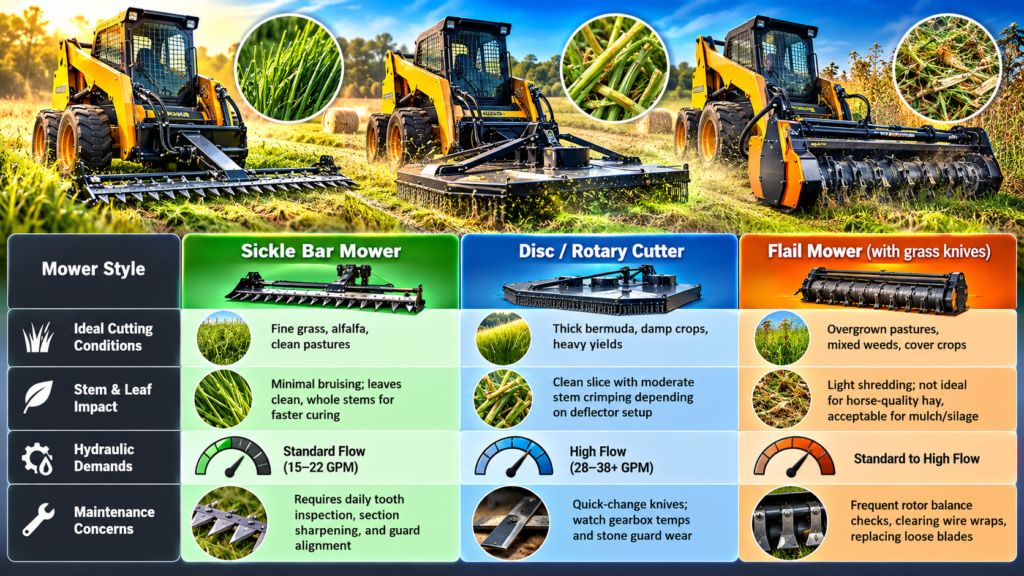
The two standard options are sickle bar mowers and disc (or drum) cutters. A sickle bar uses reciprocating knife sections against ledger plates, neatly severing the stem at ground level and laying the crop down in an intact mat that allows air to circulate freely beneath it. Disc mowers run high-speed spinning pods equipped with reversible, thin knives that slice cleanly through dense, damp bottom grass without binding.
When shopping for your skid steer hay cutting attachment, pay very close attention to whether the motor requires standard auxiliary flow (roughly 16 to 24 gallons per minute) or high-flow hydraulics (30 to 40+ GPM), and ensure your loader has the case drain line installed if the attachment’s hydraulic motor requires one.
Table: Skid Steer Hay Cutting Attachment
| Mower Style | Ideal Cutting Conditions | Stem & Leaf Impact | Hydraulic Demands | Maintenance Concerns |
| Sickle Bar Mower | Fine grass, alfalfa, clean pastures | Minimal bruising; leaves clean, whole stems for faster curing | Standard Flow (15–22 GPM) | Requires daily tooth inspection, section sharpening, and guard alignment |
| Disc / Rotary Cutter | Thick bermuda, damp crops, heavy yields | Clean slice with moderate stem crimping depending on deflector setup | High Flow (28–38+ GPM) | Quick-change knives; watch gearbox temps and stone guard wear |
| Flail Mower (with grass knives) | Overgrown pastures, mixed weeds, cover crops | Light shredding; not ideal for horse-quality hay, acceptable for mulch/silage | Standard to High Flow | Frequent rotor balance checks, clearing wire wraps, replacing loose blades |
- A dedicated skid steer hay cutting attachment preserves the structural integrity of the plant stem, preventing the mold issues caused by smashed, pulped foliage.
- Standard-flow hydraulic systems can easily power wide sickle bars, keeping fuel consumption down and engine temperatures stable during hot mid-summer cuts.
- High-flow disc mowers cut through wet, tangled forage at much faster ground speeds, but they demand clean hydraulic fluid and continuous radiator management.
Field Workflow and Using a Skid Steer Loaders Attachment for Processing
Once the crop is laid down, the real race against the weather begins. Haying is notoriously unforgiving: you need consecutive rain-free days to dry the moisture down below sixteen percent for small squares or twenty percent for net-wrapped rounds. Managing this window means having reliable machinery ready to turn and consolidate the crop.
This is where hooking up a well-built skid steer loaders attachment pays massive dividends. After the initial cut, many operators switch over to a front-mounted tedder or a hydraulically driven wheel rake.
Operating a rake mounted on the front of your loader is an eye-opening experience if you’ve spent your life craning your neck backward over a tractor fender. Because the skid steer loaders attachment runs directly in front of the cab, you can watch the windrow form in real-time, adjust your down-pressure on the fly using your joystick controls, and follow gentle ground contours with extreme accuracy. The result is fluffy, consistent windrows that dry out evenly and feed smoothly into a baler pickup head without choking the intake.
- Front-mounted rakes give you direct visual feedback, letting you spot foreign objects or adjust working depth before gouging into the dirt and contaminating the hay.
- Smooth hydraulic joystick modulation prevents jerky implement movements that can knock delicate, nutrient-rich alfalfa leaves off the stems.
- Using your primary loader for raking eliminates the hassle of keeping a second, dedicated tractor running and serviced just for light field tasks.
Must-Have Skid Steer Attachments for Handling and Stacking
Putting the hay on the ground and rolling it up is only half the battle; getting those heavy, bulky packages out of the weather and stacked securely inside your barn before a thunderstorm hits is where true efficiency shows. The agricultural implement industry has designed an impressive array of specialized skid steer attachments built specifically to take the back-breaking misery out of bale handling.
For dry round bales, a heavy-duty forged bale spear mounted on a standard quick-attach backplate remains the benchmark tool. However, if your operation wraps high-moisture baleage or winter silage in white plastic stretch film, driving a spear through the center will ruin your airtight seal and spoil hundreds of dollars worth of feed.
In that case, hydraulic bale huggers or bale squeeze skid steer attachments are vital. These units use smooth, tubular steel arms powered by hydraulic cylinders to clamp securely around the perimeter of the bale, lifting and stacking it without puncturing the wrapper.
If you produce small two-string square bales, front-mounted bale accumulators and multi-grapple systems let a single person pack, lift, and load hundreds of bales onto flatbed trailers in a single afternoon without touching a single one by hand.
- Dual-tine and single-tine bale spears make quick work of loading, moving, and stacking dry 4×5 or 5×6 round bales in tight dry-storage sheds.
- Hydraulic bale squeeze skid steer attachments preserve the critical oxygen barrier on plastic-wrapped silage bales during transport and stacking.
- Mechanical bale grapples allow a single operator to lift groups of eight to fifteen small square bales at once, slashing manual labor requirements down to zero.
FAQs: Skid Steer Hay Cutting Attachment
Can you realistically pull and power a baler with a skid steer?
Mechanically speaking, it is doable, but practically, it requires serious modifications. Standard round and square balers are engineered around a tractor’s mechanical PTO shaft and trailing drawbar hitch. Running one behind a loader means buying a specialized hydraulic-to-PTO power pack or installing an aftermarket rear-mounted hitch plate with auxiliary hydraulic plumbing routed to a heavy-duty hydraulic motor. Unless you invest in a dedicated skid-steer-specific baler model designed specifically for front mounting, running a standard baler off a loader is generally more trouble and expense than finding an affordable, older utility tractor dedicated purely to the baling phase.
- Standard agricultural balers require steady 540 or 1,000 RPM mechanical PTO drives that traditional loaders do not offer natively.
- Hydraulic conversion power packs can run a baler, but they generate massive amounts of continuous heat in the loader’s hydraulic circuit.
- Most operators find the best financial balance by cutting, raking, and handling bales with their loader, while borrowing or using an older tractor strictly for the baler.
How do you keep a skid steer from overheating when mowing in hot pastures?
Hydraulic mowers demand constant, high-pressure oil delivery under heavy load, often during the hottest ninety-degree days of July and August. At the same time, tall grass, blowing chaff, seed heads, and dried weed fluff get sucked directly toward your machine’s cooling pack. To prevent hydraulic fluid and engine coolant from pegging the redline, you must blow out your radiator, oil cooler, and engine compartment with compressed air or a leaf blower at least twice a day. Many operators running a high-demand skid steer hay cutting attachment invest in an aftermarket reversible cooling fan that automatically purges debris from the intake screens every few minutes.
- Stop the machine every few hours to blow out radiator fins, air intake screens, and belly pans to maintain proper cooling airflow.
- Install an automatic reversing engine fan to blow trapped chaff and seed heads off the rear access door while mowing.
- Keep your hydraulic fluid clean, monitor your case drain filters religiously, and never ignore early warning alarms on your temperature display.
What machine size is required to safely move 5×6 round bales?
Round bales packed tight with alfalfa, orchardgrass, or sudangrass can easily tip the scales between 1,200 and 1,800 pounds, while high-moisture silage bales can exceed 2,200 pounds. You need a machine with a Rated Operating Capacity (ROC) that comfortably handles this weight without pitching forward onto its nose every time you tap the brakes. A medium-to-large-frame loader with a minimum 50% tipping load rating of 2,500 to 3,000 pounds is recommended for handling full-size rounds safely, particularly when traversing uneven pastures or climbing trailer ramps.
- Know your bale weights: moisture content dramatically changes bale mass, turning an easy lift into a tipping hazard.
- Look for a machine with a Rated Operating Capacity of at least 2,500 lbs to maintain steerability and braking traction with a bale raised.
- Bolt on factory counterweight kits to the rear of your loader to keep the back tires or tracks planted firmly on the dirt when carrying heavy loads.
How does ground speed compare between a skid steer and a farm tractor?
In clean, flat, open fields, a high-horsepower agricultural tractor pulling a ten-foot disc mower conditioner will outpace a loader, easily mowing at ten to twelve miles per hour. A compact loader running a front-mounted mower will typically work at four to seven miles per hour depending on ground smoothness and hydraulic capacity. However, in small, oddly shaped fields with obstacles, ditches, and tight headlands, the loader makes up massive amounts of ground time during turning maneuvers, resulting in surprisingly similar overall completion times on plots under twenty acres.
- Tractors hold the speed advantage on wide-open, long-run acreage where straight-line velocity dictates total harvest time.
- Loaders narrow the productivity gap significantly in small, choppy pastures that require constant slowing, backing, and re-aligning.
- Tracked machines provide a smoother ride across dried washouts and cattle tracks, allowing the operator to maintain steady mowing speeds without getting thrown around the cab.
Will skid steer tracks or tires tear up the hayfield turf?
If you drive a skid steer the way you would on a dirt job site—spinning around rapidly on one spot—you will gouge deep ruts in the sod, tear up grass crowns, and create bald spots that invite invasive weeds. However, an experienced operator running wide, low-ground-pressure turf or multi-bar rubber tracks who makes wide, sweeping three-point radius turns will leave remarkably little footprint. In fact, on soft, moist ground, a wide-track loader often causes substantially less subsoil compaction than a heavy farm tractor with narrow, high-pressure rear tires.
- Always make wide, sweeping gradual turns at the ends of your cutting swaths instead of pivoting hard on a locked track.
- Multi-bar or block-tread rubber tracks distribute vehicle weight far better than traditional deep-lug agricultural tires, sparing grass root structures.
- Avoid cutting immediately after soaking rains when soft topsoil is prone to shearing and track slippage.
Do you need high-flow hydraulics to run a sickle bar mower?
No, one of the biggest practical advantages of a sickle bar skid steer hay cutting attachment is its modest hydraulic appetite. While disc mowers rely on raw hydraulic power to spin heavy steel plates at blinding speeds, sickle bars rely on a counter-balanced gearbox or hydraulic orbital motor to shuttle knife sections back and forth. This scissor-style cutting action requires very little fluid volume—often well under fifteen to eighteen gallons per minute—meaning even entry-level, standard-flow loaders can run them smoothly without choking the engine down or cooking the hydraulic oil.
- Sickle bars operate efficiently on standard-flow hydraulic systems, making them accessible to owners of smaller, lower-horsepower machines.
- Lower hydraulic draw means your engine doesn’t have to scream at maximum governed RPM, saving substantial amounts of diesel fuel over a long day.
- Because the fluid demands are light, your cooling system has an easier time keeping engine and transmission temps within normal parameters.
What is the typical drying time difference when cutting with a skid steer?
Drying time depends largely on whether your mower includes a crimping conditioner. Most tractor-pulled commercial mowers are “mower-conditioners” (Mo-Cos) featuring rubber or steel rollers that crush the plant stem to allow internal moisture to escape rapidly. Most front-mount skid steer attachments for cutting hay are straight cutters without heavy, bulky conditioning rollers. Because of this, unconditioned grass laid down by a skid steer mower can take an extra half-day to full day of sun exposure to cure down to baling moisture, making a secondary tedding or raking pass essential for fast drying.
- Straight-cut forage dries slightly slower than forage run through heavy conditioning rollers, requiring extra attention to weather forecasts.
- Running a tedder pass four to six hours after cutting spreads the swath wide, kicking off the sun-curing process and compensating for the lack of a roller conditioner.
- Cutting early in the morning right after the morning dew burns off maximizes day-one solar drying time across the unconditioned windrow.
Final Operational Checklist: Putting It All Together – Skid Steer Hay Cutting Attachment
At the end of the day, using a compact loader as your primary mowing platform isn’t just a clever hack; it’s a legitimate, cost-effective farming strategy for thousands of small-scale producers. Before you turn the key and head down the driveway to make your first cut of the summer, run through this quick pre-flight routine:
- Check hydraulic fluid levels and verify that the auxiliary quick-connects and case drain line are clean, dry, and locked firmly in place.
- Inspect every single tooth, knife section, and stone guard on your skid steer hay cutting attachment for chips, play, or loose hardware.
- Clear the radiator screen and verify that your cab air filters are completely free of fine chaff so you stay cool and alert through the long afternoon heat.
By matching the right tool to your forage type, managing your operational speed, and keeping an eagle eye on your machine’s cooling system, you can harvest high-quality, nutritious feed for your stock season after season using the dependable equipment already sitting in your barn.