PPE and Skid Steer Safety Practices at Jobsite Work
Have you ever stood next to a skid steer while it’s pushing a massive pile of dirt or tearing up asphalt? You can literally feel the engine’s power vibrating through the soles of your boots. These machines are the absolute workhorses of modern construction, landscaping, and agricultural sites. They can turn on a dime, fit into impossibly tight spaces, and lift crazy amounts of weight for their size. But here’s the harsh reality that every foreman knows: that same agility and power make them incredibly dangerous if you don’t respect them and care them with proper skid steer safety precautions at jobsite.
Skid steer safety isn’t just some boring corporate buzzword to satisfy insurance agents; it’s literally what makes sure you get to go home and eat dinner with your family after a grueling 10-hour shift. When a piece of heavy machinery can spin in its own tracks, things can go wrong in a split second.
Getting safety right takes a daily, stubborn commitment to doing things by the book. It means changing the culture of your jobsite so that everyone, from the guy sweeping up to the veteran operator, takes it seriously.
Before we get into the nuts and bolts, let’s talk about why we need to obsess over jobsite safety from a high-level view.
- Keeping your crew alive and in one piece is the whole ballgame. Nothing else matters if someone gets hurt on your watch; human life is always the priority.
- Busting up a machine because of a careless mistake means terrible downtime. When tracks stop moving, the project stalls, and you start bleeding money.
- Dealing with workers’ comp claims and lawsuits is a total nightmare. A single major accident can spike insurance premiums enough to sink a small contracting business.
Getting Down to the Basics of Skid Steer Safety
If you want to operate these machines safely, you have to understand how they’re physically built. Skid steers are quirky. They have a really short wheelbase, and when you lift that bucket up full of gravel, the center of gravity jumps way up high. This means they are top-heavy and tip over a lot easier than a massive front-end loader. You can’t just hand the keys to the new guy, point to a pile of dirt, and say, “figure it out.”
Real-deal operator training is absolutely non-negotiable. Before you even think about firing up the engine, you need to know exactly how that specific model works. Then there’s the daily walk-around. Yeah, it feels tedious when you’re rushing to start the day and the client is breathing down your neck, but skipping it is exactly how you end up blowing a hydraulic hose while carrying a pallet of heavy block.
You have to build these baseline habits into your daily routine.
- Don’t skip the formal, hands-on training. You need actual seat time with an expert, not just a quick YouTube tutorial on how to drive it.
- Do the daily walk-around like your life depends on it. Check the tracks, look for puddles of fluid underneath, and inspect the heavy steel lift arms for hairline cracks.
- Show up physically and mentally ready to work. If you’re hungover, exhausted, or your head is somewhere else because of personal drama, you shouldn’t be in the cab.
The PPE You Actually Need (And Why)
Let’s talk about gear. I know, wearing a bunch of heavy PPE in the middle of a blazing July afternoon stinks. But on a jobsite filled with moving metal, swinging chains, and flying debris, your gear is your only armor.
Even though modern cabs have heavy-duty metal cages—known as Rollover Protective Structures (ROPS) and Falling Object Protective Structures (FOPS)—to keep you from getting crushed, you aren’t invincible. The second you step out of that cab to talk to a laborer or check a tire, you’re just a fragile pedestrian in a danger zone.
You need a hard hat because things fall off scaffolding and out of buckets. You need safety glasses because hydraulic lines occasionally pop under pressure, and getting boiling hot fluid in your eyes is exactly as bad as it sounds. And for the love of all things construction, the ground crew needs to wear high-visibility gear.
A skid steer operator is dealing with crazy blind spots, mostly behind them and right next to the massive lift arms. If your guys aren’t glowing in neon green or orange, the operator simply might not see them in the dust.
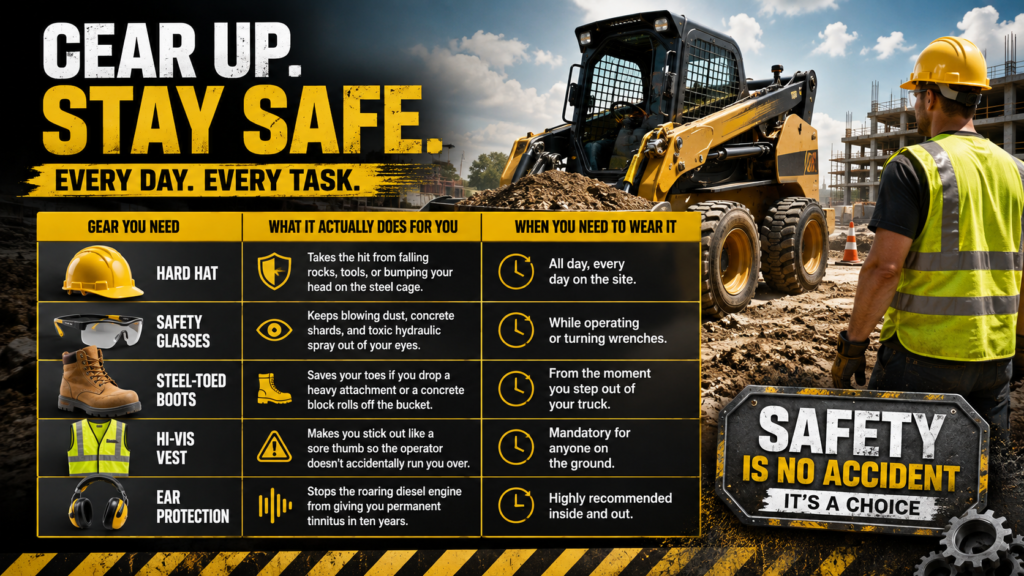
Table: PPE and Skid Steer Safety Practices at Jobsite Work
| Gear You Need | What It Actually Does For You | When You Need to Wear It |
| Hard Hat | Takes the hit from falling rocks, tools, or bumping your head on the steel cage. | All day, every day on the site. |
| Safety Glasses | Keeps blowing dust, concrete shards, and toxic hydraulic spray out of your eyes. | While operating or turning wrenches. |
| Steel-Toed Boots | Saves your toes if you drop a heavy attachment or a concrete block rolls off the bucket. | From the moment you step out of your truck. |
| Hi-Vis Vest | Makes you stick out like a sore thumb so the operator doesn’t accidentally run you over. | Mandatory for anyone on the ground. |
| Ear Protection | Stops the roaring diesel engine from giving you permanent tinnitus in ten years. | Highly recommended inside and out. |
When you are buying and wearing your gear, keep these real-world tips in mind to maximize your skid steer safety.
- Keep your hi-vis gear somewhat clean. A neon vest caked in thick brown mud doesn’t reflect light anymore, completely defeating the purpose of wearing it.
- Ditch the baggy hoodies and loose jackets. Loose clothes get snagged on joysticks and safety lap bars easily, and that’s a fast way to accidentally trigger a sudden machine movement.
- Always keep eye protection on when popping the engine hood. Pressurized hydraulic fluid doesn’t care about your excuses; safety glasses save your sight.
Driving It Without Wrecking It
Driving a skid steer isn’t like driving your pickup truck down the highway. The absolute golden rule of skid steer safety? Keep the bucket low. I see guys all the time cruising across bumpy dirt lots with a loaded bucket raised five feet in the air, and it makes my stomach drop.
That’s exactly how you tip over forward. Keep the load just high enough to clear the ground—usually a few inches is plenty.
Hills and uneven slopes are another beast entirely. The rule is simple but surprisingly easy to mess up under pressure: always keep the heavy end pointing uphill. If your bucket is full of heavy dirt, drive forward up the hill and back down. If the bucket is totally empty, the back of the machine (where the heavy diesel engine sits) is the heaviest part.
So, you back up the hill, and drive forward down it. It feels weird at first, but it keeps the machine planted. Also, you have to talk to your ground crew, and I don’t mean shouting over a roaring engine. Use your hands and make eye contact.
Navigating a chaotic site means following a few unwritten rules.
- Keep that load low to the dirt while you are moving. It anchors your center of gravity and keeps the tires firmly planted on the earth.
- Nail down a few basic hand signals with your crew. A simple “stop,” “raise,” or “lower” gesture saves a lot of screaming, confusion, and potential accidents.
- Assume you have a massive blind spot right behind you—because you do. Never back up without physically turning your head to look or waiting for a spotter’s thumbs-up.
How New Tech is Saving Lives
The heavy equipment we have today is lightyears ahead of the clunky, jerky, bare-bones machines we were driving twenty years ago. If you check out the latest equipment breakdowns on skidsteerloader.org, you’ll notice a huge, industry-wide shift toward smart safety tech.
We are seeing major brands packing these machines with serious digital upgrades meant to take the pressure off the human behind the glass.
Instead of muscling heavy mechanical levers all day, operators now get these buttery-smooth, ergonomic joysticks. That means your arms aren’t dead tired by 3 PM, which naturally cuts down on sloppy, fatigued mistakes.
Then you have the tech operating entirely behind the scenes. Auto-leveling buckets are a lifesaver. They automatically keep your load flat as you raise the lift arms, stopping loose bricks, gravel, or wet mud from spilling backward over the bucket hinge and crashing onto the cab roof.
It’s crazy how much tech is packed into these things now to improve skid steer safety.
- Telematics systems act like a digital mechanic in the cloud. They ping your phone when a part is overheating or about to fail so you can fix it before it breaks on the job.
- Low-effort joystick controls save your shoulders and back. This keeps your brain sharp and focused on the work environment instead of fighting the machine’s controls.
- Self-leveling tech stops the dreaded “spill-back.” It mathematically adjusts the tilt as you lift, ensuring heavy materials don’t slide back onto the windshield.
Dodging the Most Common Nightmares
You’d be amazed how many guys get hurt just trying to get into the cab in the morning. It’s a piece of heavy equipment, not a jungle gym. You have to use the “3-point method.” That means two hands and one foot, or two feet and one hand, locked onto the machine’s grab handles and steps at all times while climbing in. Slipping off a muddy metal step and eating steel is a bad way to start a Tuesday.
Once you are in the seat, put the seatbelt on and pull down the lap bar. I know guys who try to bypass or wire off the safety switches so they can run the hydraulics while standing outside the cab to check something. That is insanely stupid and a great way to get crushed by your own lift arms. Don’t mess with the interlocks. Period. And let’s talk about hydraulic leaks. High-pressure oil leaks are terrifying. If a pinhole leak hits your bare skin, it acts like a hypodermic needle and shoots toxic hydraulic fluid straight into your bloodstream.
Keep yourself out of the emergency room by following these rules.
- Stick to the 3-point rule every single time you climb in or out. It’s basic physics; a triangle is stable, and it stops you from falling backward onto concrete.
- Never tamper with the lap bar or seat safety switch. The machine intentionally shuts down when you stand up for a very good reason—it keeps you from getting pinned.
- Use a piece of cardboard to check for hydraulic leaks. Never, ever use your bare hands to feel for a leak; fluid injection injuries almost always require emergency surgery.
Maintenance Habits That Actually Matter
You can be the most talented operator in the world, but if you are driving a poorly maintained bucket of bolts, your luck will eventually run out. Maintenance and skid steer safety go hand-in-hand. It’s about looking at the things that endure the most physical punishment day in and day out.
Think about it: hydraulic hoses rub against hot metal all day long. If you see one that looks frayed to the wire or is bulging like a balloon, you have to swap it out immediately. If that hose bursts while you’re holding a heavy concrete barrier high in the air, that load is coming down fast, and you have zero control over it. Tire pressure is another huge one.
If your left side tires are soft and your right side tires are rock hard, the whole machine is going to wobble, which makes tipping over highly likely when you take a turn. Also, clean out your cab. Stop throwing empty water bottles and hand tools on the floorboard. If one rolls under your foot pedal, you won’t be able to stop when you need to.
Don’t wait for the mechanic to catch these things; check them yourself.
- Run your eyes over every hydraulic hose before work. A rubbed-raw hose is a ticking time bomb just waiting to drop your load unexpectedly.
- Check tire pressure and track tension constantly. A bouncy, uneven machine is incredibly dangerous to drive and exhausting to sit in all day.
- Treat the operator cab like your office, not a trash can. A stray water bottle wedged behind a steering or braking pedal is a fast track to a collision.
FAQs on Skid Steer Safety
What are the absolute biggest safety hazards with skid steers?
The most common nightmares are rollovers and tip-overs because the machine is so top-heavy when loaded. The other major hazard is a ground worker getting run over or crushed by the lift arms because they were standing in the operator’s blind spot.
Do I really have to wear a seat belt inside a closed cab?
Yes, 100%. If you hit a hidden stump and the machine tips forward, the seatbelt and lap bar keep you pinned safely in the seat. Without them, you get thrown against the glass or, worse, ejected out the front while the machine rolls.
What’s the safest way to get in and out of the machine?
You have to use the 3-point contact rule. Keep two hands and one foot, or two feet and one hand, on the machine’s actual steps and handles. Never use the joysticks as grab handles to pull yourself up.
What is the bare minimum PPE for ground workers around skid steers?
If you are walking around heavy equipment, you need a hard hat, steel-toed boots to save your feet from dropped loads, and a bright high-visibility vest so the operator actually sees you in their peripheral vision.
How do I drive a loaded skid steer on a steep hill?
Keep the heaviest part of the machine facing up the hill. If your bucket is full of dirt, drive forward up the hill. When it’s time to come down, you back down the hill. And keep that bucket practically dragging on the grass to keep your center of gravity low.
Why do I need to inspect the machine every single morning?
Because machines vibrate, and vibration loosens bolts, cracks steel, and rubs hoses raw. Catching a frayed hydraulic line at 6:00 AM in the yard is an easy fix. Having it burst at noon while lifting a load over a truck is a disaster.
Are the newer skid steers actually safer to operate?
Without a doubt. Newer models have smarter joystick controls that keep your arms from cramping, backup cameras to eliminate blind spots, and self-leveling buckets that stop you from accidentally dumping debris onto your own lap.